
Basics · November 2, 2026 · 8 min read
Learn Options Trading: A Complete Beginner's Guide
By Gerson Yoss
Options can look complicated at first: calls, puts, expiration dates, strike prices, implied volatility and the Greeks all arrive at once. The way through is to learn one idea at a time, understand the risk of each, and practice before real money is involved.
This guide is a map. It explains what an option is, the terms every beginner needs, the Greeks, the strategies people usually study first, how to think about risk, and how to practice. Each part links to a free lesson that goes deeper. It is education, not advice.
The short version
- An option is a contract that gives its buyer a right, not an obligation, to buy (a call) or sell (a put) a stock at a set price. One standard contract covers 100 shares.
- Learn the vocabulary first: strike price, expiration date, premium, moneyness, implied volatility and open interest.
- The Greeks estimate how an option's value may change. They are theoretical estimates, not promises.
- A buyer can lose the whole premium; a seller can lose much more than the premium collected. Know the worst case before any trade.
- Practice with paper trading, record each trade, and review it. There is no universal timeline for learning options.
What an option is
An option is a contract. Its buyer gets the right, but not the obligation, to buy or sell a stock at a specific price. FINRA describes the same idea in its guide to options, and one standard U.S. stock option contract covers 100 shares of the underlying stock.
There are two types. A call gives its buyer the right to buy shares at the strike price. A put gives its buyer the right to sell shares at the strike price. Calls are often used for bullish ideas and puts for bearish ones, but both can also be part of hedging or more complex structures. Our lessons on call options and put options walk through buying and selling each.
Every option also has an expiration date. After it, the contract no longer exists. An out-of-the-money option that a buyer still holds expires worthless, and the premium is lost. An in-the-money option is usually exercised automatically unless the holder tells the broker otherwise, which can mean buying or selling 100 shares. Start with the lesson on options and contract specifications, then read assignment, exercise and expiration.
The basic vocabulary
Before looking at strategies, learn the language. These terms appear in every option chain. The lesson on reading an option chain shows where each one sits on the screen.
| Term | Plain meaning |
|---|---|
| Strike price | The price at which the option can be exercised. See [strike price](/glossary/strike_price). |
| Expiration date | The last day the contract is valid. See [expiration date](/glossary/expiration_date). |
| Premium | The price the buyer pays and the seller receives, per share. Multiply by 100 for one contract. |
| In, at and out of the money | Where the strike sits compared with the stock price: in the money has intrinsic value, at the money is near the price, out of the money has none. See [moneyness](/glossary/moneyness). |
| Implied volatility | A measure of expected price movement built into the option's price. See [implied volatility](/glossary/implied_volatility). |
| Open interest | How many contracts are still open. See [open interest](/glossary/open_interest). |
An option's price has two parts: intrinsic value (what the option would be worth if exercised now) and extrinsic value (the rest, mostly time and volatility). The lesson on intrinsic and extrinsic value explains how to split any premium into the two.
The Greeks in one minute
The Greeks estimate how an option's theoretical value may change when something else changes. They help explain why an option can lose value even when the stock moves the way its owner expected.
- Delta: the estimated change in the option's price for a $1 move in the stock. See delta and gamma.
- Gamma: how quickly delta itself changes as the stock moves.
- Theta: the effect of time passing. See theta.
- Vega: sensitivity to changes in implied volatility. See vega and IV rank.
- Rho: sensitivity to interest rates, usually the least important of the five for beginners.
All five are estimates built on assumptions, and they change as conditions change. Treat them as tools for asking better questions, not as predictions.
Strategies beginners usually study first
Once calls, puts and the Greeks make sense, you can study strategies. Each one below has its own free lesson, and each comes with risks that are covered in it.
- Cash-secured put: selling a put while holding enough cash to buy the shares if you are assigned. If the stock falls, you can lose money, and the cash is tied up. See cash-secured puts.
- Covered call: owning the shares and selling a call against them. Your upside is capped at the strike, and the shares can still fall. See covered calls.
- The Wheel: a sequence that links the two above. See the Wheel strategy lifecycle.
- Vertical spreads: buying and selling options of the same type and expiration at different strikes. Profit and loss are both limited, but the loss can still be the full amount at risk. Examples: the bull call spread and the bear put spread. See vertical spread architectures.
The Wheel steps are: sell a cash-secured put; if assigned, you own the shares; sell covered calls against them; if the shares are called away, the cycle can start again. Its risks include large losses if the stock falls a long way.
A covered call can also be rolled to a later date, which has its own trade-offs.
Why risk comes before profit
Many beginners look only at how much a trade could make. Look at the loss first. For a bought option, the premium is the most it can lose, which FINRA notes in its guide. Sellers can lose more than the premium they collected, and uncovered calls have theoretically unlimited loss.
Before any position, work out these items:
- The maximum possible loss and the maximum possible profit.
- The breakeven price. The options profit calculator finds it for a call, a put or a vertical spread.
- How much cash or buying power the position ties up.
- The chance of assignment, and what happens at expiration. See assignment, exercise and expiration.
- Liquidity: a wide gap between bid and ask makes a trade costly. See bid-ask spread.
- Position size. The position size calculator and the lesson on position sizing and buying power cover it.
Practice before you use real money
Reading helps, but you learn how a position behaves by watching one. Paper trading lets you place simulated trades without risking your own capital. A simple routine:
- Pick a stock.
- Open its option chain.
- Choose an expiration date and a strike.
- Build a hypothetical position.
- Calculate its profit and loss at different prices.
- Record the trade in a journal.
- Review what happened and what you learned.
Paper trading has limits. Simulated fills can differ from real ones, and a simulation may not reproduce assignment, liquidity and every other real-market condition. Our post on paper trading versus real trading covers the differences.
The free trading journal is a place for step six. It needs a verified email, and you can add completed practice trades by hand as well as real ones. The lesson on the trade journal explains what to record and how to review it.
A structured path through the lessons
Jumping between random videos and articles leaves gaps. A fixed order helps. The free options course is organized in five parts, and every lesson can be read without an account, in English and Spanish.
| Step | What you learn |
|---|---|
| 1. Foundations | Contracts, calls, puts, moneyness, pricing and reading a chain: [start here](/education/l23). |
| 2. The Greeks | Delta, gamma, theta and vega: [delta and gamma](/education/l28). |
| 3. Execution and risk | Orders, assignment, sizing and the journal: [order types](/education/l93). |
| 4. Income strategies | Cash-secured puts, covered calls, the Wheel and rolling: [cash-secured puts](/education/l97). |
| 5. Spreads and volatility | Verticals, condors, earnings and portfolio risk: [vertical spreads](/education/l37). |
Signal Desk is the members' platform for practice: stock research, real option chains (about 15 minutes delayed), options paper trading on a simulated account, a screener and a stock grader.
A simple way to start
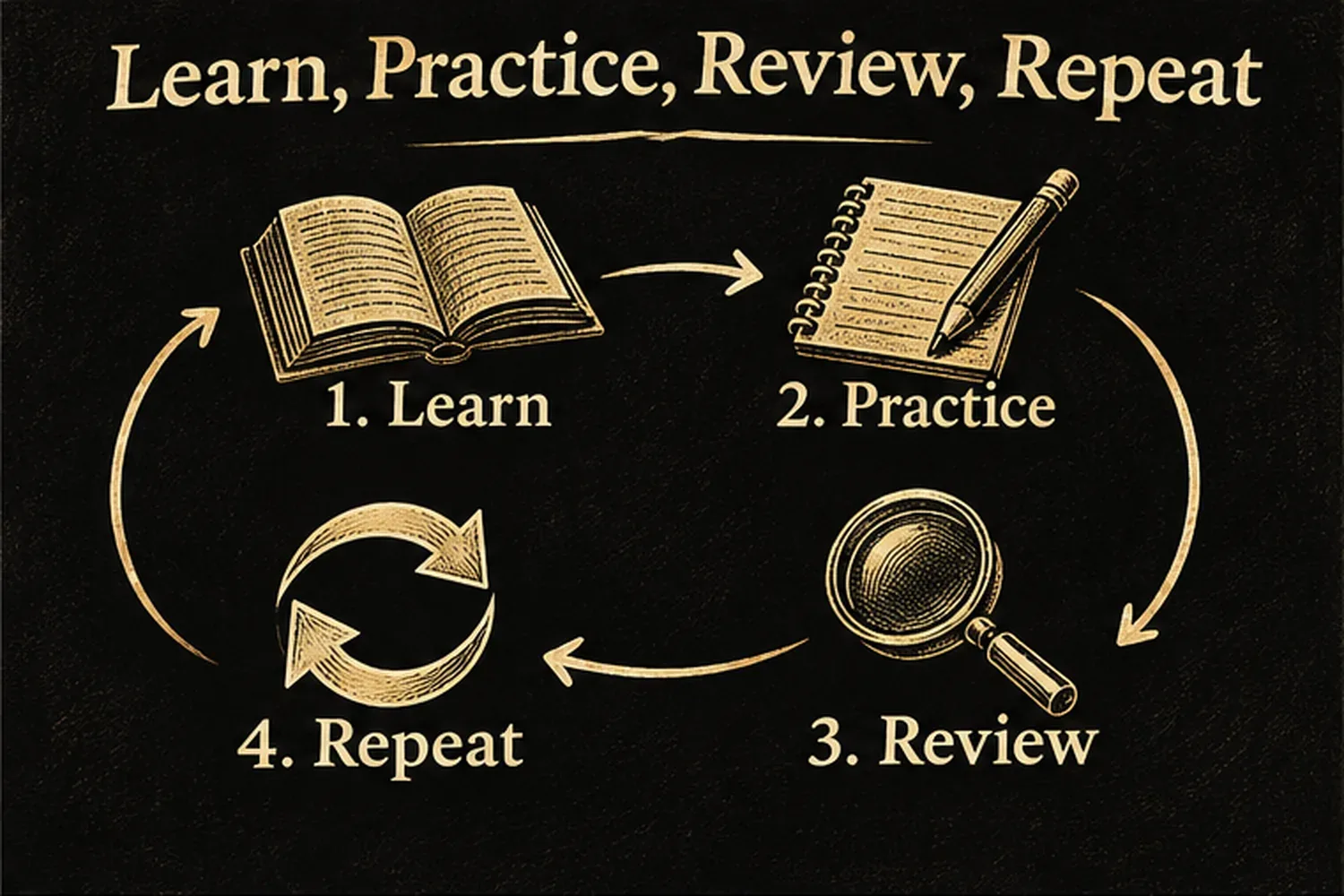
You do not need to understand everything on day one. Pick the first lesson, finish one module, and place one paper trade that uses what you just read. Write down why you chose it, then check the result against the lesson. That loop is a useful habit to build.
The order matters less than the habit: learn a piece, practice it, review it, repeat. Questions that come up along the way are usually answered by a glossary entry or the next lesson.
Questions people ask
Can beginners learn options trading?
Yes. Start with calls, puts, strike prices, expiration dates and premiums, then the Greeks, and only then study strategies.
How long does it take to learn options trading?
There is no universal timeline. It depends on what you already know, how regularly you study, and how much you practice.
Can I practice options trading without real money?
Yes. Paper trading simulates trades without risking your own capital, though simulated fills and assignment can differ from real trading.
Are options riskier than stocks?
They add complexity: expiration, leverage, time decay, volatility sensitivity and assignment. A buyer can lose the full premium, and some seller positions can lose far more than the premium received.
Sources
Educational content only, not investment advice. Trading options involves risk, including the loss of your entire investment in a position.