
A hands-on options curriculum covering real trading concepts. Read the lessons, work through examples, and test your knowledge.
OVERALL ACADEMY PROGRESS
Free Lesson
Every lesson is free to read. Subscribe to add Signal Desk, progress tracking, PDF downloads and the lesson tutor.
Key terms in this lesson
 Click to enlarge
Lesson 1: 2.0: Delta and Gamma
Delta as directional exposure, share-equivalence, and probability estimate — plus why gamma makes short-dated options behave so violently.
1. Delta — Three Meanings, One Number
Delta is the most used Greek, and it is genuinely three tools at once. Each interpretation is useful in a different situation.
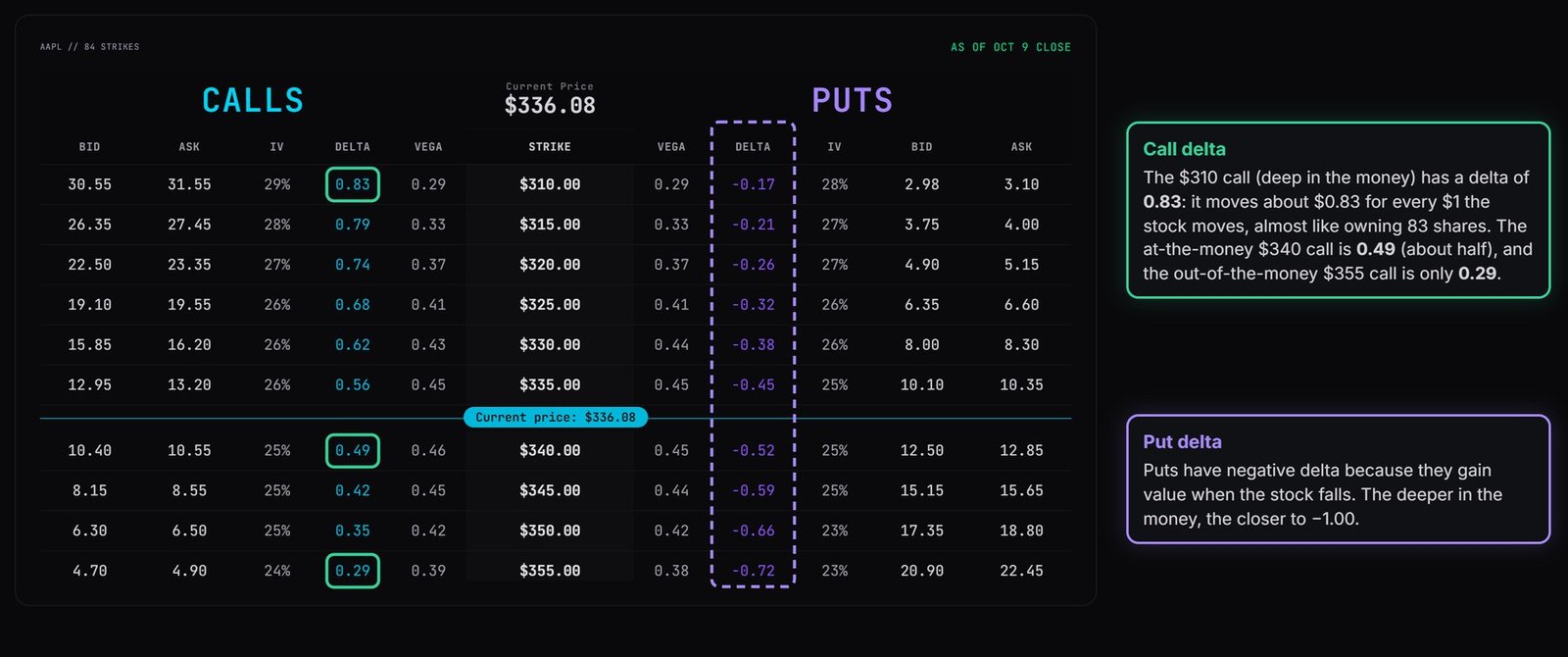
• Rate of change: How much the option premium moves per $1.00 move in the stock.
• Share equivalence: How many shares of stock the option position behaves like.
• Probability estimate: Roughly the chance the option finishes in-the-money.
Delta ranges from 0 to +1.00 for calls and 0 to −1.00 for puts. Long calls and short puts carry positive delta (they profit when the stock rises). Long puts and short calls carry negative delta.
★ Core Fact: These three interpretations are not competing definitions. They are three consequences of the same underlying mathematics, and working traders switch between them constantly.
2. Delta as Rate of Change
Worked example: You hold a call with a delta of 0.60, currently priced at $4.00.
• Stock rises $1.00 → option gains roughly $0.60, to about $4.60
• Stock rises $2.00 → option gains roughly $1.20, to about $5.20
• Stock falls $1.50 → option loses roughly $0.90, to about $3.10
In dollar terms, since one contract covers 100 shares: a $2.00 stock move on a 0.60 delta call produces roughly $120 of profit per contract.
The word 'roughly' is doing real work here. Delta itself changes as the stock moves — that is gamma, covered in Section 4. For small moves the approximation is close. For large moves it drifts.
3. Delta as Share Equivalence
This interpretation is the most practically valuable for managing risk, because it converts an options position into something directly comparable to stock.
★ Share equivalent = Delta × 100 × Number of contracts
Worked examples:
• Long 1 call at 0.60 delta = 60 share equivalents. Behaves like owning 60 shares.
• Long 5 calls at 0.30 delta = 5 × 0.30 × 100 = 150 share equivalents.
• Short 3 puts at 0.25 delta = +75 share equivalents (short puts are positive delta).
• Long 2 puts at 0.40 delta = −80 share equivalents.
Why this matters: a trader who owns 10 contracts of a 0.70 delta call may feel they hold a modest position. In reality they carry 700 share equivalents. On a $100 stock, that is $70,000 of directional exposure. Delta reveals what your account is genuinely exposed to.
⚠️ Risk Warning: Traders routinely underestimate their exposure because contracts feel small. Always convert to share equivalents before deciding whether a position is appropriately sized.
 Click to enlarge
4. Gamma — The Rate of Change of Delta
Gamma measures how much delta itself changes per $1.00 move in the stock. If delta is speed, gamma is acceleration.
Worked example: A call has delta 0.50 and gamma 0.04.
• Stock rises $1.00 → delta becomes roughly 0.54
• Stock rises another $1.00 → delta becomes roughly 0.58
• Stock falls $1.00 from the start → delta becomes roughly 0.46
This is why option gains accelerate in your favour and decelerate against you when you are long. As a winning long call moves ITM, its delta climbs toward 1.00 and each subsequent dollar of stock movement delivers more profit. That convexity is the structural appeal of owning options.
For sellers the same mechanic works in reverse and is dangerous. A short option moving against you gains delta, so losses accelerate.
5. Where Gamma Concentrates — and Why It Matters
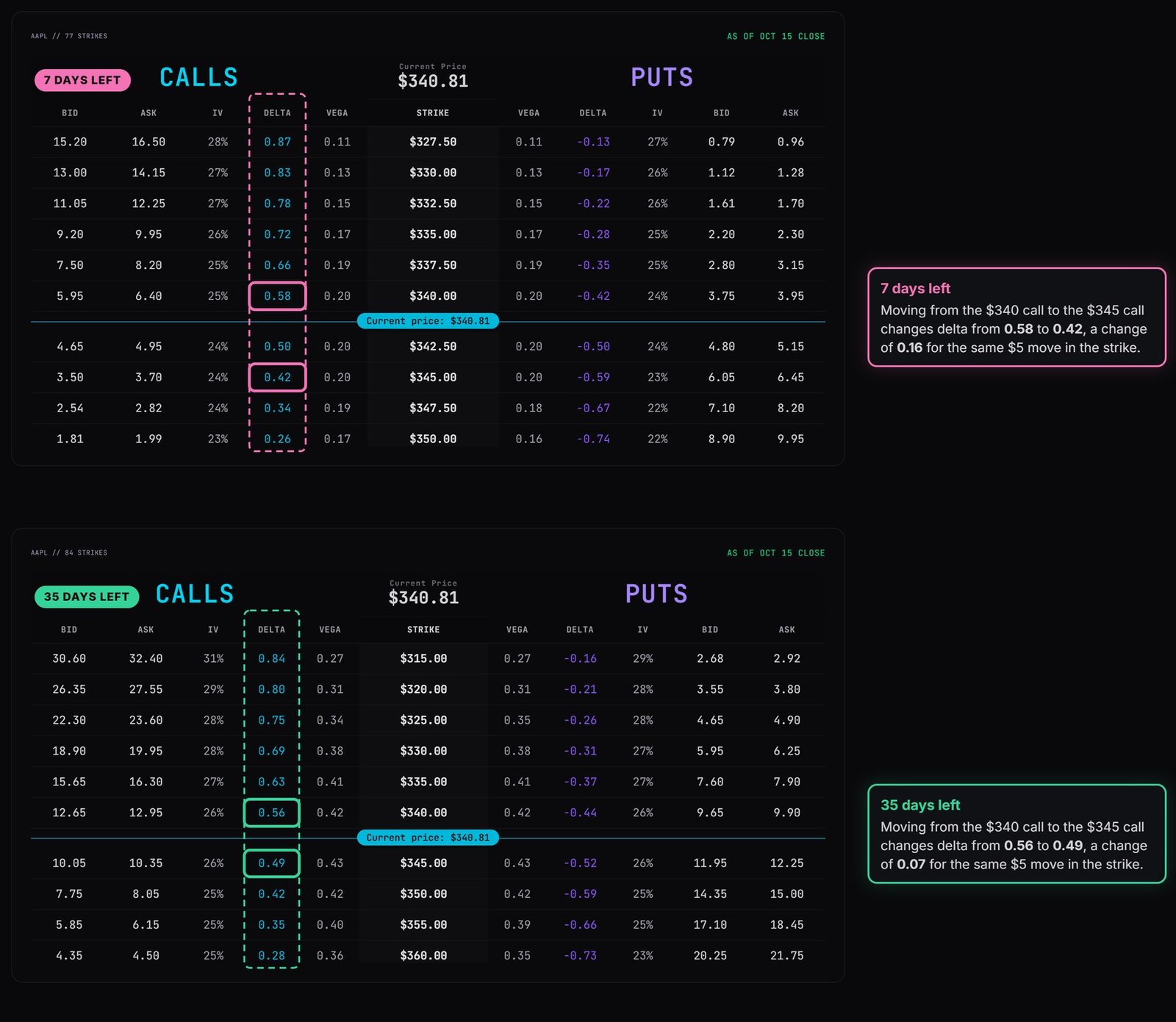
Gamma is highest for at-the-money options with little time remaining. This single fact explains a great deal of options behaviour.
Approximate gamma for an ATM option on a $100 stock:
• 60 days to expiration: low gamma — delta shifts slowly
• 14 days: moderate gamma
• 1 day: extremely high gamma — delta can swing from 0.20 to 0.80 on a small move
This is why short-dated ATM options behave so violently. On expiration day, a contract can go from nearly worthless to deeply profitable on a 1% stock move, then reverse entirely within minutes.
⚠️ Risk Warning: Selling short-dated at-the-money options exposes you to maximum gamma risk. The premium looks attractive because decay is fast, but a modest adverse move can produce losses far larger than the premium collected. This is the primary reason this course recommends 30 to 45 day expirations for premium selling.
 Click to enlarge
6. Try It in Signal Desk
Open the Options page in Signal Desk, load a chain for a stock you follow and pick a monthly expiration about 45 days out. Find the strike whose Delta reads closest to 0.30, the one nearest 0.50, and the one nearest 0.16.
Note where each sits relative to the current stock price. The 0.50 will be essentially at-the-money; the 0.16 will be noticeably further out. Click a put near 0.30 and read the "Strike vs. price" figure: it tells you in percent how far below today's price that strike sits. You have just located the strikes premium-selling strategies target, and you found them by probability rather than by guessing.
Then switch to the nearest weekly expiration and observe how much closer to the money the 0.16 delta strike sits. Less time means a smaller expected move, and the chain is showing you that directly.
See it in Signal Desk
Delta is a live column in the Live Chain, so you can read it for every strike without a calculator (members see live quotes).
- 1
Open Options, type a ticker and press Load chain. Pick an expiration about 45 days out from the buttons across the top.
- 2
Read the Delta column beside each strike. Calls run from near 1.00 deep in the money down toward 0; puts show negative delta, running from near 0 out of the money to about -1.00 deep in the money.
- 3
Click a contract to pick it. The trade panel appears with the strike's distance from today's price, the breakeven and the payoff, so you can see what a given delta means in dollars.
- 4
Below the trade, the Trade Check scores the setup. One of its lines checks whether your delta sits in the range income sellers usually use (about 0.15 to 0.35).
- 5
Change the expiration to the nearest weekly and watch the same delta move closer to the stock price. That is gamma and time at work.
Dynamic Options Greeks & Active Gauge Meters
Option Greeks measure mathematical contract risk. Explore the interactive gauges for Delta, Gamma, Theta, and Vega, and inspect the steep non-linear acceleration of time decay (Theta) as the expiration date approaches.
Dynamic Greeks Risk Command
If an option has a Delta of +0.52 and the stock rises by $1.00, the premium will increase by $0.52. It also serves as a proxy probability (52%) that the option expires valuable (in-the-money).
KNOWLEDGE RECONNAISSANCE
A call has a delta of 0.60 and the stock rises $2.00. Approximately how much does the premium increase?
You are long 5 call contracts with a delta of 0.40. What is your share-equivalent exposure?
What does gamma measure?
Under which conditions is gamma highest?
Why is selling short-dated at-the-money options considered high risk despite fast time decay?
A put option has a delta of −0.35. What does the negative sign indicate?
More lessons in this module
See every lesson in the courseSignal Desk is where you practice this on real stocks: real option chains (about 15 minutes delayed), the Trade Check and a paper-trading account that risks no real money. Join to add it, your progress tracking and PDF downloads.