
A hands-on options curriculum covering real trading concepts. Read the lessons, work through examples, and test your knowledge.
OVERALL ACADEMY PROGRESS
Free Lesson
Every lesson is free to read. Subscribe to add Signal Desk, progress tracking, PDF downloads and the lesson tutor.
Key terms in this lesson
 Click to enlarge
Lesson 2: 2.1: Theta — The Decay Engine
How time decay actually works, why it accelerates near expiration, and why theta is the engine behind every income strategy in this course.
1. What Theta Measures
Theta measures how much extrinsic value an option loses per day, holding everything else constant.
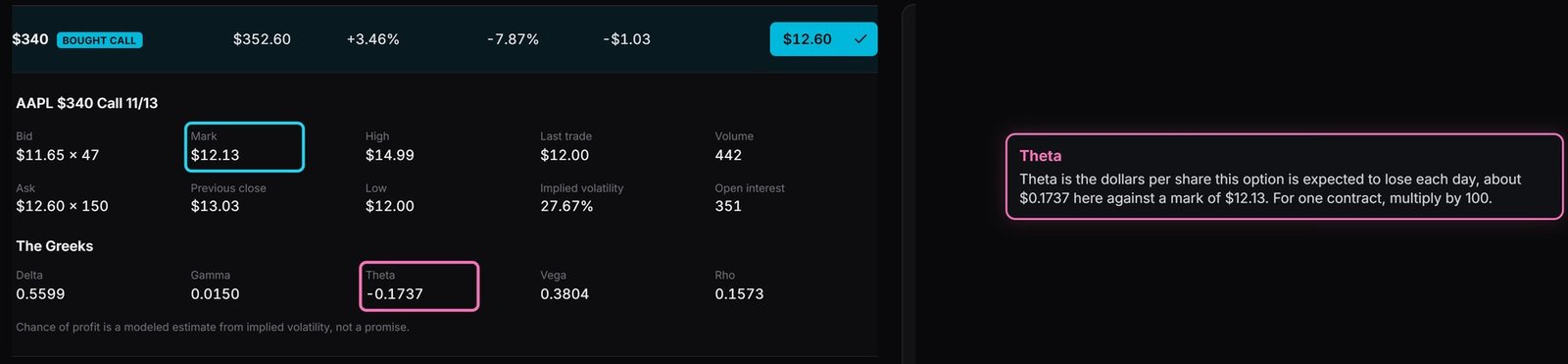
It is quoted as a negative number for long positions. A theta of −0.05 means the option loses roughly $0.05 per share per day — $5.00 per contract — purely from the passage of time.
★ Core Fact: Theta only erodes extrinsic value. Intrinsic value is untouched by time. A deep ITM option composed almost entirely of intrinsic value has very little theta; an OTM option composed entirely of extrinsic value is pure decay.
This single Greek determines who is structurally advantaged in a trade. Option buyers fight theta every day they hold. Option sellers collect it every day. Neither is inherently better, but you should always know which side of it you are on.
 Click to enlarge
2. Decay Is Not Linear
This is the most important and most misunderstood property of theta. Time decay does not proceed evenly — it accelerates sharply as expiration approaches.
Approximate extrinsic value of a $100 ATM call on a $100 stock, holding the stock perfectly still:
• 90 days out: $6.00
• 60 days: $4.90 (lost $1.10 over 30 days ≈ $0.037/day)
• 45 days: $4.20
• 30 days: $3.45 (lost $0.75 over 15 days ≈ $0.050/day)
• 14 days: $2.35
• 7 days: $1.65 (lost $0.70 over 7 days = $0.100/day)
• 2 days: $0.90
• Expiration: $0.00
The daily decay rate roughly tripled from the 90-day mark to the final week. The stock never moved at all.
★ Core Fact: Extrinsic value decays approximately in proportion to the square root of time remaining. In practical terms, an option loses about half its remaining extrinsic value in the final quarter of its life.
3. The Consequence for Buyers
If you buy options, theta is a fixed daily cost you pay for holding a directional view.
Worked example: You buy a 45-day ATM call for $4.20 with a theta of −0.045. You are correct about direction, but the stock takes three weeks to move.
• Decay over 21 days: roughly $0.95 to $1.10 of extrinsic value lost
• The stock must gain enough intrinsic value to overcome that erosion before you see profit
This is why buying very short-dated options is expensive in a way that is not obvious from the sticker price. A 7-day option is cheap in dollars but carries brutal daily decay relative to its cost.
★ Practical Guidance: If you buy options, buy more time than you think you need. Paying more premium for 60 days instead of 21 buys you a materially lower daily decay rate and room to be wrong on timing.
4. The Consequence for Sellers
If you sell options, theta is your income. It is the entire economic basis of cash-secured puts, covered calls, the Wheel, and iron condors.
Worked example: You sell a 45-day put and collect $2.00 in premium with a theta of +0.04.
• Each day that passes with the stock stable earns you roughly $4.00 per contract
• Over 30 days, if nothing else changes, you have earned back roughly $1.20 of the $2.00
This is why premium sellers structure trades around 30 to 45 days to expiration. Decay is meaningfully faster than at 90 days, but gamma risk has not yet reached the dangerous zone of the final two weeks.
⚠️ Risk Warning: Theta income is real but small and steady, while the risk you carry is occasional and large. Selling premium generates many modest wins punctuated by rare significant losses. Position sizing — Lesson 3.2 — is what determines whether that math works in your favour.
5. The 21-Day Guideline
Many experienced premium sellers close positions at roughly 21 days to expiration rather than holding to expiry, and the reasoning follows directly from the two Greeks you now understand.
By 21 days, a large share of the available decay has already been captured. What remains is the portion where gamma rises sharply, meaning the risk of a sudden adverse swing increases considerably.
The trade-off: you forgo the final chunk of premium in exchange for avoiding the most dangerous stretch of the contract's life.
★ Practical Guidance: A common working rule is to close a short premium position when either 50% of the maximum profit has been captured or 21 days remain, whichever comes first. This is a guideline, not a law — but it encodes a genuine structural insight about the theta-gamma trade-off.
6. Try It in Signal Desk
Open the Easy Chain in Signal Desk, choose Buy and Call, and find the at-the-money call for three expirations: about 7 days, 45 days and 120 days out. Tap each strike and record the premium (mark) and the theta from its details.
Now compute theta as a percentage of the premium for each one. You will typically find the 7-day contract losing several percent of its value per day, while the 120-day contract loses a fraction of a percent.
That ratio, daily decay relative to capital at risk, is the real cost of holding a long option, and it is invisible if you look only at the premium.
See it in Signal Desk
Tap any strike in the Easy Chain and its details show the Greeks, including theta (members see live quotes).
- 1
Open Options, switch to the Easy Chain, load a ticker and choose Buy and Call.
- 2
Pick an expiration, then tap the strike nearest the stock price. The details open under the row.
- 3
Read the mark price in the first block and the theta under "The Greeks". Theta is the dollars per share the option is expected to lose each day, so a theta of -0.16 costs about $16 a day per contract.
- 4
Change the expiration to a nearer date and tap the same kind of strike. The theta is larger relative to the price because decay speeds up near expiry.
- 5
Now choose Sell instead of Buy. The same decay that hurts a buyer is what a seller collects.
KNOWLEDGE RECONNAISSANCE
An option has a theta of −0.05. What does this mean in dollar terms per contract?
Which component of an option's premium does theta erode?
How does the rate of time decay change as expiration approaches?
Why do premium sellers commonly target 30 to 45 days to expiration?
You buy a 7-day option instead of a 60-day option to save money. What is the hidden cost?
What is the reasoning behind closing short premium positions around 21 days to expiration?
More lessons in this module
See every lesson in the courseSignal Desk is where you practice this on real stocks: real option chains (about 15 minutes delayed), the Trade Check and a paper-trading account that risks no real money. Join to add it, your progress tracking and PDF downloads.