
A hands-on options curriculum covering real trading concepts. Read the lessons, work through examples, and test your knowledge.
OVERALL ACADEMY PROGRESS
Free Lesson
Every lesson is free to read. Subscribe to add Signal Desk, progress tracking, PDF downloads and the lesson tutor.
Key terms in this lesson
 Click to enlarge
Lesson 1: 4.0: Cash-Secured Puts
Getting paid to set a buy limit — full entry criteria, return math, and the two conditions that separate a sound strategy from a reckless one.
 Video lessonSell Cash-Secured Puts Step by StepClassic Chain & RobinhoodWatch on YouTube
1. The Trade in One Sentence
A cash-secured put is a limit order to buy a stock, for which you get paid whether or not the order fills.
You choose a stock you want to own and a price below the current market at which you would be happy to buy it. You sell a put at that strike and set aside the full purchase cost in cash. If the stock falls to your price, you buy it — at a discount to the strike, because you keep the premium. If it does not, you keep the premium and repeat.
★ Core Fact: There are exactly two outcomes and both are acceptable by design. Either you are paid for waiting, or you buy a stock you wanted below the price you named. Any framing that treats assignment as a failure has misunderstood the strategy.
2. Entry Criteria — Stated as Numbers
This is where most explanations stop at 'pick a good stock.' Here are the actual parameters:
• Underlying: A company you would hold for at least a year. Liquid options — open interest above 500, tight spreads.
• Strike: 0.20 to 0.30 delta. This implies roughly a 70 to 80 percent chance of expiring worthless.
• Days to expiration: 30 to 45. Fast enough decay, before gamma risk escalates.
• IV Rank: above 30, ideally above 50. Below 30 you are accepting the full obligation for unusually little compensation. (Signal Desk does not show IV Rank yet. Use the Trade Check line that compares the option's IV with the stock's realized volatility instead: you want IV above realized.)
• Capital: the full strike × 100 available in cash, and that amount must be an acceptable share of your account per Lesson 3.2.
★ Practical Guidance: If any single criterion fails, skip the trade. There is another setup next week. The discipline of not trading in poor conditions is most of the edge.
 Click to enlarge
3. Full Worked Example
Stock XYZ trades at $100. You have researched it and would genuinely own it at $95. IV Rank is 55.
You sell one $95 put, 45 days out, at 0.25 delta, collecting $2.00.
• Premium received: $2.00 × 100 = $200
• Capital secured: $95 × 100 = $9,500
• Breakeven: $95 − $2.00 = $93.00
Outcome A — stock stays above $95 (roughly 75% likely):
• The put expires worthless. You keep $200.
• Return on capital: $200 ÷ $9,500 = 2.11% over 45 days
• Annualized: 2.11% × (365 ÷ 45) = approximately 17.1%
Outcome B — stock falls to $92, you are assigned:
• You buy 100 shares at $95, paying $9,500
• Effective cost basis: $93.00 per share
• Stock trades at $92, so you hold a $100 unrealized loss — while owning a company you researched and wanted, one dollar above market
★ Core Fact: The annualized figure assumes you can repeat the trade continuously at similar terms. Treat it as a comparison tool between opportunities, not a projection of yearly returns.
 Click to enlarge
4. The Two Conditions That Make It Safe
The strategy above is sound. Violate either of these and it becomes something quite different.
Condition one — you must genuinely want the stock at that strike. The test is simple: if you woke up tomorrow owning 100 shares at your breakeven, would you be content to hold for a year? If the honest answer is no, do not place the trade. Selling puts purely to harvest premium on companies you have no view about means your normal outcome is a portfolio of positions you cannot manage.
Condition two — the cash must genuinely be there. Cash-secured means the full assignment cost sits idle in your account. Brokers will let you sell puts on margin, which converts a conservative strategy into a leveraged one.
⚠️ Risk Warning: A short put has a downside profile similar to owning 100 shares, but your upside is capped at the premium collected. You accept nearly all of the stock's downside in exchange for a small fixed payment. That trade is reasonable only when you actually want the shares.
 Click to enlarge
5. When It Goes Wrong
The realistic bad case is not the stock drifting a few dollars below your strike. It is a gap.
Worked example: You sold the $95 put for $2.00. Overnight, XYZ announces an accounting investigation and opens at $58.
• You will be assigned at $95, paying $9,500 for shares worth $5,800
• Unrealized loss: roughly $3,700, against the $200 you collected
• The premium covered 5% of the damage
Nothing about the strategy failed here. This is the tail the premium was paying you to accept. The defences are not clever adjustments — they are the boring ones:
• Size so that a 40% overnight gap is survivable, not catastrophic
• Avoid selling puts through binary events like earnings unless that is deliberately the trade
• Diversify across sectors, since correlated positions gap together
★ Core Fact: You cannot manage your way out of a gap. Position sizing is the only defence that works, and it must be decided before entry.
6. Try It in Signal Desk
Choose one company you would genuinely hold for a year and run it through Stock Research first. If the business or the chart fails the checklist from Lesson 1.6, you have just correctly declined a trade.
If it passes, open the Options page, pick an expiration 30 to 45 days out and sell a put near 0.25 delta. Record the premium, the capital required, the breakeven and the return on capital for the period, then read what the Trade Check says about the setup.
Send the trade to Paper Trading and compare its capital with your paper account's buying power. For most people, one contract on a $100 stock will be too large a share of the portfolio, which is exactly the constraint that makes defined-risk spreads worth learning in Module 5. No real money moves in the paper account, so use it to see how the trade behaves through expiration.
See it in Signal Desk
The whole cash-secured put workflow, from picking the stock to logging the trade, lives in one place (members see live quotes).
- 1
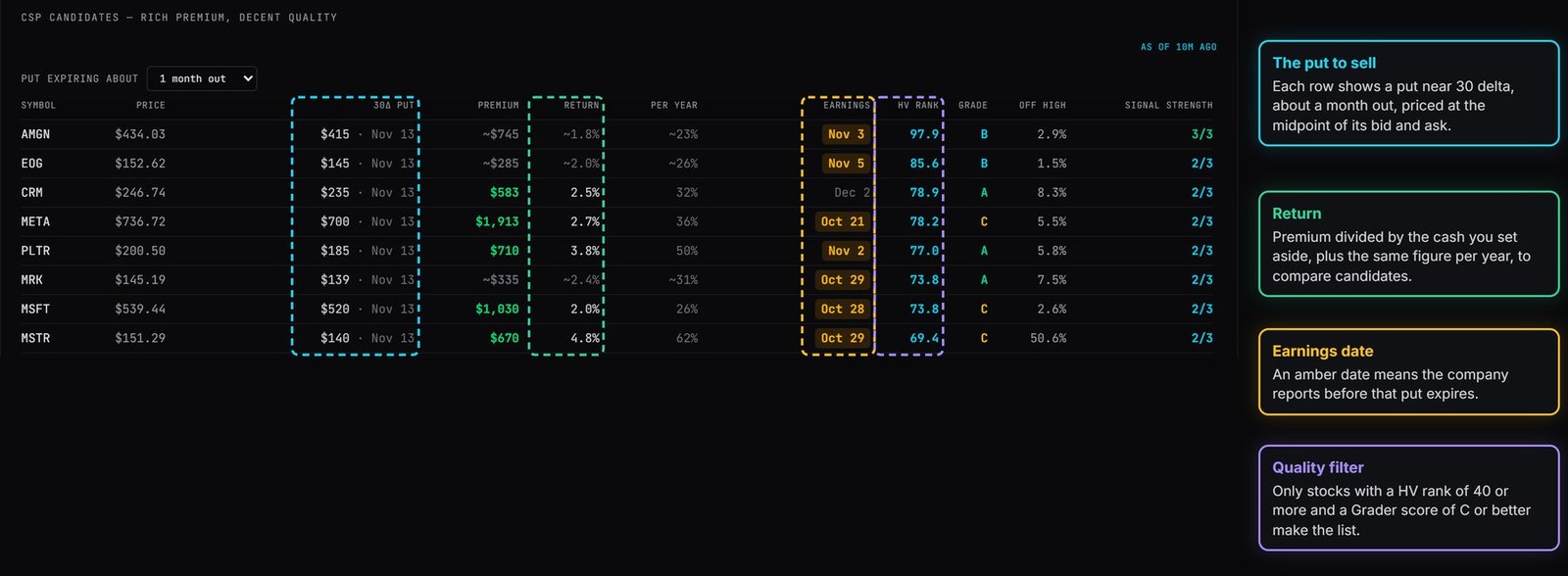
Open the Market tab and find CSP candidates. The table lists stocks with rich premium and decent quality, showing a roughly 30 delta put about a month out with its return, its yearly rate and a date if earnings fall before it expires.
- 2
Open the stock in Stock Research and run the checklist from Lesson 1.6. If you would not hold it for a year, stop here.
- 3
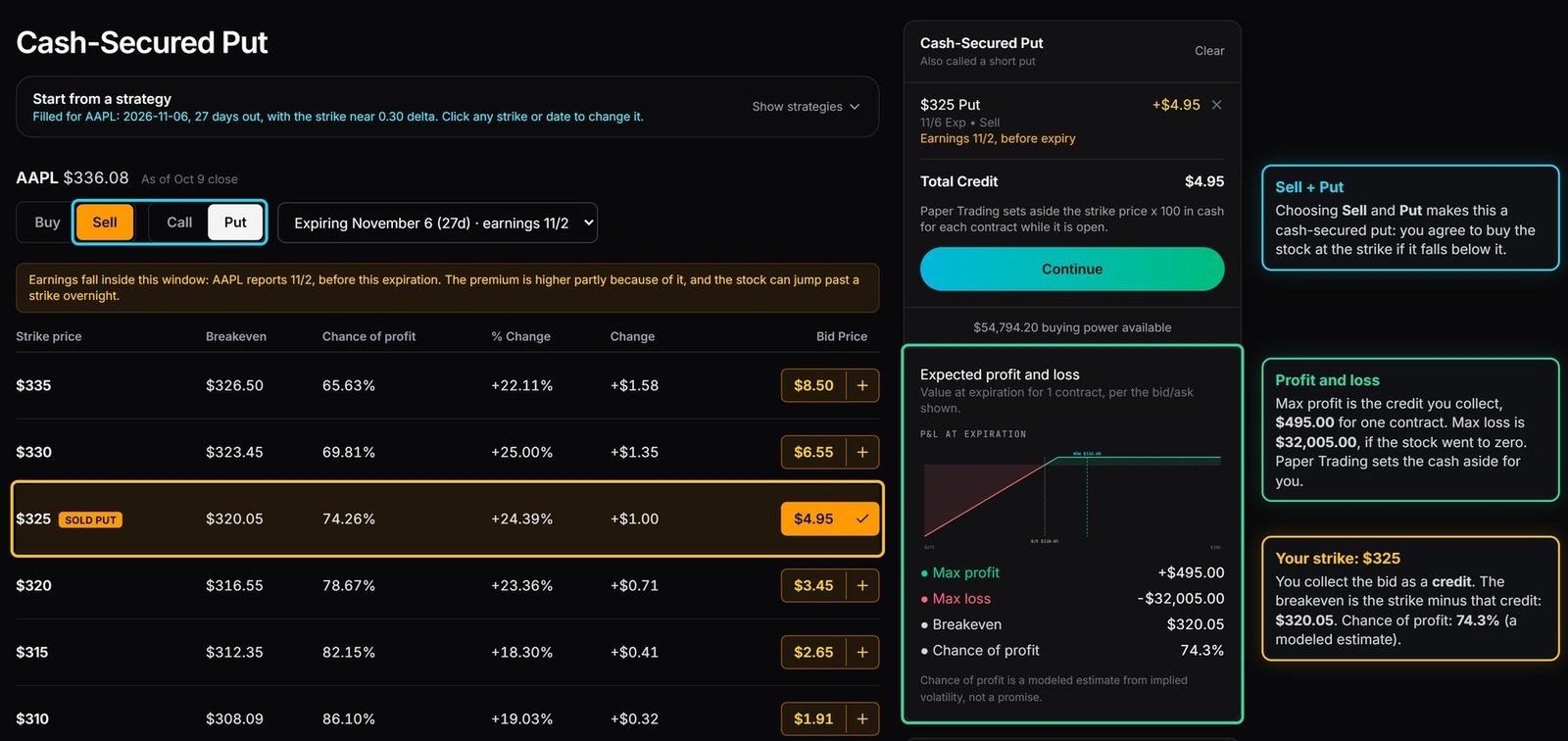
On the Options page, load the chain, pick an expiration 30 to 45 days out, switch to Sell and click a put near 0.25 delta. The trade panel shows the premium, the capital secured, the breakeven and the return on capital.
- 4
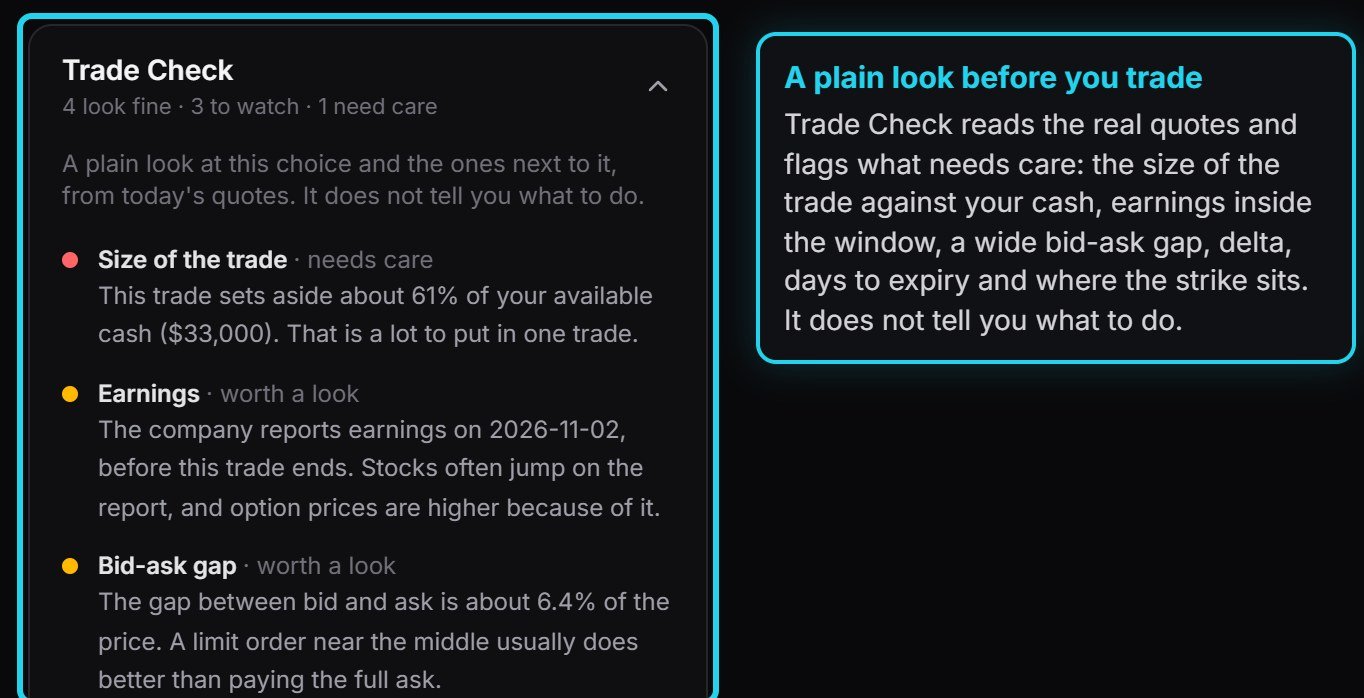
Read the Trade Check. It flags delta outside the usual seller range, days to expiry, earnings inside the trade, a wide bid-ask gap, volatility against realized volatility, the size of the trade against your buying power, and whether the strike sits under a Strike Zone.
- 5
When you are happy, send it to Paper Trading. It tracks the position, settles it at expiration and shows your results over time, with no real money at risk.
Try it with your own numbers
Free calculators, no account needed.
KNOWLEDGE RECONNAISSANCE
You sell a $95 cash-secured put for $2.00 with 45 days to expiration. What is your return on capital if it expires worthless?
What delta range do premium sellers typically target for cash-secured puts?
IV Rank on your chosen stock is 18. What does the entry criteria suggest?
What is the correct test for whether you should sell a put on a given stock?
Why is selling puts on margin rather than fully cash-secured a significant change?
Your stock gaps down 40% overnight on bad news while you are short a put. What was the only effective defence?
More lessons in this module
See every lesson in the courseSignal Desk is where you practice this on real stocks: real option chains (about 15 minutes delayed), the Trade Check and a paper-trading account that risks no real money. Join to add it, your progress tracking and PDF downloads.