
A hands-on options curriculum covering real trading concepts. Read the lessons, work through examples, and test your knowledge.
OVERALL ACADEMY PROGRESS
Free Lesson
Every lesson is free to read. Subscribe to add Signal Desk, progress tracking, PDF downloads and the lesson tutor.
Key terms in this lesson
 Click to enlarge
Lesson 4: 4.3: Rolling — Defending and Extending Positions
How to roll for a credit, when rolling genuinely helps, and the honest test for whether you are managing a trade or refusing to accept a loss.
1. What Rolling Actually Is
Rolling means closing an existing option position and simultaneously opening a similar one at a different strike, a different expiration, or both. It is submitted as a single multi-leg order so both legs execute together.
The three forms:
• Roll out: Same strike, later expiration. Buys time.
• Roll down (puts) or up (calls): Different strike, same expiration. Moves your obligation further from the money.
• Roll out and down/up: Both at once. The most common defensive adjustment.
★ Core Fact: Rolling is not a repair that erases a loss. It is a decision to keep a position open on modified terms. The original loss still exists — you have chosen to carry it forward rather than realize it, in exchange for more time and usually additional premium.
 Click to enlarge
2. The Credit Rule
The single most important discipline in rolling: only roll for a net credit.
A net credit means you collect more premium than you pay to close the existing position. This improves your breakeven with every roll. A net debit means you are paying to stay in a losing trade, which worsens your position and has no natural stopping point.
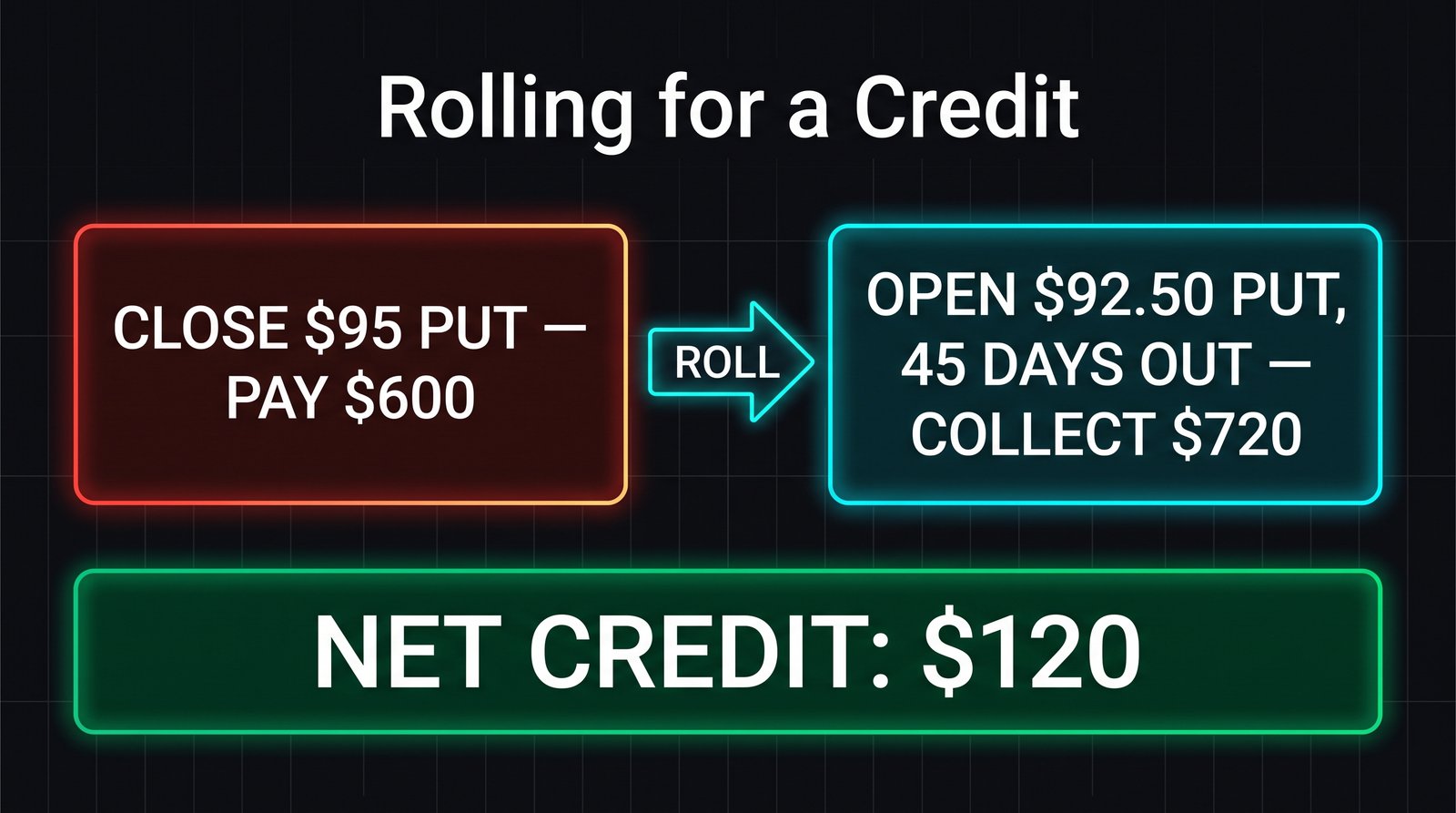
Worked example — rolling a short put:
• Current position: short $95 put, now deep in the money, trading at $6.00. Closing costs $600.
• You sell the $92.50 put 45 days further out for $7.20, collecting $720.
• Net credit: $720 − $600 = $120
You have lowered your obligation by $2.50 per share, extended your timeline by 45 days, and been paid $120 for doing so. Your cumulative premium on the position rises, lowering your effective basis further.
★ Practical Guidance: If you cannot roll for a credit, the market is telling you the position has deteriorated beyond what additional time can fix. That is information, and the correct response is usually to close and accept the loss.
3. Rolling a Threatened Covered Call
The stock has rallied past your short call and you would prefer to keep the shares.
Worked example: You own shares at a $90 basis, sold the $105 call for $1.50. The stock is now $112 and the call trades at $8.50.
• Buy back the $105 call: −$850
• Sell the $115 call, 45 days out: +$9.10 = $910
• Net credit: $60
Result: your cap moves from $105 to $115, you collect an additional $60, and you retain the shares. If assigned at $115 you now profit ($115 − $90) × 100 + accumulated premiums.
The cost is time. Your capital remains committed for another 45 days, and you have deferred the outcome rather than resolved it.
⚠️ Risk Warning: Rolling a covered call up chases a rising stock. If it keeps climbing you may roll repeatedly, each time capping a position that keeps outrunning you. At some point accepting assignment and redeploying the capital is the better decision.
4. When Rolling Is the Wrong Answer
Rolling is a legitimate technique that becomes destructive when used to avoid an emotion rather than to improve a position.
Do not roll when:
• The thesis has broken. If the company announced something that changes why you wanted it, rolling keeps you in a position you would no longer enter fresh.
• You can only roll for a debit. You are paying to postpone a loss.
• You have already rolled twice. Repeated rolling on the same position usually signals a refusal to accept the outcome.
• The capital is better used elsewhere. A position rolled indefinitely ties up buying power that could fund trades with intact theses.
★ The Honest Test: Ask yourself — if I had no position here today, and this cash were free, would I open this exact trade right now at these strikes? If the answer is no, you are not managing a position. You are avoiding realizing a loss.
5. Rolling Within the Wheel
Rolling fits naturally into the Wheel, but it changes what the strategy is doing and that deserves stating clearly.
On the put side: The stock drops toward your strike near expiration. Rolling out and down for a credit delays assignment and lowers your eventual basis. This is reasonable once, occasionally twice.
But note what you are doing. The Wheel's design says assignment is an acceptable outcome — you wanted the stock. If you find yourself repeatedly rolling to avoid assignment, that reveals you did not actually want the shares, which means the position failed the entry test in Lesson 4.0.
On the call side: Rolling up and out preserves shares in a rally, at the cost of continued capital commitment.
★ Core Fact: In a properly constructed Wheel, rolling should be occasional rather than routine. Frequent defensive rolling is a symptom that entry criteria were too loose — usually strikes too close to the money, positions too large, or underlyings you were never genuinely willing to own.
6. Try It in Signal Desk
If you hold any short option in Paper Trading, price a hypothetical roll right now without confirming it. Find what it costs to buy back your current contract, and what you would collect selling the same strike 30 to 45 days further out. Compute the net.
Doing this while the position is comfortable teaches you the mechanics before you need them under pressure.
Then write your roll policy in advance and keep it with your trade journal: the maximum number of times you will roll a single position, and the condition under which you will close instead. Deciding this calmly, before a position moves against you, is the entire value of having a policy.
See it in Signal Desk
Paper Trading lets you pick the new option on the chain and shows the roll before you confirm it (members see live quotes).
- 1
Open Paper Trading and find an open short option, such as a sold put or a covered call.
- 2
Press the Roll button on that trade. The banner shows the option you are rolling, when it expires and what it was sold for.
- 3
Press "Pick the new option on the chain". You are taken to the Options page, where you choose the new strike and date. The Trade Check shows the real quotes beside your choice.
- 4
Come back and read the summary: how far the strike moves, how many days later the expiration is, and the net credit or debit after paying to close the old option at its current ask.
- 5
Nothing changes until you confirm, so you can try several rolls and compare them. A roll that costs a debit is a red flag the lesson explains.
Try it with your own numbers
Free calculators, no account needed.
KNOWLEDGE RECONNAISSANCE
What does rolling an option position accomplish?
You buy back a short put for $600 and sell a further-dated one for $720. What have you done?
Why should you generally avoid rolling for a net debit?
What is the 'honest test' for whether a roll is justified?
You find yourself repeatedly rolling puts to avoid assignment in the Wheel. What does this reveal?
You own shares at $90 and sold the $105 call. The stock is $112. You buy the call back for $850 and sell the $115 call for $910. What is the effect?
More lessons in this module
See every lesson in the courseSignal Desk is where you practice this on real stocks: real option chains (about 15 minutes delayed), the Trade Check and a paper-trading account that risks no real money. Join to add it, your progress tracking and PDF downloads.