
A hands-on options curriculum covering real trading concepts. Read the lessons, work through examples, and test your knowledge.
OVERALL ACADEMY PROGRESS
Free Lesson
Every lesson is free to read. Subscribe to add Signal Desk, progress tracking, PDF downloads and the lesson tutor.
Key terms in this lesson
 Click to enlarge
Lesson 3: 4.2: The Wheel Strategy Lifecycle
The complete Wheel — entry rules as numbers, a full cycle with real P&L, the failure mode that traps traders, and the capital reality nobody mentions.
1. The Mechanic — Why It Works
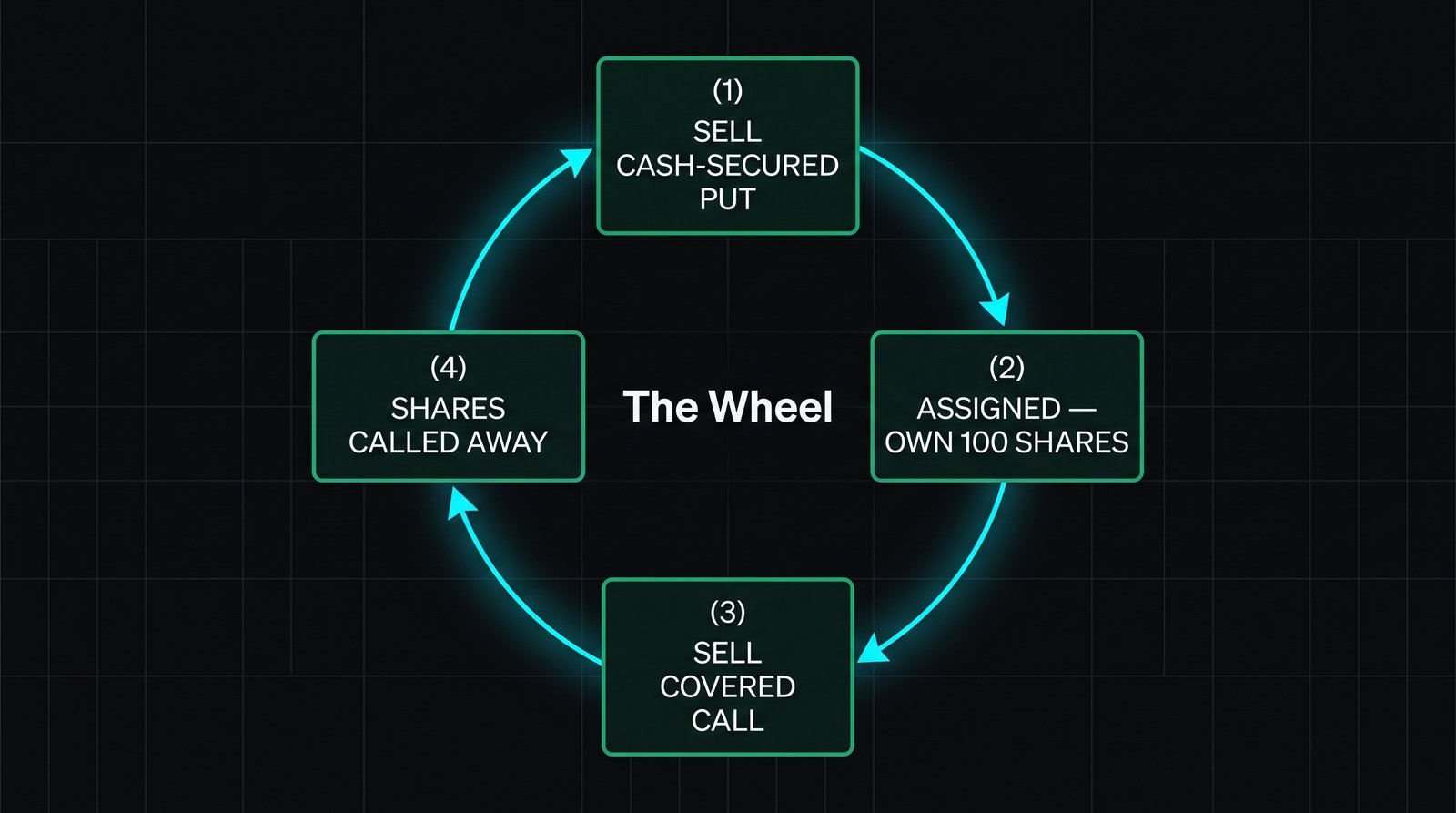
The Wheel combines the two strategies you just learned into a continuous cycle: sell cash-secured puts until assigned, then sell covered calls until the shares are called away, then start again.
Its economic engine is theta. At every stage you are the seller of extrinsic value, collecting time decay as compensation for accepting an obligation. You are never buying premium and never fighting decay.
The reason it appeals to investors rather than traders is that both assignment outcomes leave you in a position you chose in advance. Assigned on the put? You own a stock you wanted. Called away on the call? You sold at a price you named. There is no scenario that forces an unplanned decision — provided you set it up correctly.
★ Core Fact: The Wheel is not a way to generate returns from stocks you do not want to own. It is a way to get paid while accumulating and disposing of stocks you do want, at prices you choose. Every failure of this strategy traces back to ignoring that sentence.
 Click to enlarge
2. Entry Rules, Stated as Numbers
The parameters are the strategy. Without them you have a slogan.
• Underlying: A company you would hold for a year or more through a drawdown. Liquid options: open interest above 500, bid-ask under 10% of mid.
• Avoid: Biotechs awaiting trial results, companies with going-concern doubts, anything where a 50% single-day move is plausible.
• Put strike: 0.20 to 0.30 delta, below current price, at a level you independently consider attractive.
• Days to expiration: 30 to 45 at entry.
• IV Rank: above 30. Below that you are underpaid for the obligation. (Signal Desk does not show IV Rank yet; use Trade Check's IV-versus-realized line instead.)
• Exit rule: Close at 50% of maximum profit, or at 21 days to expiration, whichever comes first.
★ Why 30 to 45 days: Theta decay is meaningfully fast in this window, while gamma has not yet reached the volatile final stretch. Shorter expirations pay more per day but expose you to sharp adverse swings, as covered in Lesson 2.0.
3. A Complete Cycle with Real Numbers
Stock XYZ trades at $50. You have researched it, you would own it at $47.50, and IV Rank is 48.
Step 1 — Sell the cash-secured put.
• Sell one $47.50 put, 45 days to expiration (DTE), 0.25 delta, for $1.20
• Premium collected: $120. Capital secured: $4,750
Step 2 — The stock falls and you are assigned.
• XYZ closes at $46 at expiration. You buy 100 shares at $47.50, paying $4,750
• Effective cost basis: $47.50 − $1.20 = $46.30 per share
• You now own 100 shares at a $46.30 basis with the stock at $46 — an unrealized loss of $30
Step 3 — Sell a covered call above your basis.
• Sell one $50 call, 35 DTE, for $0.90
• Premium collected: $90. Adjusted cost basis: $46.30 − $0.90 = $45.40
Step 4 — The stock recovers and shares are called away.
• XYZ rallies to $52. You sell 100 shares at $50, receiving $5,000
Total profit on the cycle:
• Premiums: $120 + $90 = $210
• Stock gain: ($50 − $47.50) × 100 = $250
• Total: $460 on $4,750 committed, over roughly 80 days
• Verify against basis: sold at $50 against a $45.40 adjusted basis = $4.60 × 100 = $460 ✓
★ Core Fact: Notice the shares were assigned to you at a loss and the cycle still produced $460. The premiums did the work. That is the Wheel functioning exactly as designed.
4. When the Wheel Breaks
The cycle above is the good case. Here is the one that traps people, using the identical starting position.
You sold the $47.50 put and were assigned at a $46.30 basis. But instead of recovering, XYZ keeps falling — to $30 over the following months on deteriorating fundamentals.
• You hold 100 shares at a $46.30 basis worth $3,000
• Unrealized loss: roughly $1,630
Now the strategy stops working, and understanding why is essential:
• Selling a covered call at your $46.30 basis pays almost nothing, because that strike is now far out-of-the-money on a $30 stock
• Selling a call near the money — say $32 — pays real premium, but if assigned you lock in a loss of roughly $1,430
• So you either collect negligible income, or you convert a paper loss into a realized one
This is the Wheel's actual failure mode, and it is common. You are not wiped out; you are stuck. Capital that was supposed to cycle every 80 days is now immobilized in a losing position, potentially for years, generating almost nothing.
⚠️ Risk Warning: The Wheel converts a cash position into a stock position at exactly the moment the stock is falling. That is inherent to the design. It is survivable only if you genuinely wanted the company and sized the position so that being stuck in it is tolerable.
5. The Capital Reality
This is the section most Wheel explanations omit, and it determines whether the strategy is available to you at all.
Every cash-secured put requires strike × 100 in reserved cash. On our $50 stock that is $4,750 per contract.
• On a $10,000 account: one contract is 47.5% of the portfolio. Unacceptable concentration.
• On a $25,000 account: 19%. Still aggressive for a single name.
• On a $100,000 account: 4.75%. Reasonable, and you could run several across different sectors.
For the Wheel to be run properly — diversified across five or six uncorrelated names, each a modest share of the account — you realistically need a six-figure account, or you must confine yourself to lower-priced stocks.
★ Honest Assessment: On accounts below roughly $30,000, running the Wheel on $50+ stocks means holding one or two concentrated positions. That is not diversified income generation; it is a leveraged bet on two companies with the upside capped. Defined-risk put spreads, covered in Module 5, offer related exposure at a fraction of the capital.
The returns are also worth stating plainly. The cycle above produced $460 on $4,750 over 80 days — roughly 9.7% for the period. Attractive, but it required the stock to recover. Cycles that end with you holding a fallen stock produce far less, and they are not rare.
6. Try It in Signal Desk
Pick one company you would genuinely hold through a 30% drawdown and run it through Stock Research first. If the business or the chart fails the checklist from Lesson 1.6, stop there.
If it passes, find the put near 0.25 delta, 30 to 45 days out, in the Easy Chain. Write down five numbers: the premium, the capital required, the effective cost basis if assigned, the capital as a percentage of your account, and the return on capital for the period.
Then answer the two questions that decide whether you place it. First: if I am assigned and the stock falls another 30%, am I comfortable holding this for two years? Second: is the capital committed a share of my account I can accept being immobilized? If either answer is no, the correct action is to not place the trade, or to reduce it to a defined-risk spread. Declining a trade for the right reason is a skill this course is trying to build.
See it in Signal Desk
Paper Trading tracks a wheel for you, and the Backtest shows how the strategy would have done (members see live quotes).
- 1
Run the stock through Stock Research and the checklist from Lesson 1.6 before you enter anything.
- 2
Open the Easy Chain, choose Sell and Put, and send a put near 0.25 delta to Paper Trading.
- 3
In Paper Trading, find the Wheel panel. Each card is one symbol's trip around the wheel: selling puts, owning shares, selling covered calls, then complete. It shows the premium kept and your adjusted cost basis.
- 4
If the put is assigned, the shares appear in your holdings and the card moves to "holding shares" with the next step spelled out: a covered call.
- 5
Open the Backtest tab on the Options page and choose the wheel to see how the strategy would have performed on a stock's real price history, including the periods where it got assigned and the stock kept falling.
Try it with your own numbers
Free calculators, no account needed.
The Mechanical Wheel Strategy Lifecycle
The Wheel strategy is a mechanical premium harvesting cycle. Click the rotating steps below to examine the process, and play with the dynamic calculator to see how Put premium cushions your net share acquisition cost.
Rotating Wheel Cycle Map
Covered Wheel Cost Basis Ledger
• By capturing $550 premium upfront, your effective entry price upon assignment falls from $100 to $94.50.
KNOWLEDGE RECONNAISSANCE
What is the first step in executing the Wheel Strategy?
You sell a $47.50 put for $1.20 and are assigned. You then sell a $50 covered call for $0.90. What is your adjusted cost basis?
In the full cycle example, shares were assigned at a paper loss yet the cycle produced $460. Why?
You are assigned at a $46.30 basis and the stock falls to $30. Why does the Wheel stall here?
Running the Wheel on a $50 stock in a $10,000 account commits what share of the portfolio to one position?
Why does this course recommend 30 to 45 days to expiration for the Wheel?
More lessons in this module
See every lesson in the courseSignal Desk is where you practice this on real stocks: real option chains (about 15 minutes delayed), the Trade Check and a paper-trading account that risks no real money. Join to add it, your progress tracking and PDF downloads.