
A hands-on options curriculum covering real trading concepts. Read the lessons, work through examples, and test your knowledge.
OVERALL ACADEMY PROGRESS
Free Lesson
Every lesson is free to read. Subscribe to add Signal Desk, progress tracking, PDF downloads and the lesson tutor.
Key terms in this lesson
 Click to enlarge
Lesson 2: 4.1: Covered Calls
Generating income on shares you own, the opportunity cost most explanations gloss over, and how to pick strikes without capping your own thesis.
1. The Structure
A covered call means owning 100 shares and selling one call against them. You collect premium in exchange for agreeing to sell your shares at the strike if the stock rises above it.
It is called covered because the obligation is already satisfied by shares you hold. If assigned, you simply deliver stock you own — there is no need to buy anything at market, which is precisely what makes a naked call dangerous.
★ Core Fact: A covered call does not reduce your downside risk in any meaningful way. If the stock falls, you still own it and still lose. The premium offsets a small portion of the decline and nothing more. Covered calls are an income strategy, not a hedge.
2. Strike Selection and What Each Choice Means
The strike determines the trade-off between income and upside participation.
Stock at $100, 35 days to expiration — approximate premiums:
• $100 strike (ATM, ~0.50 delta): $3.20 premium. High income, but you are capped immediately and will likely be assigned.
• $105 strike (~0.30 delta): $1.50 premium. Moderate income, 5% of upside retained.
• $110 strike (~0.16 delta): $0.60 premium. Low income, 10% of upside retained.
The 0.20 to 0.30 delta range is the common choice, for the same reason as cash-secured puts: it collects meaningful premium while leaving roughly a 70 to 80 percent chance the shares are not called away.
★ Practical Guidance: Choose the strike by asking where you would be genuinely happy to sell the shares. If you would be annoyed to lose them at $105, do not sell the $105 call — the premium will not compensate for the regret.
3. Full Worked Example
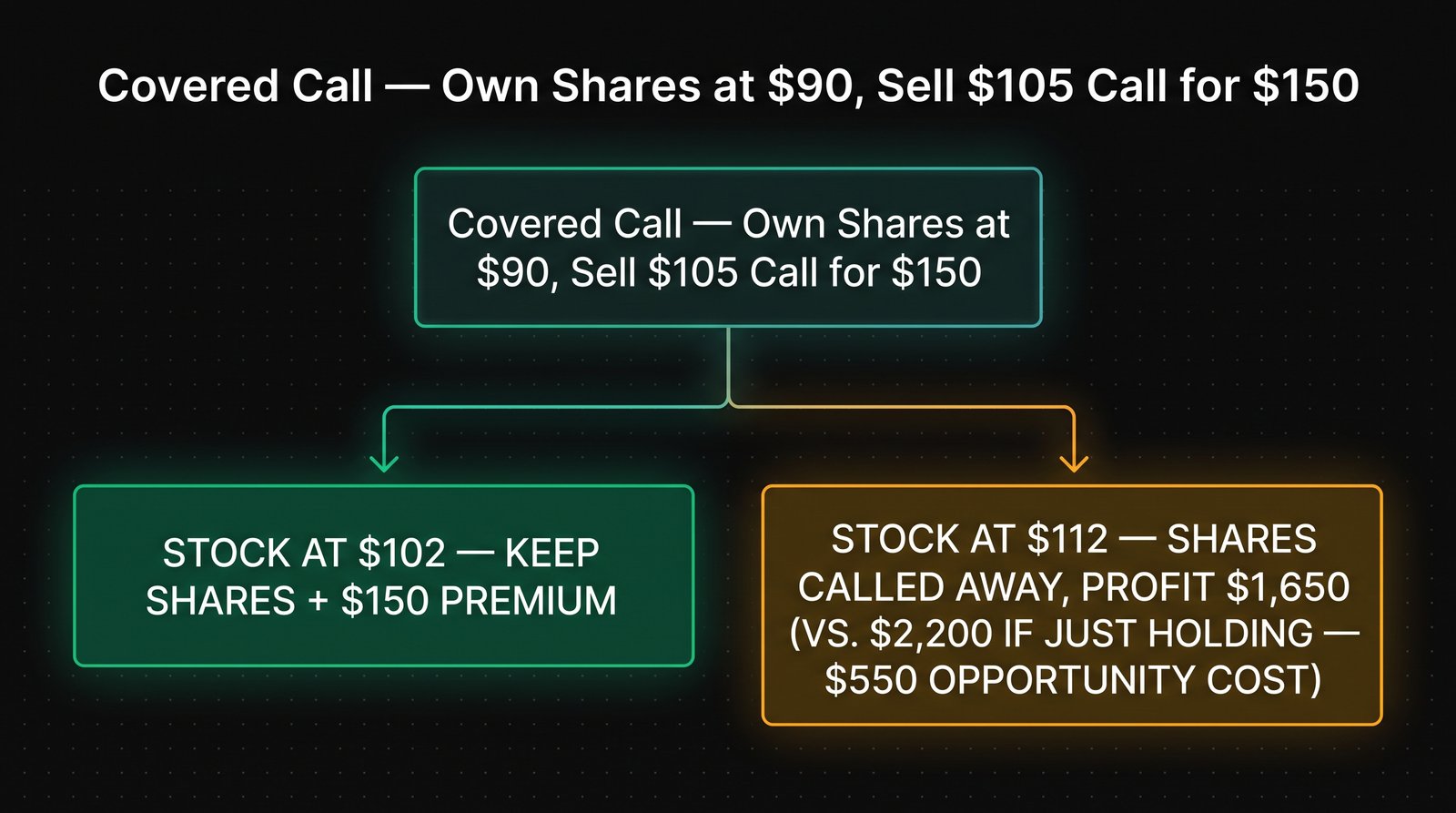
You own 100 shares of XYZ purchased at $90. The stock now trades at $100. You sell the $105 call, 35 days out, for $1.50.
• Premium received: $150
• Additional capital required: none — the shares are the collateral
Outcome A — stock at $102 at expiration:
• Call expires worthless. You keep the $150 and your shares.
• Return on the shares' current value: $150 ÷ $10,000 = 1.5% over 35 days, roughly 15.6% annualized if repeatable
Outcome B — stock at $112, shares called away:
• You sell 100 shares at $105, receiving $10,500
• Total profit: ($105 − $90) × 100 + $150 = $1,500 + $150 = $1,650
• But had you not sold the call, your shares would be worth $11,200 — a $2,200 gain
• Opportunity cost: $550
Outcome C — stock at $88:
• Call expires worthless, you keep $150
• Your shares are down $1,200 from the $100 mark. The premium offset 12.5% of that decline.
★ Core Fact: Outcome B is the one most explanations skip. You made money and still underperformed simply holding the shares. That is the genuine cost of the strategy, and it recurs precisely when your thesis is working.
 Click to enlarge
4. The Opportunity Cost Problem
Covered calls have an asymmetry that runs opposite to what most people assume: they cap your best outcomes while leaving your worst ones essentially intact.
Over many cycles this produces a specific pattern. You collect steady modest premiums, and occasionally a stock runs hard and you are called away near the bottom of the move, watching it continue without you.
This is why covered calls suit particular situations and not others:
• Good fit: Shares you are neutral to mildly bullish on, positions you were considering trimming anyway, stocks in a range.
• Poor fit: A high-conviction long-term holding you expect to appreciate substantially. Capping a compounder for 1.5% a month is usually a bad trade.
⚠️ Risk Warning: Repeatedly selling calls against a strong performer and being called away each time can meaningfully underperform simply holding it. The income feels productive because it arrives regularly; the foregone appreciation is invisible because it never appears in your account.
5. Managing an In-the-Money Call
The stock rallies past your strike and assignment looks likely. You have three choices.
Accept assignment. Sell the shares at the strike and take the profit. Clean, and often correct — you set that strike for a reason.
Roll up and out. Buy back the current call and sell a higher strike further out, ideally for a net credit. This preserves the shares and raises the cap, but ties up capital longer. Covered fully in Lesson 4.3.
Buy back the call outright. If your view on the stock has changed and you now want unrestricted upside, close the short call at a loss and keep the shares. This is an admission the trade is being abandoned — sometimes the right call, but be honest that it is a loss.
★ Practical Guidance: Decide which of these you will do before the stock reaches your strike. Making this decision under pressure with the stock moving is how traders end up rolling losing positions indefinitely to avoid realizing a loss.
6. Try It in Signal Desk
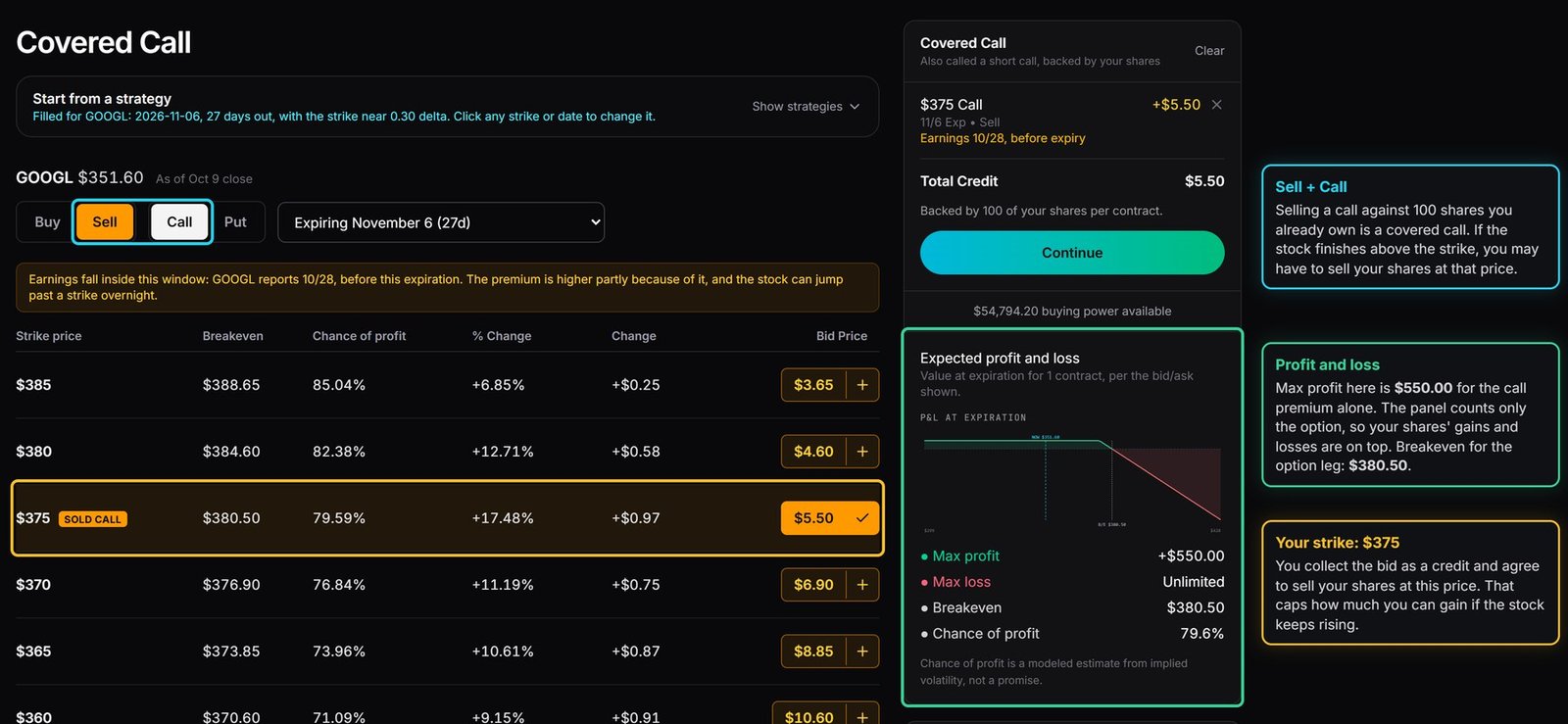
If you own 100 or more shares of anything, open the Easy Chain in Signal Desk, choose Sell and Call, and find the call near 0.30 delta about 35 days out. Record the premium and the return it represents against the current share value.
Then ask the real question: if the stock closed above that strike next month and your shares were called away, would you be content? Write down the answer.
If you do not own shares yet, buy 100 in Paper Trading first and then run the exercise. The arithmetic of income versus capped upside is worth internalizing before you have real capital committed to it.
See it in Signal Desk
A covered call is a Sell and Call against shares in your paper account (members see live quotes).
- 1
Open Paper Trading and use Buy / Sell Shares to buy 100 shares of a stock. They appear in your Holdings.
- 2
Open Options, switch to the Easy Chain on the start page. Stocks you hold are listed as "covered call ready".
- 3
Choose Sell and Call, pick an expiration around 35 days out and a strike near 0.30 delta. The panel confirms the call is backed by your shares and shows the premium, the maximum profit if the shares are called away, and the breakeven.
- 4
Compare a strike close to the price with one further out. The closer one pays more but gives up more of the upside.
- 5
Send it to Paper Trading. Each open covered call ties up 100 shares per contract, so you cannot sell those shares until the call is closed.
Try it with your own numbers
Free calculators, no account needed.
KNOWLEDGE RECONNAISSANCE
What does a covered call do to your downside risk?
You own shares bought at $90, now at $100. You sell the $105 call for $1.50 and are assigned with the stock at $112. What is your total profit?
Which situation is the poorest fit for a covered call?
How much additional buying power does selling a covered call consume?
Your short call has gone in-the-money and you want to keep the shares. What is the standard adjustment?
Why is choosing a strike where you would be 'genuinely happy to sell' important?
More lessons in this module
- 4.0: Cash-Secured Puts
- 4.2: The Wheel Strategy Lifecycle
- 4.3: Rolling — Defending and Extending Positions
Signal Desk is where you practice this on real stocks: real option chains (about 15 minutes delayed), the Trade Check and a paper-trading account that risks no real money. Join to add it, your progress tracking and PDF downloads.