
A hands-on options curriculum covering real trading concepts. Read the lessons, work through examples, and test your knowledge.
OVERALL ACADEMY PROGRESS
Free Lesson
Every lesson is free to read. Subscribe to add Signal Desk, progress tracking, PDF downloads and the lesson tutor.
Key terms in this lesson
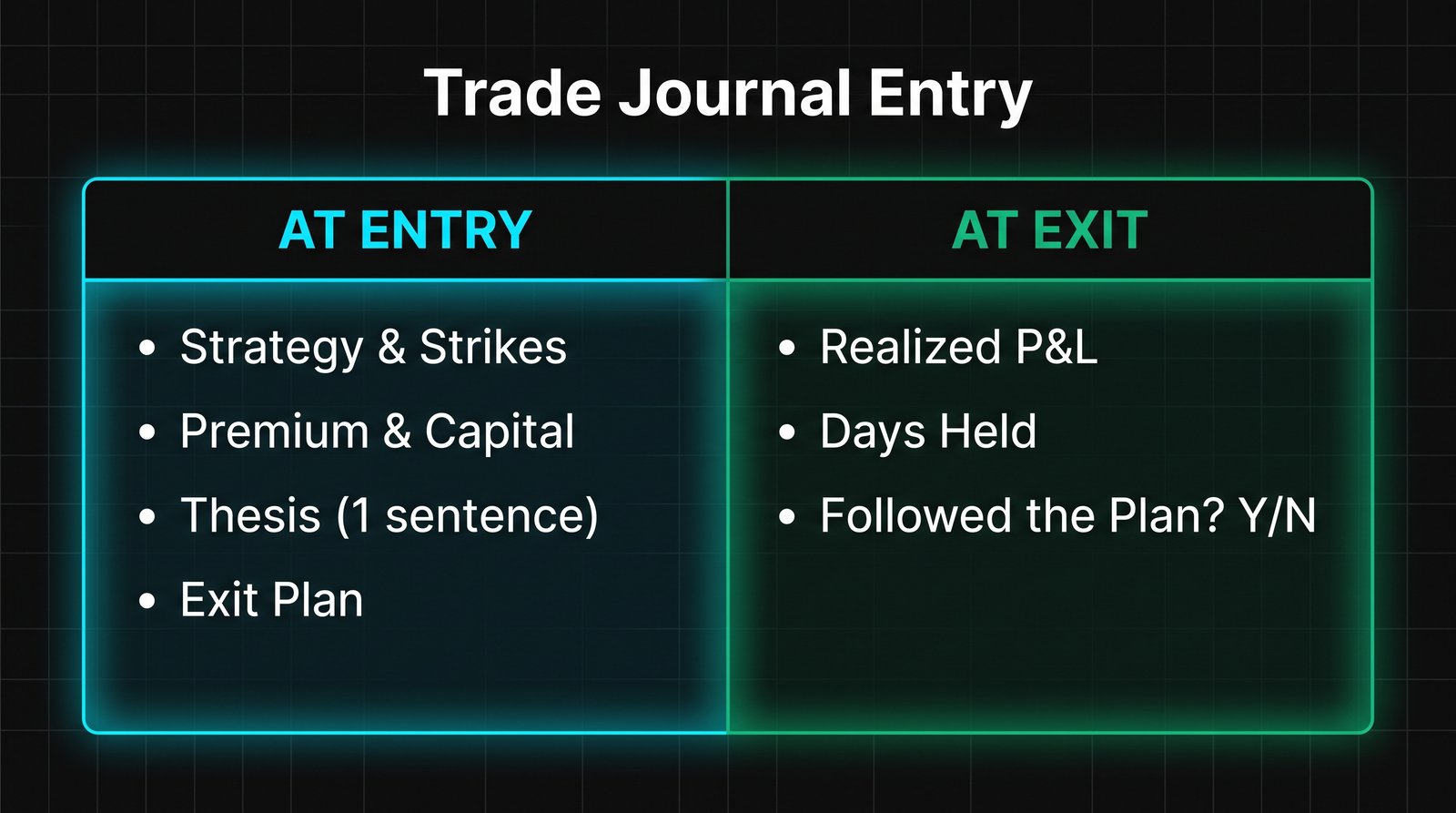 Click to enlarge
Lesson 4: 3.3: The Trade Journal — Reviewing Your Own Data
What to record on every trade, the metrics that actually reveal whether you have an edge, and how to run a monthly review that changes behaviour.
1. Why Memory Is Not Enough
Every trader believes they remember their trades accurately. Almost none do.
Memory systematically distorts trading history in predictable ways: winners are recalled vividly and losers get rationalized as unlucky, the reasoning behind an entry is reconstructed after the fact to match the outcome, and losing streaks feel longer than they were while winning streaks feel like skill.
A written record is the only defence, because it captures your reasoning before you know the result.
★ Core Fact: The purpose of a trade journal is not bookkeeping. Your broker already tracks P&L. The purpose is to capture your reasoning at the moment of entry, so you can later separate good decisions from good outcomes — which are not the same thing.
2. What to Record at Entry
Record these before the trade resolves, when you still do not know the answer:
• Date, underlying, strategy type, strikes and expiration
• Premium collected or paid, and total capital committed
• Delta of the short strike, and days to expiration at entry
• IV Rank at the time of entry (Signal Desk does not show IV Rank yet, so write down the HV Rank and Trade Check's IV-versus-realized line instead)
• Your thesis in one sentence — why this trade, why now
• Your exit plan — the profit target and the point at which you will close for a loss
That last pair matters most. A trade with no predetermined exit is a trade you will manage emotionally when it moves against you.
★ Practical Guidance: If you cannot write the thesis in one clear sentence, you do not have one. That alone filters out a meaningful share of bad trades before they are placed.
3. What to Record at Exit
When the position closes, add:
• Exit date, closing price, and realized profit or loss
• Days actually held
• Whether you followed your stated exit plan — yes or no
• What actually happened, in one sentence
The 'did I follow my plan' field is the single most valuable column in the journal. Over time it reveals whether your losses come from bad strategy or from abandoning good strategy under pressure. Those two problems have completely different solutions.
★ Core Fact: A profitable trade where you abandoned your plan is a warning sign, not a success. It rewards the behaviour that will eventually produce a large loss.
4. The Metrics That Matter
Once you have thirty or more closed trades, these numbers begin to mean something:
• Win rate: percentage of trades closed profitably. Premium selling strategies typically run high — 70% or more — which is expected and not itself evidence of skill.
• Average win and average loss in dollars. For premium sellers the average loss should be larger than the average win; the question is by how much.
• Profit factor: gross profits divided by gross losses. Above 1.0 is profitable. Above 1.5 is genuinely good.
Worked example: 40 trades. 30 winners averaging $180 ($5,400 total). 10 losers averaging $520 ($5,200 total).
• Win rate: 75%
• Profit factor: $5,400 ÷ $5,200 = 1.04
That trader wins three out of four trades and is barely profitable. A high win rate concealed the fact that losses were nearly large enough to erase everything. Without the journal, they would likely describe themselves as successful.
★ Practical Guidance: Win rate alone tells you almost nothing. Profit factor tells you whether the strategy works.
5. The Monthly Review
Set aside thirty minutes at the end of each month. Sort your closed trades by profit and loss and answer four questions:
• What did my three largest losses have in common? Look for a pattern in IV Rank, days to expiration, position size, or sector.
• How many trades did I exit according to plan? A rate below 80% means the problem is discipline, not strategy.
• Was my sizing consistent? Oversized positions usually cluster around trades you felt most confident about — which is precisely when overconfidence is most expensive.
• Which setups produced my best profit factor? Do more of those.
★ Core Fact: Most traders discover their losses concentrate in a small number of identifiable circumstances — often trades placed at low IV Rank, sized too large, or held past the planned exit. Those are fixable problems, but only if you can see them.
6. Try It in Signal Desk
Open Paper Trading in Signal Desk and log any position you currently hold, with the fields from Section 2. If you hold nothing, log the next trade you place before you place it. The Trade log keeps the dates, strikes and results for you.
Open the Account review on the same page. It reads your own trades and tells you in plain words how you size them, how they were opened and how you manage them. You can also open the Trading Journal on the site to record your thesis and what you felt, which the numbers cannot capture.
Then put a recurring reminder on the last day of each month for the review in Section 5. The journal only produces value if something regularly forces you to read it.
See it in Signal Desk
Paper Trading keeps the record, and the Account review reads it back to you (members see live quotes).
- 1
Open Paper Trading and look at the Trade log. Every trade shows its strike, premium, dates and outcome, and settled trades carry the result.
- 2
On an ended trade, click the clipboard icon to open its review. It shows what the stock did and how your strike would have compared, kept apart from the checks you saw when you opened it.
- 3
Scroll to the Account review. It summarizes your sizing, how you open trades and how you manage them, from your own history. It never says what to buy or sell.
- 4
If you want a written review, the page can send your paper account to an AI reviewer after you agree to a notice about what is sent. The review is educational, not advice.
- 5
Open the Trading Journal from the main menu to record your thesis, your exit plan and whether you followed the plan.
Try it with your own numbers
Free calculators, no account needed.
KNOWLEDGE RECONNAISSANCE
What is the primary purpose of a trade journal?
A trader has 30 winners averaging $180 and 10 losers averaging $520. What is the profit factor?
Why is win rate alone a poor measure of a premium-selling strategy?
Which journal field best reveals whether losses stem from discipline rather than strategy?
Why should IV Rank be recorded at entry?
How should you view a profitable trade where you abandoned your exit plan?
More lessons in this module
- 3.0: Order Types and Getting Filled
- 3.1: Assignment, Exercise & Expiration Mechanics
- 3.2: Position Sizing & Buying Power
Signal Desk is where you practice this on real stocks: real option chains (about 15 minutes delayed), the Trade Check and a paper-trading account that risks no real money. Join to add it, your progress tracking and PDF downloads.