
A hands-on options curriculum covering real trading concepts. Read the lessons, work through examples, and test your knowledge.
OVERALL ACADEMY PROGRESS
Free Lesson
Every lesson is free to read. Subscribe to add Signal Desk, progress tracking, PDF downloads and the lesson tutor.
Key terms in this lesson
 Click to enlarge
Lesson 1: 3.0: Order Types and Getting Filled
Why market orders on options are dangerous, how to work the mid-price, and the multi-leg order mechanics that save real money.
1. Never Use Market Orders on Options
This is close to an absolute rule, and it is the single most expensive habit new options traders carry over from stock trading.
In liquid stocks, a market order fills within a cent of the last price. Options are different. Spreads are wider, quotes move faster, and a market order instructs your broker to accept whatever price is available — which on a thin contract can be dramatically worse than the displayed quote.
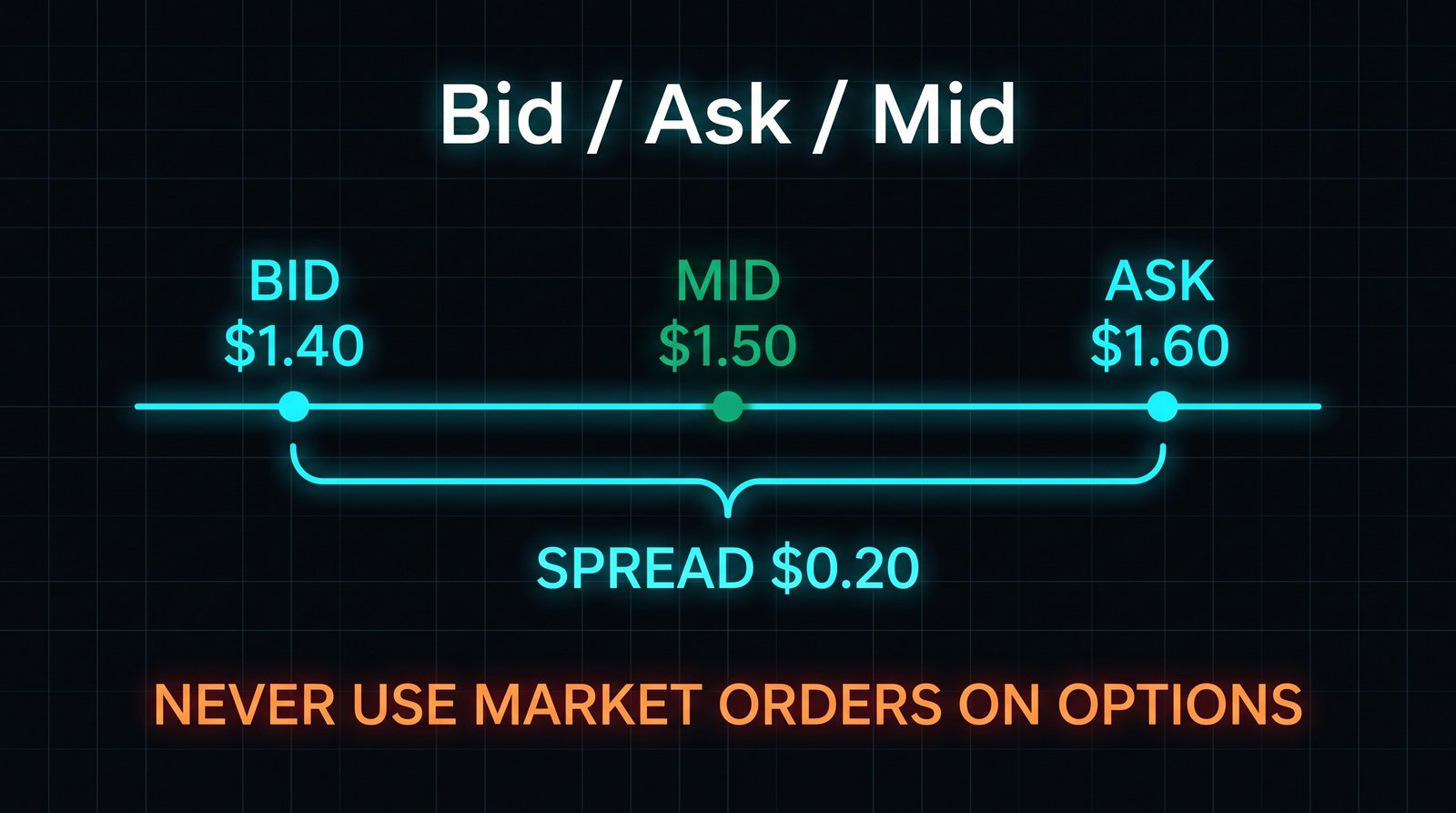
Worked example: A contract shows Bid $1.40 / Ask $1.60. You send a market buy order. In the moment between submission and execution, a market maker widens the quote to $1.40 / $2.10. You fill at $2.10 — paying $50 per contract more than the ask you saw.
⚠️ Risk Warning: Always use limit orders on options. There is essentially no situation in this course's strategies where a market order is the correct choice.
2. The Mid-Price and How to Work It
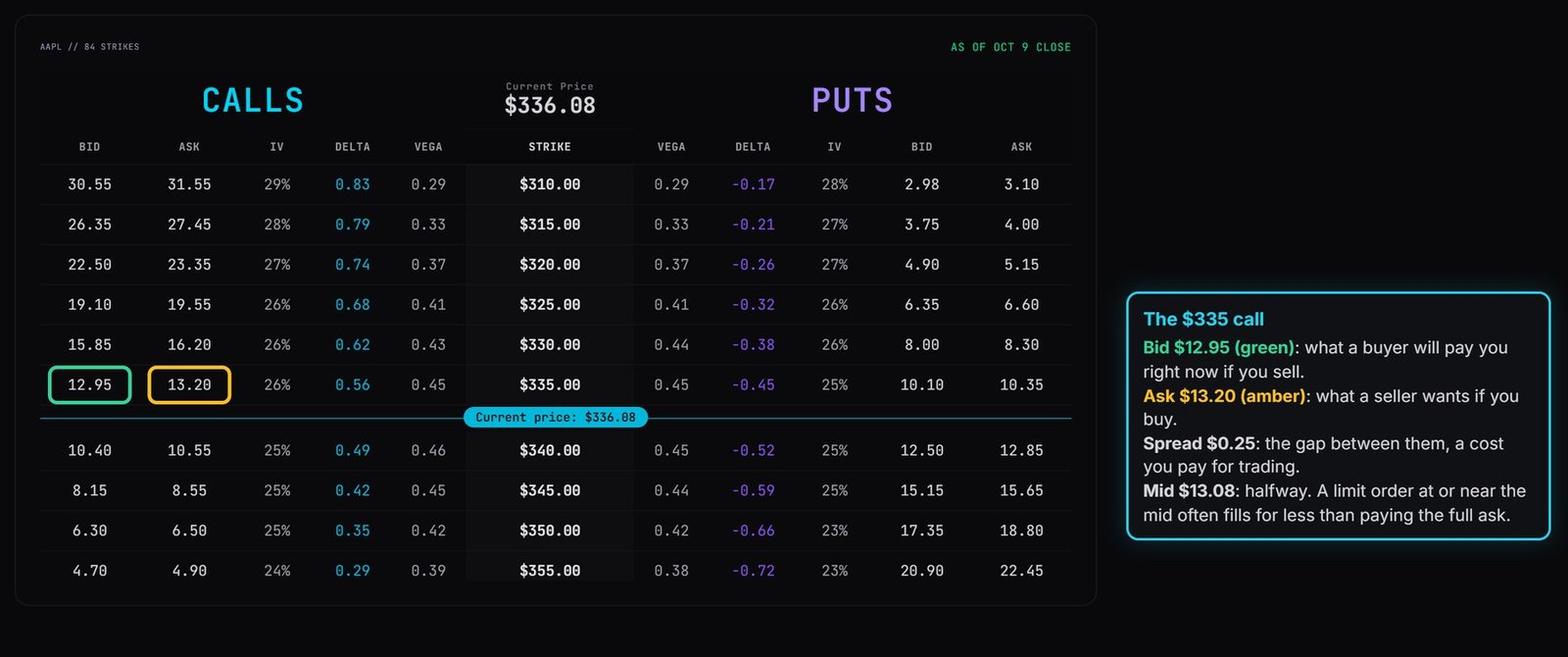
The mid-price is the midpoint between bid and ask, and it is your reference point for what a contract is genuinely worth.
★ Mid = (Bid + Ask) ÷ 2
With Bid $1.40 / Ask $1.60, the mid is $1.50. That $0.20 spread is the market maker's compensation for providing liquidity, and part of it is negotiable.
The standard technique for entering a position:
• Start your limit order at the mid ($1.50 to buy).
• Wait 30 to 60 seconds. On liquid contracts this fills surprisingly often.
• If unfilled, adjust by $0.01 to $0.05 toward the ask and wait again.
• Repeat until filled or until you reach a price you are unwilling to pay.
★ Core Fact: On a liquid contract you should routinely fill at or very near the mid. If you consistently have to pay the full ask, that is evidence the contract is not liquid enough to be trading.
 Click to enlarge
3. What the Spread Actually Costs You
The spread is a real cost, paid twice — once entering and once exiting — and it is invisible in your P&L because it never appears as a line item.
Worked comparison on a contract you intend to buy and later sell:
Liquid contract, Bid $2.95 / Ask $3.05 (mid $3.00):
• Buy at mid: $3.00. Sell later at mid: round-trip cost is essentially zero beyond commissions.
• Buy at ask, sell at bid: $3.05 in, $2.95 out — $0.10 round trip, about 3.3% of the position.
Illiquid contract, Bid $2.50 / Ask $3.50 (mid $3.00):
• Buy at ask, sell at bid: $3.50 in, $2.50 out — $1.00 round trip, about 33% of the position.
On that second contract the stock must move roughly a third in your favour just to break even on execution alone. This is why the liquidity screen from Lesson 1.5 is not optional.
★ Practical Guidance: Estimate your round-trip spread cost before entering. If it exceeds roughly 5% of the premium, the trade needs to clear a bar most trades cannot.
4. Multi-Leg Orders
Spreads, iron condors, and the rolls covered in Lesson 4.3 involve multiple contracts at once. How you submit them matters enormously.
Legging in means executing each contract separately. This exposes you to the risk that the market moves between fills, leaving you with an unintended position — for example holding a naked short call because the long leg never filled.
A combo or spread order submits all legs as a single package at a net price. Either the entire structure fills at your price or nothing fills at all.
Worked example — a vertical spread: Buy the $100 call, sell the $105 call. Rather than two orders, you submit one spread order for a net debit of $1.80. The broker routes it as a unit.
⚠️ Risk Warning: Never leg into a multi-leg position manually while learning. A partial fill on a defined-risk spread can leave you holding an undefined-risk naked position, which is a fundamentally different trade from the one you intended.
5. Debits, Credits, and Reading Order Tickets
Multi-leg orders are quoted as a net debit or net credit, and misreading the sign leads to real mistakes.
• Net debit: You pay to open. Cash leaves your account. Typical of long spreads and calendars.
• Net credit: You receive cash to open. Typical of cash-secured puts, covered calls, credit spreads, and iron condors.
Worked example: An iron condor quoted at a $1.20 net credit means you collect $120 per structure at entry. Your maximum profit is that $120 if all legs expire worthless.
When closing a credit position, you buy it back — paying a debit. If you sold for $1.20 and buy back at $0.40, you keep the $0.80 difference, or $80 per structure.
★ Core Fact: Profit on a credit trade equals credit received minus debit paid to close. You are not waiting for expiration by necessity — closing early at a favourable debit is often the better decision, per the 21-day guideline in Lesson 2.1.
6. Try It in Signal Desk
Open the Easy Chain in Signal Desk, choose Sell and Put, and tap a strike. Notice that the price shown is the bid, because a seller gets paid the bid when the order fills straight away, and that the details also list the mark, which is the midpoint.
Now go to Paper Trading and start a new trade. Type a premium that is better than the market, such as a sold put priced above the ask, and read what the Fill check says. It tells you what a seller can realistically get and offers a button to use the midpoint.
Knowing how quotes turn into fills before you trade prevents the most common category of execution error: submitting an order that does something different from what you intended.
See it in Signal Desk
Paper Trading checks the premium you type against the live bid and ask, so you learn what fills realistically (members see live quotes).
- 1
Open Options, switch to the Easy Chain and tap a strike. The details show the bid, the ask and the mark (the midpoint) with their sizes.
- 2
Send a trade to Paper Trading, or open its New Trade form and enter an option yourself.
- 3
Under the form, the Fill check compares your premium with the market: "Within the live market" when it is realistic, or a plain warning if you entered more than the ask or less than the bid.
- 4
Press "Use mid" to fill in the midpoint. A limit order near the midpoint often fills for less than paying the full ask.
- 5
For a two-leg spread, enter both legs and watch the form show one net credit or debit instead of two separate prices.
KNOWLEDGE RECONNAISSANCE
Why should market orders be avoided on options?
A contract shows Bid $2.20 / Ask $2.60. What is the mid-price?
You buy at the ask ($3.50) and later sell at the bid ($2.50) on a contract with a $3.00 mid. What was your round-trip execution cost?
What is the primary risk of 'legging into' a multi-leg spread?
You sell an iron condor for a $1.20 net credit and later buy it back for a $0.40 debit. What is your profit per structure?
Which order type opens a position where cash is received into your account?
More lessons in this module
- 3.1: Assignment, Exercise & Expiration Mechanics
- 3.2: Position Sizing & Buying Power
- 3.3: The Trade Journal — Reviewing Your Own Data
Signal Desk is where you practice this on real stocks: real option chains (about 15 minutes delayed), the Trade Check and a paper-trading account that risks no real money. Join to add it, your progress tracking and PDF downloads.