
A hands-on options curriculum covering real trading concepts. Read the lessons, work through examples, and test your knowledge.
OVERALL ACADEMY PROGRESS
Free Lesson
Every lesson is free to read. Subscribe to add Signal Desk, progress tracking, PDF downloads and the lesson tutor.
Key terms in this lesson
 Click to enlarge
Lesson 3: 3.2: Position Sizing & Buying Power
The lesson that prevents account-ending losses — how much capital any single trade should risk, and why option sellers must size to the worst case.
1. Why This Is the Most Important Lesson Here
Every other lesson in this course teaches you how to construct a trade. This one determines whether a bad trade ends your account.
Traders do not usually fail because their strategy is wrong. They fail because a strategy with a positive edge was sized so large that a normal losing streak wiped them out before the edge could express itself.
★ Core Fact: You can be right 70% of the time and still go to zero if the 30% is large enough. Position sizing is what converts a statistical edge into an actual outcome.
2. The Percentage Rules
Two limits govern responsible sizing, and both should be checked before any trade.
• Maximum risk per trade: 1% to 3% of account value. For a $25,000 account, that is $250 to $750 of maximum loss on any single position.
• Maximum capital committed per position: roughly 5% of account value for defined-risk trades, and no more than 20% for cash-secured positions.
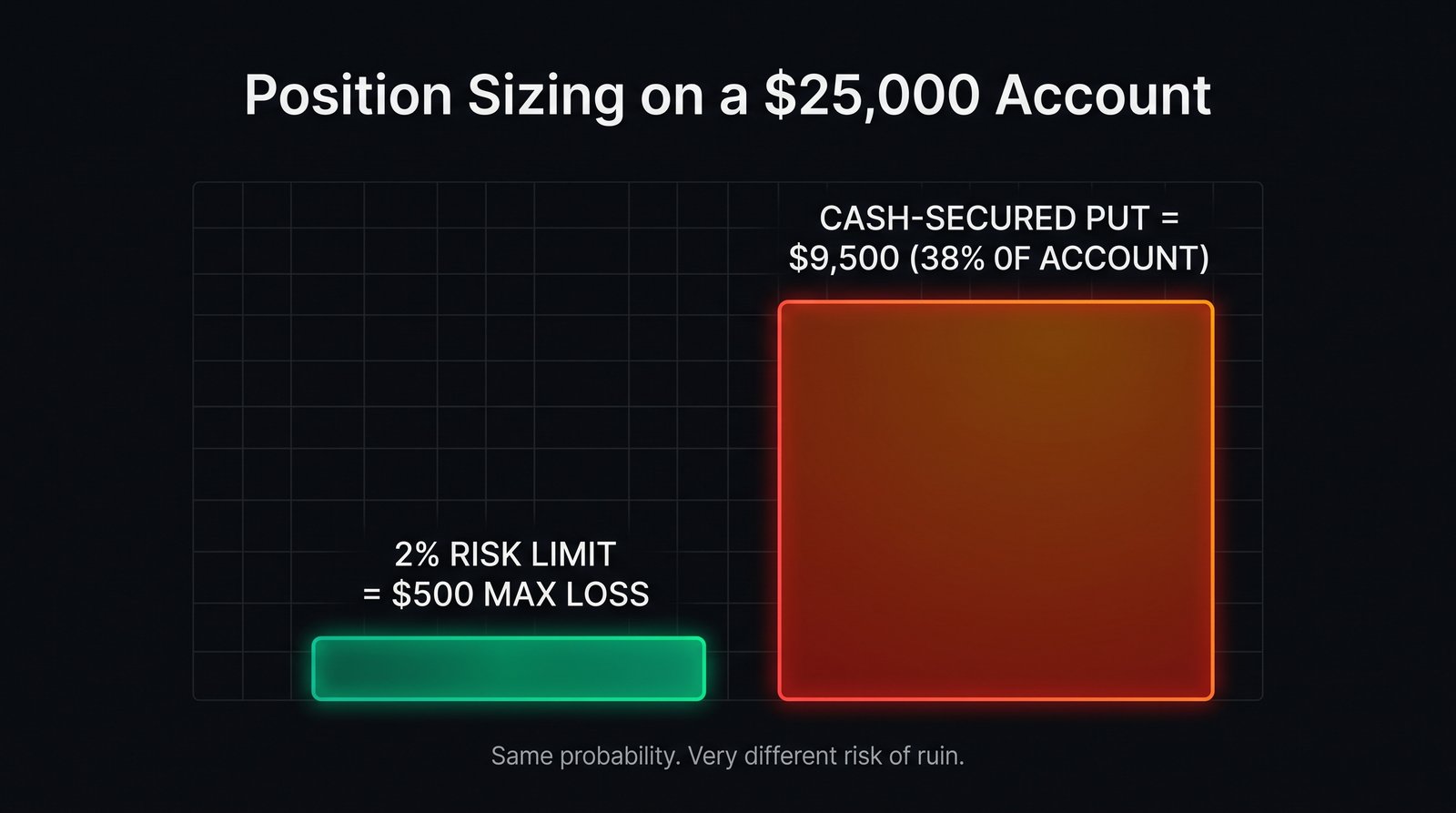
Worked example on a $25,000 account with a 2% risk limit ($500 max loss):
• Long call at $250 per contract: 2 contracts maximum, since the premium is the entire risk.
• Vertical spread with $400 max loss per spread: 1 spread.
• Cash-secured put requiring $9,500 collateral: this is 38% of the account in one position — too concentrated regardless of probability.
⚠️ Risk Warning: That last example is the one that catches people. A cash-secured put on a $95 stock looks conservative because assignment is 'just buying a stock you want.' But committing 38% of an account to a single name is concentration risk, not conservatism.
3. Sizing Premium Selling to the Worst Case
Selling options produces a distribution of outcomes that is easy to misjudge: frequent small wins and infrequent large losses. Sizing must be based on the loss, not the win.
Worked example: You sell a cash-secured $95 put for $2.00.
• Best case: keep $200.
• Realistic bad case: stock falls to $80. You own shares at a $93 basis, holding a $1,300 unrealized loss.
• Severe case: stock falls to $55 on bad news. Unrealized loss of $3,800 against $200 collected.
The correct question is never 'how likely is the severe case?' It is 'if the severe case happened tomorrow, would my account survive it comfortably?' If the answer is no, the position is too large regardless of probability.
★ Practical Guidance: Ask what happens if the stock drops 40% overnight. If that outcome would be genuinely damaging rather than merely unpleasant, reduce size until it is merely unpleasant.
4. Buying Power and Its Reductions
Buying power is the capital your broker permits you to deploy. Different strategies consume it very differently, and this is often the binding constraint on a smaller account.
• Cash-secured put: reduces buying power by Strike × 100. A $95 put ties up $9,500.
• Covered call: consumes no additional buying power, since the shares are already held as collateral.
• Defined-risk spread: reduces buying power by the maximum loss — typically the strike width minus credit received. A $5-wide spread with a $1.50 credit ties up $350.
• Naked short option: reduces buying power by a formula-driven margin requirement, often 15% to 20% of the underlying value, and it changes as the stock moves.
★ Core Fact: Defined-risk spreads are dramatically more capital-efficient than cash-secured positions. Selling a $5-wide put spread might tie up $350 versus $9,500 for the cash-secured put — roughly 27 times less capital for a related directional view.
 Click to enlarge
5. Correlation — The Hidden Concentration
Position sizing rules applied per-trade can still leave a portfolio dangerously concentrated if the positions move together.
Worked example: You hold five cash-secured puts, each sized responsibly at 4% of your account, on five different large technology companies.
Individually, each looks disciplined. Collectively, you have 20% of your account short volatility on a single sector that tends to fall together. A broad technology selloff assigns all five positions simultaneously.
★ Practical Guidance: Track exposure by sector and by direction, not only by individual position. A useful check: if the whole market dropped 15% tomorrow, how many of your positions would be in trouble at once? If the answer is 'all of them,' your diversification is illusory.
This is also the honest argument for the beta-weighted delta technique covered in Lesson 5.3 — it converts a scattered portfolio into a single directional number.
6. Try It in Signal Desk
Write down the value of your paper account in Signal Desk. Multiply it by 0.02 to get your per-trade risk limit, and keep that number where you will see it before you place a trade.
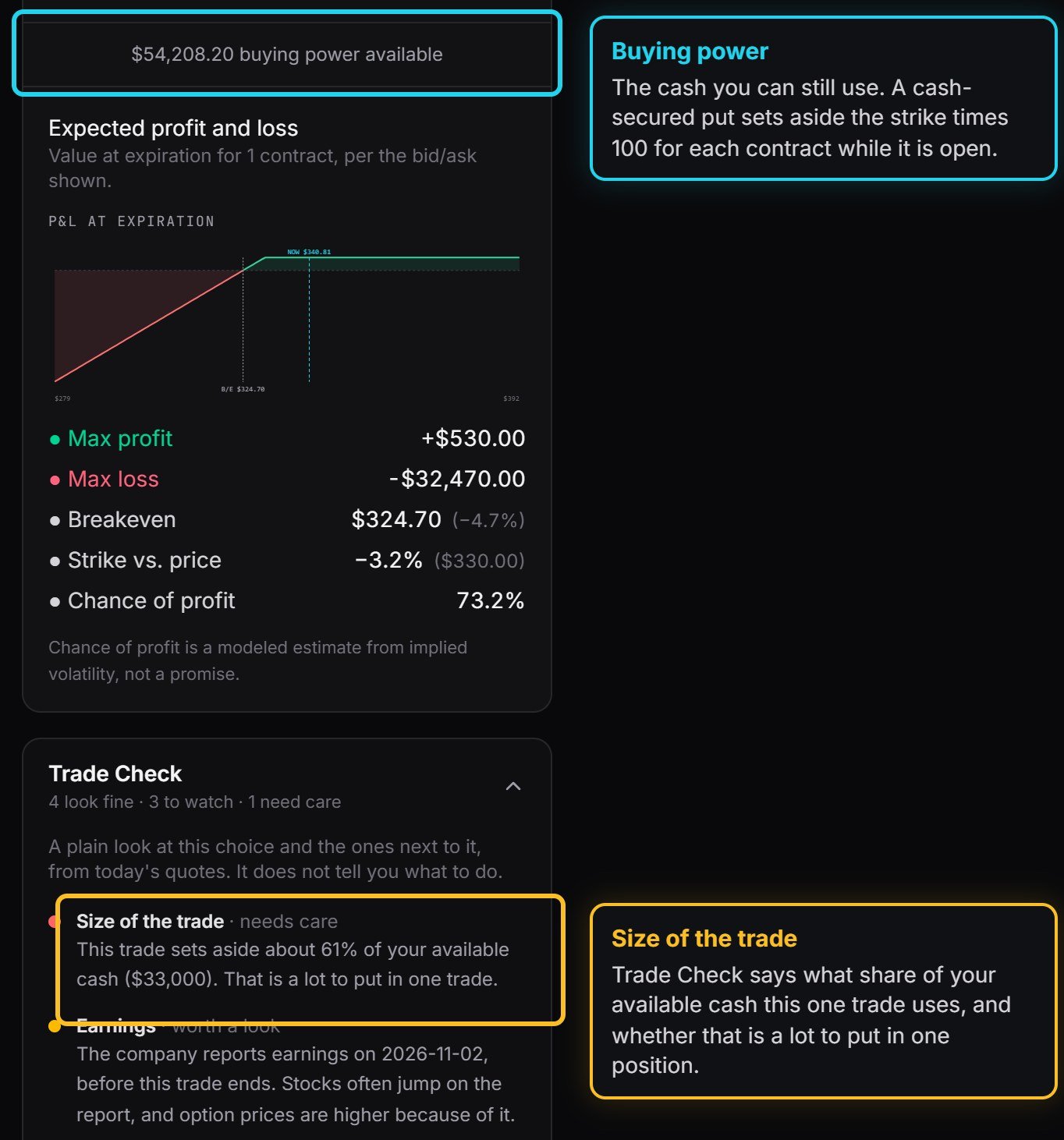
Then take any trade you are considering in the Easy Chain and read three numbers from its panel: the maximum loss, the cash it would set aside, and the buying power available. Divide the cash set aside by your account value to get the capital percentage.
If the capital percentage for a single stock exceeds roughly 20%, the trade is too large no matter how attractive the setup looks. Reduce contracts, choose a lower strike, or use a defined-risk spread instead. The Trade Check will flag it too, under "Size of the trade".
See it in Signal Desk
Signal Desk shows the buying power, the cash a trade ties up, and a plain check on how big the trade is (members see live quotes).
- 1
Open Options, switch to the Easy Chain and build a cash-secured put. The side panel states how much buying power you have available.
- 2
Read the maximum loss and the note that Paper Trading sets aside the strike times 100 in cash for each contract. That is the capital committed.
- 3
Scroll to the Trade Check. Its "Size of the trade" line says what share of your available cash the trade uses and whether that looks like a lot.
- 4
Change the number of contracts or choose a lower strike and watch the line change from needs care to fine.
- 5
Open the ROC Calculator to compare the return on capital of different sizes before you decide.
Try it with your own numbers
Free calculators, no account needed.
KNOWLEDGE RECONNAISSANCE
On a $25,000 account using a 2% per-trade risk limit, what is the maximum acceptable loss on a single position?
Why is a cash-secured put requiring $9,500 of collateral problematic on a $25,000 account?
How much buying power does a covered call consume beyond the shares already held?
A $5-wide put spread is sold for a $1.50 credit. Approximately how much buying power does it consume?
You hold five responsibly sized cash-secured puts, all on large technology companies. What risk have you overlooked?
When sizing a short premium position, which scenario should determine the size?
More lessons in this module
- 3.0: Order Types and Getting Filled
- 3.1: Assignment, Exercise & Expiration Mechanics
- 3.3: The Trade Journal — Reviewing Your Own Data
Signal Desk is where you practice this on real stocks: real option chains (about 15 minutes delayed), the Trade Check and a paper-trading account that risks no real money. Join to add it, your progress tracking and PDF downloads.