
A hands-on options curriculum covering real trading concepts. Read the lessons, work through examples, and test your knowledge.
OVERALL ACADEMY PROGRESS
Free Lesson
Every lesson is free to read. Subscribe to add Signal Desk, progress tracking, PDF downloads and the lesson tutor.
Key terms in this lesson
 Click to enlarge
Lesson 2: 3.1: Assignment, Exercise & Expiration Mechanics
What actually happens when you are assigned, when early assignment is genuinely likely, and how to avoid the pin-risk trap on expiration Friday.
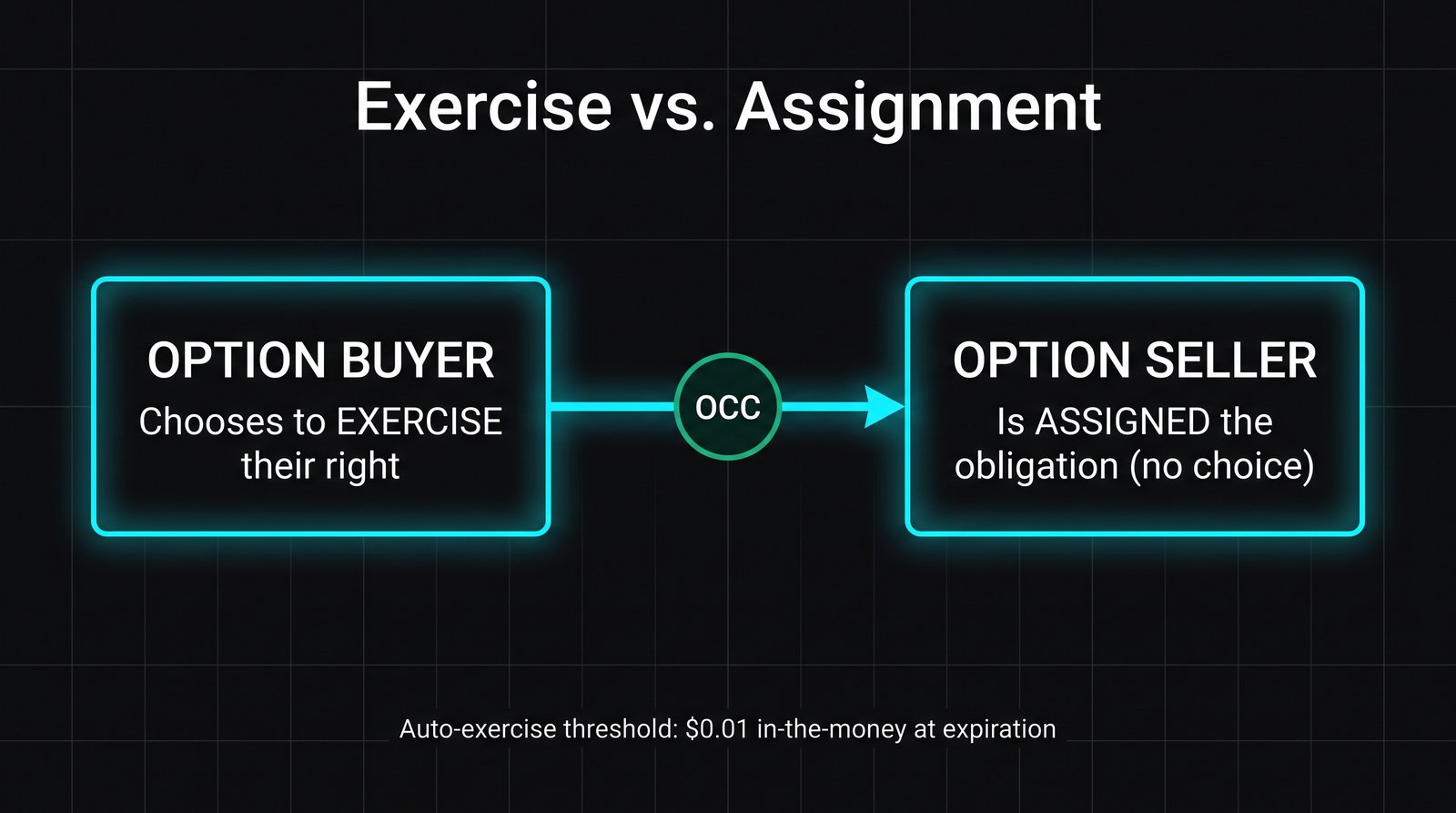
1. Exercise vs. Assignment
These two words describe the same event from opposite sides, and keeping them straight prevents confusion later.
• Exercise is an action the option buyer takes. They invoke their right to buy (call) or sell (put) the underlying shares.
• Assignment is what happens to the option seller. They are notified that they must fulfil the obligation.
You control exercise if you are long. You do not control assignment if you are short — it happens to you.
★ Core Fact: Assignment is randomly allocated. When a buyer exercises, the Options Clearing Corporation assigns the obligation to a broker, who then allocates it among short holders by lottery or a similar procedure. Being assigned is not personal and cannot be predicted with certainty.
2. Automatic Exercise at Expiration
Most traders never manually exercise anything, because the clearing system does it automatically.
Any option that finishes in-the-money by $0.01 or more at expiration is automatically exercised. This threshold is set by the OCC and applies unless you specifically instruct your broker otherwise.
Consequences of this rule:
• A long call finishing $0.02 ITM will exercise, and you will purchase 100 shares. If you do not have the cash, your broker will issue a margin call or liquidate on Monday.
• A short put finishing $0.03 ITM will be assigned, and you will buy 100 shares.
Worked example: You hold one long $50 call and forget about it. The stock closes Friday at $50.04. Monday morning you own 100 shares that cost $5,000 — on an account that may hold far less.
⚠️ Risk Warning: Never let long options you cannot afford to exercise expire in-the-money. Close them before the market closes on expiration day. This is one of the most common ways small accounts get into serious trouble.
 Click to enlarge
3. When Early Assignment Actually Happens
American-style options can be assigned any time, but in practice early assignment is uncommon and follows predictable patterns.
Early assignment is rare because exercising early forfeits any remaining extrinsic value. A buyer holding an ITM call with $0.80 of extrinsic value would destroy that $0.80 by exercising — selling the contract is better.
Early assignment becomes genuinely likely in two situations:
• Deep ITM with minimal extrinsic value. When extrinsic value approaches zero, there is nothing left to forfeit and exercise becomes rational.
• Dividends on short calls. If you are short a call on a dividend-paying stock and the remaining extrinsic value is less than the dividend, expect assignment the day before the ex-dividend date. The buyer exercises to capture the dividend.
★ Practical Guidance: If you are short calls on a dividend payer, check the ex-dividend date. If your short call is ITM and its extrinsic value is below the dividend amount as that date approaches, close or roll the position.
4. What Assignment Costs and Requires
Assignment is not a penalty. It is the contract working as designed. But it has concrete cash consequences.
Short put assigned: You buy 100 shares at the strike. Cash required = Strike × 100.
• Worked example: Short $95 put assigned. You pay $9,500 and receive 100 shares. If you sold the put for $2.00, your effective cost basis is $93.00 per share.
Short call assigned (covered): You deliver 100 shares you already own and receive Strike × 100 in cash. Straightforward.
Short call assigned (naked): You must buy 100 shares at market to deliver them at the strike. If the stock is far above the strike, this is where catastrophic losses occur.
★ Core Fact: For a cash-secured put, assignment consumes exactly the cash you already set aside. This is why the strategy is called cash-secured — the capital was never available for other uses in the first place.
5. Pin Risk and Expiration Friday
Pin risk is the uncertainty that arises when a stock closes almost exactly at your strike on expiration day.
If you are short a $50 call and the stock closes at exactly $50.00, you do not know whether you will be assigned. Some holders will exercise, some will not. You may find out Monday morning that you are unexpectedly short 100 shares.
The exposure is real: over the weekend you hold an unhedged stock position you did not plan for, and news can move the price before you can react.
★ Practical Guidance: The clean solution is to close any short option that is near the money before expiration Friday's close. Paying $0.05 to buy back a nearly worthless contract eliminates all weekend uncertainty. That is cheap insurance against an unplanned 100-share position.
This is another argument for the 21-day guideline from Lesson 2.1 — positions closed well before expiration never encounter pin risk at all.
6. Try It in Signal Desk
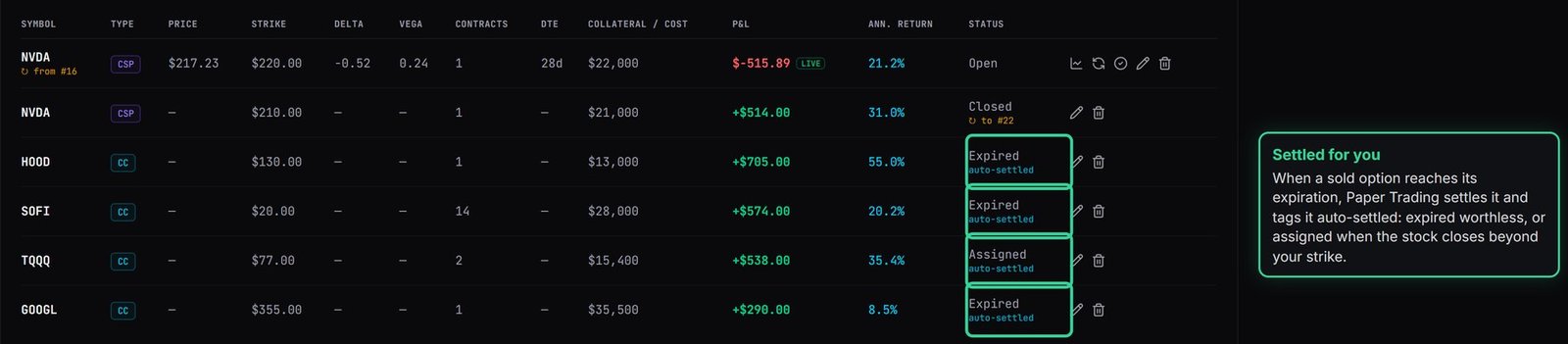
Open Paper Trading in Signal Desk and look at the Trade log. When an option you sold reaches its expiration, the paper account settles it for you and tags it as expired worthless, assigned or cash-settled, with the price the stock closed at. Find a settled trade, or enter a short-dated one and come back after it expires.
Read what happened to your cash and your shares. An assigned put turns into shares in the Holdings table at your strike, and an assigned call takes the shares away.
Finally, look at any short option you hold that is near the money with expiration approaching. If you find one, you now know why closing it early is usually the right call. Check your real broker's auto-exercise policy and its do-not-exercise deadline as well, since those rules belong to the broker.
See it in Signal Desk
Paper Trading settles expired options automatically and shows you the result (members see live quotes).
- 1
Open Paper Trading and find the Trade log. Each trade shows its status: open, closed, expired or assigned.
- 2
When an option expires, the account marks it "auto-settled" and says what happened: expired worthless, assigned, or cash-settled, with the stock's closing price.
- 3
An assigned short put buys the shares at the strike. They appear in your holdings with an average cost, and the cash that was set aside is used.
- 4
An assigned covered call sells your shares at the strike. You keep the premium and the shares leave your holdings.
- 5
Dividends and splits on shares you hold are applied to the paper account too, which is a good way to see what the stock does to a position.
Try it with your own numbers
Free calculators, no account needed.
KNOWLEDGE RECONNAISSANCE
What is the difference between exercise and assignment?
An option finishes $0.02 in-the-money at expiration. What happens by default?
Why is early assignment generally uncommon?
You are short a call on a dividend-paying stock. When is early assignment most likely?
What is pin risk?
You are short a $95 cash-secured put and are assigned. You originally collected $2.00 in premium. What is your effective cost basis per share?
More lessons in this module
- 3.0: Order Types and Getting Filled
- 3.2: Position Sizing & Buying Power
- 3.3: The Trade Journal — Reviewing Your Own Data
Signal Desk is where you practice this on real stocks: real option chains (about 15 minutes delayed), the Trade Check and a paper-trading account that risks no real money. Join to add it, your progress tracking and PDF downloads.