
A hands-on options curriculum covering real trading concepts. Read the lessons, work through examples, and test your knowledge.
OVERALL ACADEMY PROGRESS
Free Lesson
Every lesson is free to read. Subscribe to add Signal Desk, progress tracking, PDF downloads and the lesson tutor.
Key terms in this lesson
 Click to enlarge
Lesson 2: 1.1: Call Options — Buying and Selling Mechanics
Long and short calls with full dollar math, breakeven calculation, and an honest look at why most long calls expire worthless.
Words to Know in This Lesson
• Long call: You bought a call. You hold the right to buy shares.
• Short call: You sold a call. You collected a premium and took on the duty to sell shares if asked.
• Breakeven: The stock price where you neither make nor lose money.
• Leverage: Controlling a lot of stock with a small amount of money. It magnifies both gains and losses.
• Covered call: You sold a call and you own the 100 shares behind it.
• Naked call: You sold a call and you do not own the shares. This carries very large risk.
• Assigned: The buyer used their right, so you, the seller, must now do what the contract says.
1. The Long Call
Buying a call gives you the right to purchase 100 shares at the strike price, any time before expiration. You pay premium for this right.
The appeal is leverage with defined risk. Leverage means a small amount of money controls a much larger amount of stock. Controlling 100 shares of a $100 stock outright costs $10,000. A call option on those same shares might cost $400. If the stock rallies, your percentage return dwarfs what you would have earned on the shares. If it collapses, you lose the $400 and not a dollar more.
★ Payoff Profile: Maximum loss is the premium paid. Maximum gain is theoretically unlimited, since there is no ceiling on how high a stock can go.
2. Long Call — Full Worked Example
Stock XYZ trades at $100. You buy one $105 call expiring in 45 days for a premium of $2.50.
• Cash outlay: $2.50 × 100 = $250. This is your entire risk.
• Breakeven at expiration: Strike + Premium = $105 + $2.50 = $107.50
★ Critical Insight: The stock must rise above $107.50 — not $105 — for you to make money at expiration. Beginners routinely forget that the premium must be recovered before profit begins. The stock has to move 7.5% just to break even.
Now the outcomes at expiration:
• Stock at $98: Option expires worthless. Loss = $250 (100% of what you paid).
• Stock at $105: Option expires worthless. Loss = $250. Being exactly at the strike is not a win.
• Stock at $107.50: Option worth $2.50. You recover your premium. Profit = $0.
• Stock at $115: Option worth $10.00 ($1,000). Profit = $1,000 − $250 = $750, a 300% return on the premium.
• Stock at $130: Option worth $25.00 ($2,500). Profit = $2,250.
Compare that $115 scenario against simply owning the stock: 100 shares bought at $100 and sold at $115 returns $1,500 on $10,000 of capital, or 15%. The call returned $750 on $250, or 300%. That is leverage — and it cuts both ways.
 Click to enlarge
3. Why Most Long Calls Lose
This is the part most courses skip. Buying calls feels like the natural way to start, and it is where a large share of new options traders lose money consistently.
The reason is that a long call requires you to be right about three things simultaneously:
• Direction — the stock must go up.
• Magnitude — it must go up by more than the premium you paid.
• Timing — it must do so before expiration.
Being right on direction alone is not enough. A stock that rises 4% over your 45-day holding period when you needed 7.5% still hands you a total loss. Meanwhile, time decay (the option losing value as the days pass) works against you every single day you hold.
⚠️ Risk Warning: A long call can lose 100% of its value while the underlying stock finishes higher than where you bought it. This is normal, not a malfunction. If you cannot accept frequent total losses on individual positions, long calls are the wrong instrument.
4. The Short Call — Covered vs. Naked
Selling a call means collecting premium and accepting the obligation to deliver 100 shares at the strike if assigned. There are two very different versions of this trade.
Covered call: You already own 100 shares. If assigned, you simply deliver the shares you hold. Your risk is that you miss upside above the strike — an opportunity cost, not a catastrophic one. This is a conservative, widely used income strategy and we devote Lesson 4.1 to it.
Naked call: You sell the call without owning the shares. If assigned, you must buy the stock at market price to deliver it. Because a stock's price has no upper limit, your potential loss has no upper limit either.
⚠️ Risk Warning: A naked short call carries theoretically unlimited loss. If you sell a $105 call for $2.50 and the company is acquired overnight at $180, you are obligated to deliver shares you must buy at $180 for $105. That is a loss of $7,500 per contract against $250 collected.
5. Naked Calls and Broker Approval
Because of that unlimited risk, brokers place naked call selling at the highest options approval tier — typically Level 4, sometimes called Tier 3 or "advanced" depending on the firm.
Getting approved generally requires a margin account (an account where the broker lends you money), a substantial account balance, and a stated history of options experience. Requirements vary meaningfully between brokers.
This is not a rule that only institutions can sell naked calls — approved retail traders can and do. But the approval gate exists for a genuine reason, and the strategy sits well outside the scope of what this course recommends.
★ Practical Guidance: For essentially every trader reading this, if you want short call exposure, own the shares first. The covered call gives you the same premium income with a defined, survivable risk profile.
6. Try It in Signal Desk
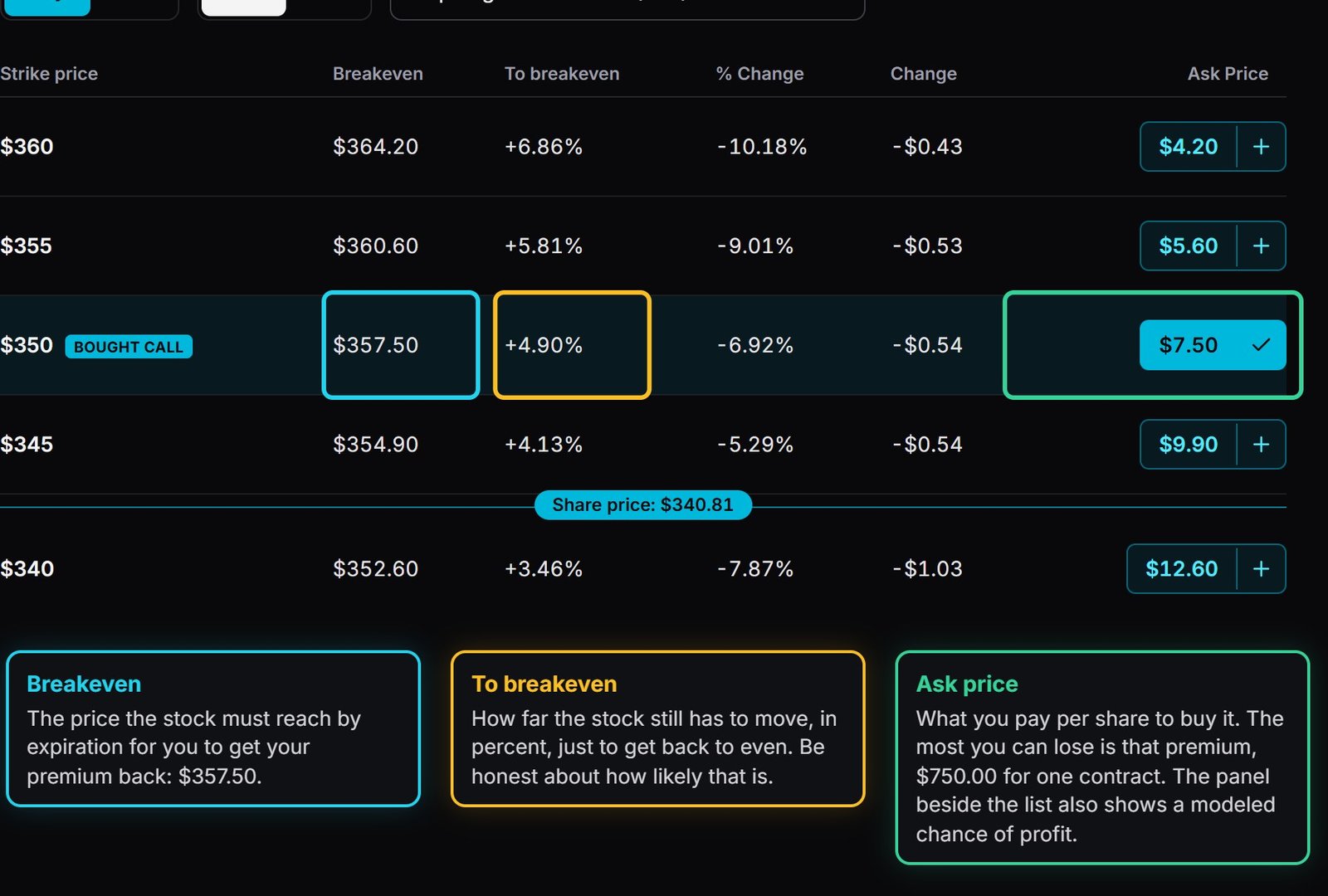
Pick a stock you follow and open its Easy Chain in Signal Desk. Choose Buy and Call, pick an expiration about 45 days out, and find the strike roughly 5% above the current price.
Write down three numbers from the screen: the premium, the total cost for one contract (premium times 100), and the breakeven. Then read the "To breakeven" column, which shows how far the stock has to rise just to get back to even.
Ask yourself honestly how likely that move is in the next 45 days. Do this for five different stocks before you ever buy a call with real money. Most traders discover the required move is larger than their instinct suggested.
See it in Signal Desk
The Easy Chain builds a long call step by step and shows its breakeven and chance of profit (members see live quotes).
- 1
Open Options, switch to the Easy Chain, type a ticker and press Load.
- 2
Choose Buy, then Call, then an expiration about 45 days out. The list shows each strike with its breakeven, the move needed to reach it, and a modeled chance of profit.
- 3
Tap a strike and press the plus button to add it to your trade. The side panel shows the total cost, the maximum loss (the premium paid) and a profit-and-loss picture at expiration.
- 4
Compare a strike near the price with one far above it. The cheaper contract needs a much bigger move to break even.
- 5
When you are ready to practice, send the trade to Paper Trading. No real money moves.
Try it with your own numbers
Free calculators, no account needed.
P&L Profile Curve at Expiration
Dissect the interactive Profit/Loss profile simulator. Slide parameters for Strike, Implied Volatility (IV), and stock price to visualize contract behavior at expiration.
Simulation Inputs
KNOWLEDGE RECONNAISSANCE
You buy a $50 call for a premium of $1.75. What is your breakeven price at expiration?
What is the maximum possible loss on a long call position?
You buy a $105 call for $2.50 when the stock is at $100. At expiration the stock is $106. What is your result?
Why is a naked short call considered to have unlimited risk?
What are the three things a long call buyer must get right simultaneously?
What is the key structural difference between a covered call and a naked call?
More lessons in this module
- 1.0: Introduction to Options & Contract Specifications
- 1.2: Put Options — Buying and Selling Mechanics
- 1.3: Option Moneyness & Value Structure
- 1.4: Option Pricing — Intrinsic vs. Extrinsic Value
- 1.5: Reading an Option Chain
- 1.6: Choosing the Stock — Fundamentals and Technicals
Signal Desk is where you practice this on real stocks: real option chains (about 15 minutes delayed), the Trade Check and a paper-trading account that risks no real money. Join to add it, your progress tracking and PDF downloads.