A hands-on options curriculum covering real trading concepts. Read the lessons, work through examples, and test your knowledge.
OVERALL ACADEMY PROGRESS
Free Lesson
Every lesson is free to read. Subscribe to add Signal Desk, progress tracking, PDF downloads and the lesson tutor.
Key terms in this lesson
 Click to enlarge
Lesson 1: 1.0: Introduction to Options & Contract Specifications
What an option contract actually is, the five terms that define every contract, and the multiplier that trips up most beginners.
Words to Know in This Lesson
• Option: A contract that gives you the right, but not the duty, to buy or sell a stock at a set price before a set date.
• Call and put: A call is an option to buy. A put is an option to sell.
• Underlying: The stock (or fund) the option is based on.
• Strike price: The set price written in the contract.
• Expiration date: The day the contract ends.
• Premium: The price of the option. You pay it when you buy an option and you receive it when you sell one.
• Contract: One option contract covers 100 shares.
• Buyer and seller: The buyer holds the right. The seller (also called the writer) takes on the duty.
1. Why Options Exist
Think of a deposit on a house. You pay $2,000 today to lock in a price of $300,000 for the next 30 days. If the house turns out to be a bargain, you buy it at the locked price. If not, you walk away and lose only the deposit. An option works the same way, except it is about shares of a stock instead of a house.
Before defining anything, it helps to understand the problem options solve. If you own 100 shares of a stock and you are worried about a drop over the next month, you have two choices without options: sell the shares, or accept the risk. Options give you a third choice — pay a fee, called the premium, to transfer that risk to someone else for a fixed period.
That is all an option is: a contract that transfers a specific risk from one party to another for a fee, with an expiration date attached.
Everything else in this course — the Greeks (numbers that show how an option reacts), spreads (two options traded together) and the Wheel (a repeating income strategy) — is built on that single idea. Each one gets its own lesson, so you do not need to know them yet. Someone wants to shed a risk, someone else is willing to carry it for a price, and the option is the contract between them.
★ Core Fact: Options are a zero-sum transfer between buyer and seller before costs. Every dollar the buyer gains, the seller loses, and vice versa. There is no third party creating value.
2. The Contract Definition
An option is a contract that grants the buyer the right, but not the obligation, to buy or sell an underlying asset at a set price on or before a specified date.
The seller (also called the writer) has no choice in the matter. If the buyer chooses to exercise, the seller must fulfill the contract. This asymmetry is the heart of options: the buyer holds a right, the seller holds an obligation, and the premium is the price paid for that imbalance.
★ Core Fact: Options are wasting assets. Every day that passes, an option loses a little value purely because there is less time left for it to work. A stock can sit at the same price for a year and still be worth the same. An option cannot.
3. The Five Standardized Terms
Every listed equity option is defined by exactly five parameters. When a trader says "I bought the AAPL 190 call expiring March 21st for $4.20," they have specified all five:
• Underlying Asset: The stock or ETF the contract is based on. (AAPL)
• Option Type: Call (right to buy) or Put (right to sell). (Call)
• Strike Price: The pre-agreed price at which the asset changes hands if exercised. ($190)
• Expiration Date: The last day the contract is valid. (March 21st)
• Premium: The market price paid to acquire the contract. ($4.20)
Only the premium floats. The other four are fixed by the exchange when the contract is listed, which is why options can be traded in a liquid market at all — everyone is trading identical, standardized instruments.
4. The Multiplier — Where Beginners Lose Money
One standard equity option contract controls 100 shares. This is the single most common source of costly beginner mistakes.
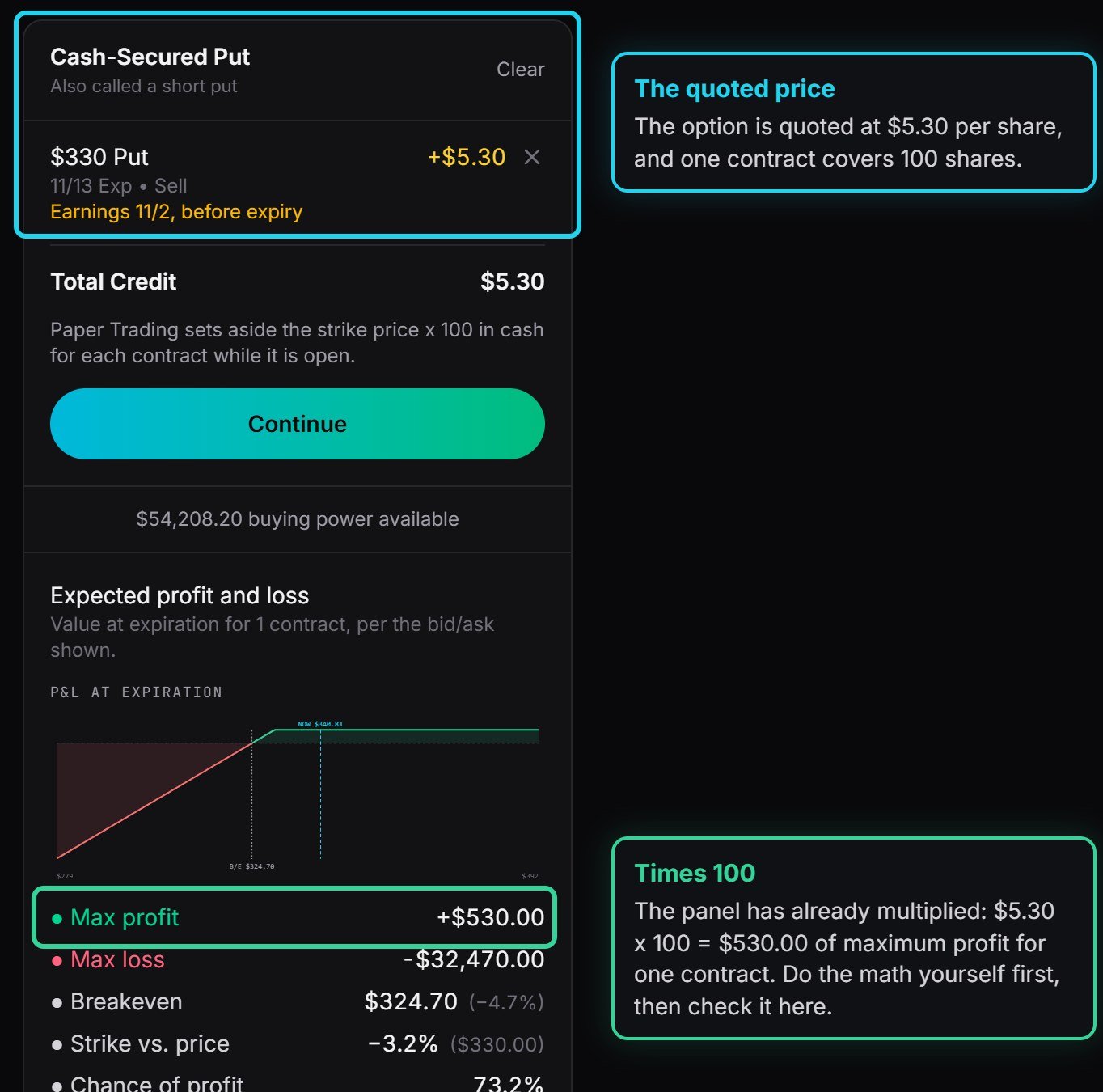
When an option is quoted at $4.20, that is the per-share price. The actual cash cost of the contract is $4.20 × 100 = $420.
Worked example: You want to buy 5 contracts of a call quoted at $2.35.
• Per-share price: $2.35
• Cost per contract: $2.35 × 100 = $235
• Total for 5 contracts: $235 × 5 = $1,175
A trader who reads "$2.35" and thinks they are risking about $12 on five contracts is off by a factor of 100. They are risking $1,175.
⚠️ Risk Warning: Always compute your total dollar exposure before submitting an order. Multiply the quoted premium by 100, then by the number of contracts. Do this every single time until it is automatic.
 Click to enlarge
5. American vs. European Style
Listed options come in two exercise styles, and the difference matters for anyone selling options.
• American style: Can be exercised by the buyer at any time up to expiration. Essentially all individual stock and ETF options in the US are American style.
• European style: Can only be exercised at expiration. Most index options (SPX, NDX, VIX) are European style. They are cash-settled, which means they pay out in cash and no shares change hands.
For an option buyer this rarely matters, because selling the contract in the open market is almost always better than exercising early. For a seller it matters a great deal — with American-style options you can be assigned at any moment, including in ways that are inconvenient. We cover this fully in Lesson 3.1.
★ Core Fact: If you trade single-stock options, assume you can be assigned early at any time. If you trade SPX, you cannot.
6. Try It in Signal Desk
Open the Options page in Signal Desk and load a chain for any stock you follow. Do not place a trade. Find all five contract terms on the screen: the underlying, the call and put sides, the strikes down the middle, the expiration buttons, and the bid and ask quotes.
Then switch to the Easy Chain, pick Buy and Call, and tap a strike. The panel shows the premium per share and the total cost of one contract, with the 100 multiplier already applied: a $5.30 premium becomes a $530 cost. Do the same multiplication yourself first, then check it against the panel.
That habit, translating a quoted premium into real dollars before doing anything else, is the foundation of every risk decision you will make in this course.
See it in Signal Desk
Every term from this lesson is on the Options page, with the multiplier done for you (members see live quotes).
- 1
Open Options, type a ticker and press Load chain. The ticker is the underlying.
- 2
The buttons across the top are the expirations. Calls sit on the left, puts on the right, and the strike prices run down the middle.
- 3
Each row shows the bid and the ask, which is the premium you can sell or buy for. Only these quotes move during the day; the strike and expiration of a contract never change.
- 4
Switch to the Easy Chain, choose Buy and Call, and tap a strike. The side panel shows the total cost and the maximum loss for one contract, which is the quoted premium times 100.
- 5
Notice the earnings tag on any expiration that includes the company's next report. It is a reminder that the contract can be worth far more or less after the news.
Try it with your own numbers
Free calculators, no account needed.
Options Structure Exploration
Options are contracts cleared in the bid-ask auction market. Interact with the Order Book below to understand how buy offers (bids) and sell offers (asks) intersect, and inspect the structural breakdown between Call and Put contracts.
Limit Order Book & Spread Interface
Hover over ASK or BID to dissect the auction market dynamics.
Right to Buy
- Outlook: Bullish (Goes up)
- Risk: Capped to premium paid
- Profit: Scales as stock surges
Right to Sell
- Outlook: Bearish (Goes down)
- Risk: Capped to premium paid
- Profit: Scales as stock falls
KNOWLEDGE RECONNAISSANCE
What is the fundamental asymmetry between an option buyer and an option seller?
An option is quoted at $3.15. What is the actual cash cost of purchasing 3 contracts?
Which of the five contract terms is the only one that changes continuously in the market?
Why are options described as 'wasting assets'?
You sold a call option on a single US stock. When can you be assigned?
Which of these contracts is European style, meaning it can only be exercised at expiration?
More lessons in this module
- 1.1: Call Options — Buying and Selling Mechanics
- 1.2: Put Options — Buying and Selling Mechanics
- 1.3: Option Moneyness & Value Structure
- 1.4: Option Pricing — Intrinsic vs. Extrinsic Value
- 1.5: Reading an Option Chain
- 1.6: Choosing the Stock — Fundamentals and Technicals
Signal Desk is where you practice this on real stocks: real option chains (about 15 minutes delayed), the Trade Check and a paper-trading account that risks no real money. Join to add it, your progress tracking and PDF downloads.