
A hands-on options curriculum covering real trading concepts. Read the lessons, work through examples, and test your knowledge.
OVERALL ACADEMY PROGRESS
Free Lesson
Every lesson is free to read. Subscribe to add Signal Desk, progress tracking, PDF downloads and the lesson tutor.
Key terms in this lesson
 Click to enlarge
Lesson 3: 1.2: Put Options — Buying and Selling Mechanics
Long puts as insurance and short puts as income, with the assignment math that determines whether selling puts is safe or reckless.
Words to Know in This Lesson
• Long put: You bought a put. You hold the right to sell shares.
• Short put: You sold a put. You collected a premium and took on the duty to buy shares if asked.
• Protective put: A put you buy to insure shares you already own.
• Cash-secured put: A put you sold while keeping enough cash on hand to buy the shares if asked.
• Assigned: The buyer used their right, so you, the seller, must now do what the contract says.
• Cost basis: What you really paid per share, after counting any premium you collected.
• Gain or loss on paper (unrealized): A change in value you have not locked in, because you have not sold yet.
• Annualized: A short-term return stretched out to a full year, so trades of different lengths can be compared.
1. The Long Put
Buying a put gives you the right to sell 100 shares at the strike price. It gains value as the stock falls.
There are two distinct reasons to buy a put, and confusing them causes poor decisions:
• Speculation: You believe the stock will decline and want leveraged exposure to that view.
• Insurance (a protective put): You own the stock and want to cap your downside for a defined period.
The mechanics are identical. The intent, position sizing, and definition of success are completely different. A speculator wants the put to gain value. A hedger hopes it expires worthless, because that means their shares went up.
★ Core Fact: A protective put is the closest thing in markets to an insurance policy. You pay a premium, you hope you never need it, and the cost is the price of sleeping well.
2. Long Put — Worked Example
Stock XYZ trades at $100. You buy one $95 put expiring in 45 days for $2.00.
• Cash outlay: $2.00 × 100 = $200
• Breakeven at expiration: Strike − Premium = $95 − $2.00 = $93.00
Outcomes at expiration:
• Stock at $102: Expires worthless. Loss = $200.
• Stock at $95: Expires worthless. Loss = $200.
• Stock at $93: Put worth $2.00. You recover premium. Profit = $0.
• Stock at $85: Put worth $10.00 ($1,000). Profit = $800.
• Stock at $70: Put worth $25.00 ($2,500). Profit = $2,300.
Note the asymmetry versus a call: a put's maximum value is capped, because a stock can only fall to zero. If XYZ went to $0, the $95 put would be worth $9,500 — large, but finite.
 Click to enlarge
3. The Protective Put in Practice
Suppose you own 100 shares of XYZ bought at $80, now trading at $100. You have a $2,000 gain on paper (not locked in until you sell) and earnings are in three weeks. You do not want to sell — but you also do not want to give back the gain.
You buy the $95 put for $2.00 ($200 total).
• If the stock crashes to $70: Your shares lose $3,000 of value, but your put is worth $2,500. Net damage is roughly $700 (the $500 gap between $100 and $95, plus the $200 premium) instead of $3,000.
• If the stock rallies to $115: The put expires worthless. You are out $200, and your shares gained $1,500. The insurance cost you 13% of your gain and you would buy it again.
★ Framing: Judge a protective put the way you judge car insurance. The premium is not a loss when you do not crash. It is the price of a bounded outcome.
4. The Short Put — Getting Paid to Set a Buy Limit
Selling a put means collecting premium and accepting the obligation to buy 100 shares at the strike if assigned.
Framed correctly, this is one of the most sensible strategies available to a patient investor. You are being paid to place a limit order on a stock you already wanted to own at a price you already considered attractive.
Worked example: XYZ trades at $100. You would happily own it at $95. You sell the $95 put for $2.00, collecting $200.
• Capital required (cash-secured): $95 × 100 = $9,500 must be set aside.
• If the stock stays above $95: The put expires worthless. You keep $200 on $9,500 committed for 45 days — roughly 2.1% for the period, or about 17% a year if you could repeat it every time.
• If the stock falls to $92: You are assigned and buy 100 shares at $95. But your effective cost basis (what you really paid per share) is $95 − $2.00 = $93.00. You own a stock you wanted, roughly $1 above where it is trading.
★ Core Fact: Assignment on a cash-secured put is not a failure. It is one of the two designed outcomes. You either keep the premium or you buy a stock you wanted at a discount to where you sold the put.
5. When Selling Puts Goes Wrong
The strategy above only works under two conditions, and violating either turns it dangerous.
Condition one — you must genuinely want the stock. If you sell puts purely to harvest premium on a company you would never own, assignment leaves you holding something you have no thesis for and no plan to manage.
Condition two — you must actually have the cash. A cash-secured put means the full assignment cost sits in your account. Selling puts on margin without that cash is how small accounts get destroyed.
The genuine risk case: XYZ does not drift to $92. It gaps to $60 on a fraud investigation. You are assigned at $95 on a stock now worth $60, holding a $3,500 loss on paper against the $200 you collected.
⚠️ Risk Warning: Selling a put has a payoff profile similar to owning 100 shares, but your upside is capped at the premium. You take on most of the downside of stock ownership in exchange for a limited, fixed payment. Size positions accordingly.
6. Try It in Signal Desk
Identify one stock you would genuinely be happy to own 100 shares of, at a price below where it trades today. Write down that price. This is the discipline that makes short puts work.
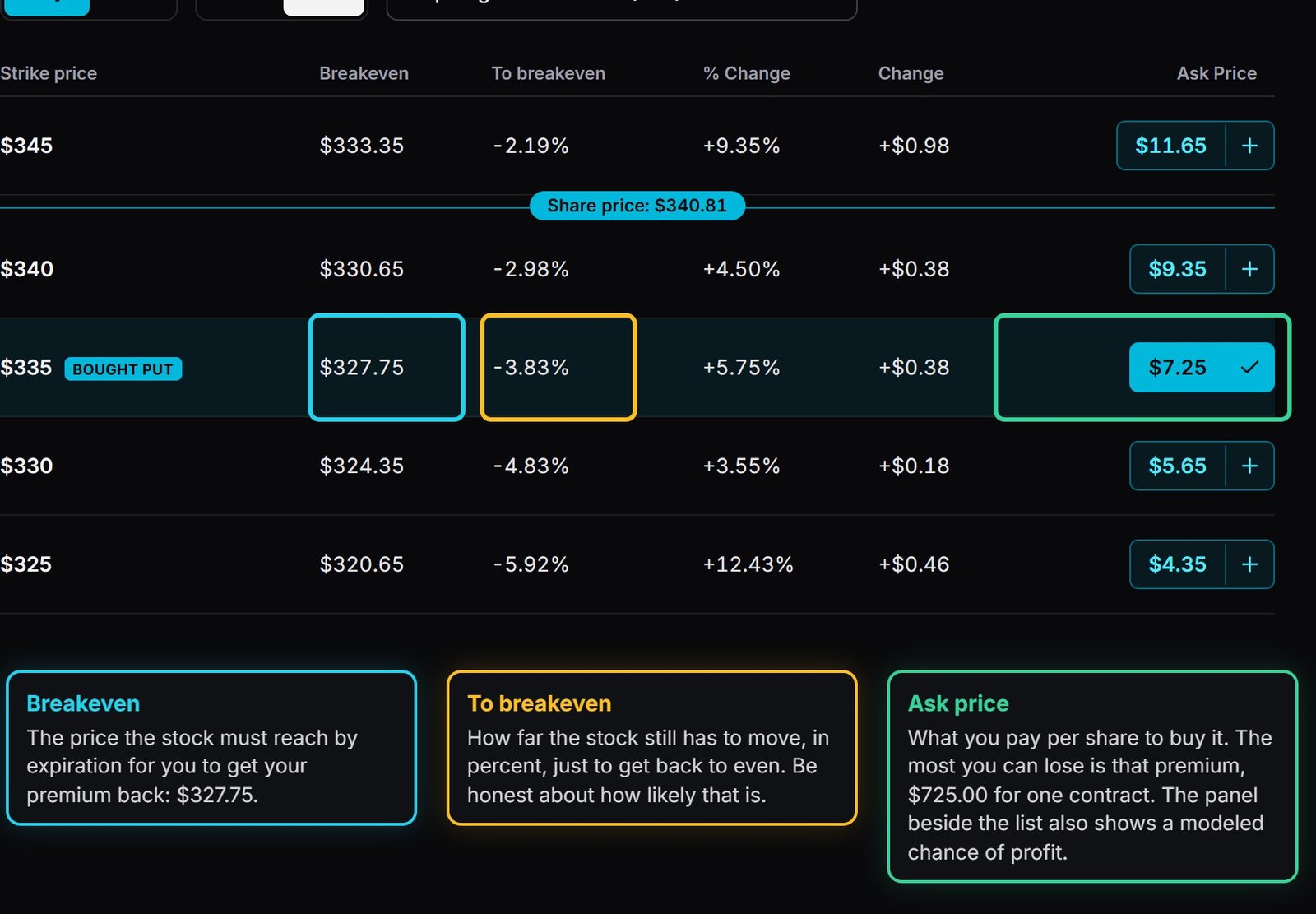
Now open the Easy Chain in Signal Desk, choose Sell and Put, pick an expiration 30 to 45 days out and find the put near that strike. Note the premium, then compute two things: the capital required (strike times 100) and your effective cost basis if assigned (strike minus premium). The side panel shows both the maximum profit and the breakeven, so check your arithmetic against it.
Ask yourself: if I woke up tomorrow owning 100 shares at that cost basis, would I be content? If the answer is anything other than a clear yes, you have found a trade you should not place.
See it in Signal Desk
A short put is a Sell and Put in the Easy Chain, and the panel does the capital and breakeven math (members see live quotes).
- 1
Open Options, switch to the Easy Chain, load a ticker and choose Sell and Put.
- 2
Pick an expiration 30 to 45 days out. Each strike lists its breakeven and a modeled chance of profit; strikes further below the price pay less but are less likely to be reached.
- 3
Tap the strike where you would be glad to buy the stock and press the plus button. The panel shows the credit, the maximum profit (the premium), the maximum loss and the breakeven, which is the strike minus the premium.
- 4
Notice that Paper Trading sets aside the strike price times 100 in cash for each contract while the trade is open. That is the capital the lesson means.
- 5
To see the other side of the lesson, switch to Buy and Put and compare what a protective or speculative put costs for the same strike.
Try it with your own numbers
Free calculators, no account needed.
P&L Profile Curve at Expiration
Dissect the interactive Profit/Loss profile simulator. Slide parameters for Strike, Implied Volatility (IV), and stock price to visualize contract behavior at expiration.
Simulation Inputs
KNOWLEDGE RECONNAISSANCE
You buy a $95 put for $2.00. What is your breakeven at expiration?
You sell a cash-secured $95 put and collect $2.00 in premium. If assigned, what is your effective cost basis per share?
How much cash must be set aside to sell one cash-secured $95 put?
Why is a long put's maximum profit capped, unlike a long call's?
You own 100 shares and buy a protective put. The stock rallies and the put expires worthless. How should you evaluate this?
What is the primary danger of selling puts on a stock you do not actually want to own?
More lessons in this module
- 1.0: Introduction to Options & Contract Specifications
- 1.1: Call Options — Buying and Selling Mechanics
- 1.3: Option Moneyness & Value Structure
- 1.4: Option Pricing — Intrinsic vs. Extrinsic Value
- 1.5: Reading an Option Chain
- 1.6: Choosing the Stock — Fundamentals and Technicals
Signal Desk is where you practice this on real stocks: real option chains (about 15 minutes delayed), the Trade Check and a paper-trading account that risks no real money. Join to add it, your progress tracking and PDF downloads.