
A hands-on options curriculum covering real trading concepts. Read the lessons, work through examples, and test your knowledge.
OVERALL ACADEMY PROGRESS
Free Lesson
Every lesson is free to read. Subscribe to add Signal Desk, progress tracking, PDF downloads and the lesson tutor.
Key terms in this lesson
 Click to enlarge
Lesson 4: 1.3: Option Moneyness & Value Structure
ITM, ATM, and OTM defined precisely, why the same strike is simultaneously all three depending on type, and what moneyness implies about probability.
Words to Know in This Lesson
• Moneyness: How the stock price compares with the strike price.
• In the money (ITM): Using the option right now would give you value.
• At the money (ATM): The stock price is at, or very close to, the strike.
• Out of the money (OTM): Using the option right now would give you nothing.
• Delta: A number showing how much an option moves when the stock moves $1. It is also a rough guess at the chance the option ends in the money. Lesson 2.0 covers it fully.
• Breakeven: The stock price where you neither make nor lose money.
1. What Moneyness Describes
Moneyness is the relationship between the current stock price and the option's strike price. It answers one question: if this option were exercised right now, would it produce value?
• In-the-Money (ITM): Exercising now would produce positive value.
• At-the-Money (ATM): Stock price equals (or is very near) the strike.
• Out-of-the-Money (OTM): Exercising now would produce nothing. The option's entire value is time and volatility.
★ Core Fact: Moneyness is a snapshot, not a prediction. An OTM option is not a bad option — it is simply one whose value rests entirely on what happens between now and expiration.
2. The Rules Are Mirrored for Calls and Puts
Calls and puts grant opposite rights, so their moneyness conditions are exact mirrors:
• Call is ITM when: Stock > Strike (you can buy below market)
• Call is OTM when: Stock < Strike
• Put is ITM when: Stock < Strike (you can sell above market)
• Put is OTM when: Stock > Strike
Concrete illustration — stock trades at $100:
• $90 call: ITM (buy at $90, worth $100)
• $110 call: OTM (why buy at $110 what costs $100?)
• $90 put: OTM (why sell at $90 what fetches $100?)
• $110 put: ITM (sell at $110 something worth $100)
★ Memory Aid: The same $90 strike is in-the-money for a call and out-of-the-money for a put, simultaneously. Moneyness is a property of the contract, not of the strike.
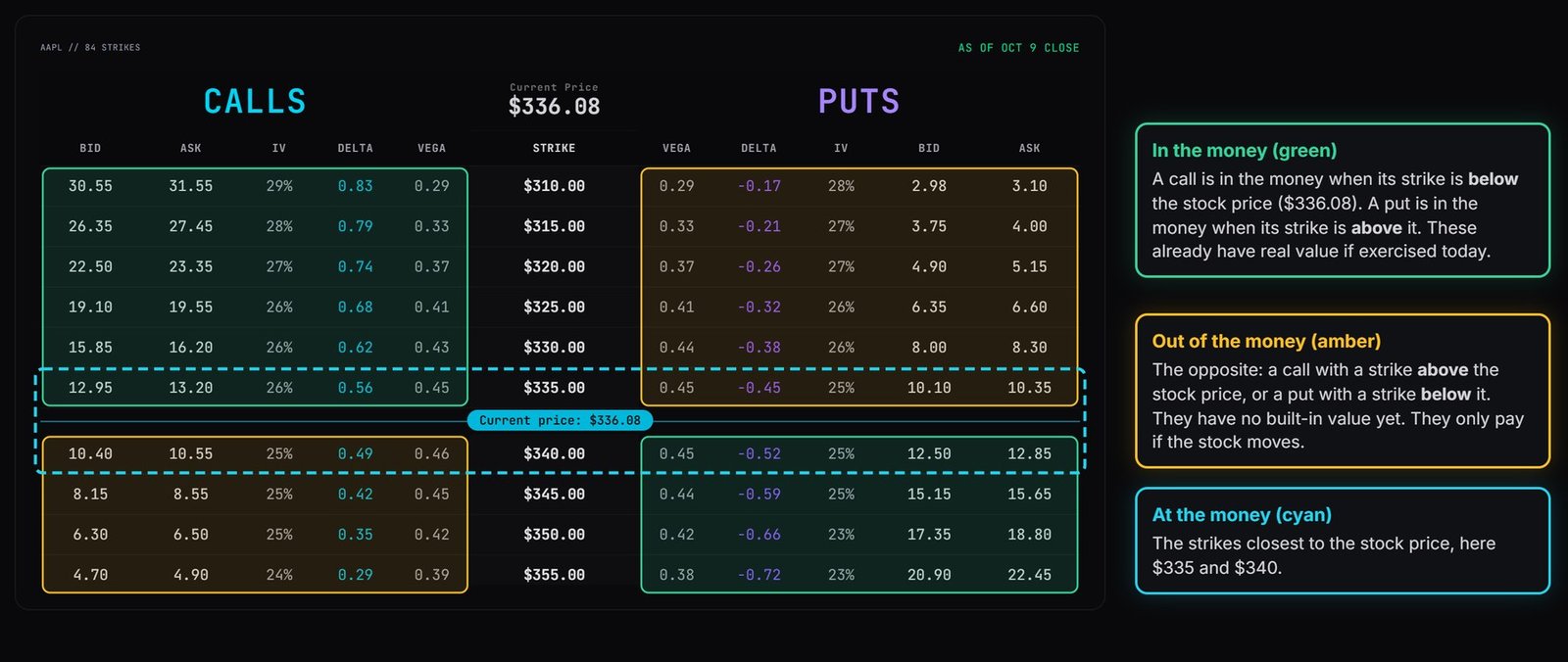 Click to enlarge
3. Moneyness and the Cost of a Contract
Moneyness drives price, and understanding why prevents the classic mistake of assuming cheap options are good value.
Stock at $100, 45 days to expiration. Approximate call premiums:
• $85 call (deep ITM): ~$15.60 — mostly real, exercisable value
• $95 call (ITM): ~$7.30
• $100 call (ATM): ~$3.50
• $105 call (OTM): ~$1.50
• $115 call (far OTM): ~$0.30 — almost pure hope
The $115 call looks like a bargain at $30 per contract. But it needs a 15% move in 45 days just to reach the strike, and 15.3% to break even. Cheap options are cheap because they are unlikely to pay.
⚠️ Risk Warning: Buying far-OTM options because they are affordable is one of the most reliable ways to lose money in options. The low price is the market's assessment of the odds, not a discount.
4. Moneyness as a Rough Probability Signal
There is a useful approximation used constantly by working traders: an option's delta roughly estimates the probability it finishes in-the-money.
• A 0.50 delta ATM option: roughly a 50% chance of finishing ITM — essentially a coin flip.
• A 0.30 delta OTM option: roughly a 30% chance.
• A 0.16 delta far-OTM option: roughly a 16% chance.
This is why premium sellers frequently target the 0.16 to 0.30 delta range. Selling a 0.20 delta put means the market implies roughly an 80% chance it expires worthless and you keep the premium.
We cover delta properly in Lesson 2.0. For now the takeaway is that moneyness and probability are directly linked, and the option chain is quietly telling you the odds on every line.
★ Core Fact: Delta is an approximation of ITM probability, not an exact figure. It ignores dividends and assumes a particular pricing model, but it is close enough to guide real decisions.
5. How Moneyness Changes as Expiration Nears
Moneyness is not static. Two forces act on it as time passes.
The stock moves, which changes moneyness directly. And separately, the value of being OTM erodes. An OTM option with 60 days left has real value because much can happen. The same option with two days left has almost none, because very little can.
This is why an option can be OTM for weeks and then, in the final days, collapse toward zero even though the stock has barely moved. Nothing changed about direction — the time available to be rescued ran out.
★ Practical Consequence: If you buy OTM options, you are racing a clock that accelerates. Lesson 2.1 on theta explains exactly how that acceleration works.
6. Try It in Signal Desk
Open the Options page in Signal Desk and load a chain for a stock trading near a round number. Find the line that marks the current stock price between two strikes and note which strikes sit above it and which below. Confirm that the same strike is in the money for a call and out of the money for a put, and the other way around.
Then read the premiums from deep in the money down to far out of the money and watch the price decay. Pick the cheapest contract on the board and calculate the percentage move the stock needs to reach breakeven.
That number is usually startling, and it is the most useful thing a new options trader can internalize early.
See it in Signal Desk
The Live Chain draws the current price between the strikes, so moneyness is visible at a glance (members see live quotes).
- 1
Open Options, type a ticker and press Load chain, then pick an expiration about 45 days out.
- 2
Find the line labeled with the current price. Strikes below it are in the money for calls and out of the money for puts; strikes above it are the reverse.
- 3
Read the delta column from the top of the chain to the bottom. Calls near the price sit around 0.50, and the number shrinks as you move out of the money, a rough probability signal.
- 4
Click a deep in-the-money call and a far out-of-the-money call and compare their premiums and breakevens in the trade panel.
- 5
Switch to a closer expiration and watch the at-the-money strikes get cheaper while the in-the-money ones barely change.
Try it with your own numbers
Free calculators, no account needed.
KNOWLEDGE RECONNAISSANCE
Stock XYZ trades at $105. What is the moneyness of the $100 call?
Stock XYZ trades at $105. What is the moneyness of the $100 put?
What is an Out-of-the-Money option's value composed of?
A far-OTM call trades for just $0.25. Why should this low price be treated with caution?
An option has a delta of 0.30. Roughly what does this imply?
An OTM option loses significant value in its final days even though the stock has not moved. Why?
More lessons in this module
- 1.0: Introduction to Options & Contract Specifications
- 1.1: Call Options — Buying and Selling Mechanics
- 1.2: Put Options — Buying and Selling Mechanics
- 1.4: Option Pricing — Intrinsic vs. Extrinsic Value
- 1.5: Reading an Option Chain
- 1.6: Choosing the Stock — Fundamentals and Technicals
Signal Desk is where you practice this on real stocks: real option chains (about 15 minutes delayed), the Trade Check and a paper-trading account that risks no real money. Join to add it, your progress tracking and PDF downloads.