
A hands-on options curriculum covering real trading concepts. Read the lessons, work through examples, and test your knowledge.
OVERALL ACADEMY PROGRESS
Free Lesson
Every lesson is free to read. Subscribe to add Signal Desk, progress tracking, PDF downloads and the lesson tutor.
Key terms in this lesson
 Click to enlarge
Lesson 5: 1.4: Option Pricing — Intrinsic vs. Extrinsic Value
Decompose any option premium into its two components, calculate both from a live quote, and understand what you are really paying for.
Words to Know in This Lesson
• Intrinsic value: The part of the premium that is real, usable value right now.
• Extrinsic value (time value): The rest of the premium. It pays for the chance that the option gains value before it ends, and it shrinks to zero at expiration.
• Mid price (midpoint): The halfway point between the bid and the ask.
• Implied volatility: How big a move the market expects. Bigger expected moves make options cost more. Lesson 2.2 covers it.
• Theta (time decay): The value an option loses each day as time passes. Lesson 2.1 covers it.
1. Every Premium Splits in Two
Any option premium, no matter how complex the underlying situation, decomposes into exactly two parts:
★ Premium = Intrinsic Value + Extrinsic Value
Intrinsic value is what the option is worth if exercised immediately. It is concrete and cannot be negative.
Extrinsic value — commonly called time value — is everything else. It is what buyers pay for the possibility that the option becomes more valuable before expiring.
Being able to split a quote into these two numbers instantly is the most practically useful skill in this module. It tells you what you are actually buying.
2. Calculating Intrinsic Value
The formulas are simple and worth memorizing:
★ Call Intrinsic Value = Max(0, Stock Price − Strike Price)
★ Put Intrinsic Value = Max(0, Strike Price − Stock Price)
The Max(0, …) just means "take the result, but never go below zero." It matters because intrinsic value is never negative. An option that would be worthless to exercise simply has zero intrinsic value.
Worked examples with the stock at $103:
• $100 call: Max(0, $103 − $100) = $3.00 intrinsic
• $105 call: Max(0, $103 − $105) = $0 intrinsic (negative result floors at zero)
• $110 put: Max(0, $110 − $103) = $7.00 intrinsic
• $95 put: Max(0, $95 − $103) = $0 intrinsic
3. Extracting Extrinsic Value from a Real Quote
Extrinsic value is found by subtraction: whatever the option costs beyond its intrinsic value.
★ Extrinsic Value = Premium − Intrinsic Value
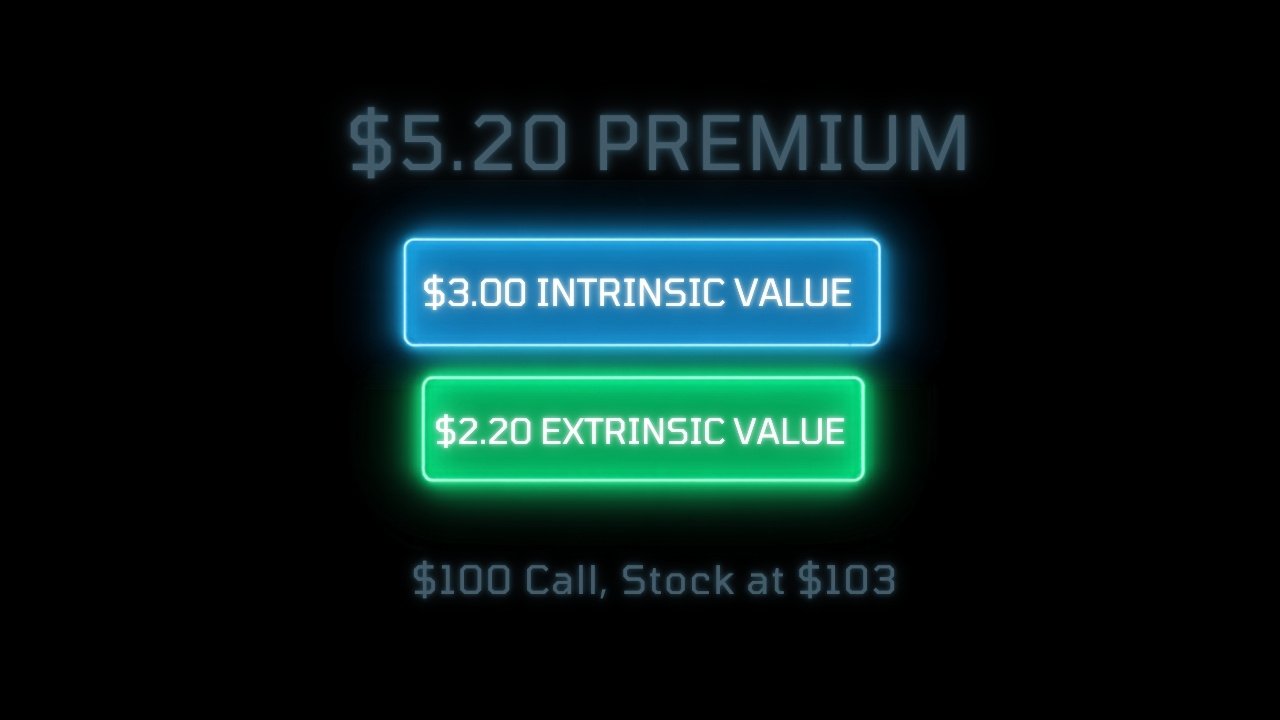
Worked example: Stock at $103. The $100 call is quoted at $5.20.
• Intrinsic: $103 − $100 = $3.00
• Extrinsic: $5.20 − $3.00 = $2.20
You are paying $3.00 for value that exists right now, and $2.20 for the chance the stock keeps climbing. That $2.20 is the portion that decays to zero by expiration.
Second example: Stock at $47. The $50 put is quoted at $4.50.
• Intrinsic: $50 − $47 = $3.00
• Extrinsic: $4.50 − $3.00 = $1.50
★ Critical Insight: Extrinsic value always decays to exactly zero at expiration. At expiry, an option is worth its intrinsic value and nothing more. Every dollar of extrinsic value you pay is a dollar that must be earned back through stock movement.
 Click to enlarge
4. Where Extrinsic Value Concentrates
Extrinsic value is not distributed evenly across the option chain. It peaks at-the-money and declines in both directions.
Stock at $100, 45 days out — approximate extrinsic values:
• $85 call: ~$0.60 extrinsic (deep ITM, almost pure intrinsic)
• $95 call: ~$2.30 extrinsic
• $100 call: ~$3.50 extrinsic (ATM — the maximum)
• $105 call: ~$1.50 extrinsic
• $115 call: ~$0.30 extrinsic
The reason is uncertainty. A deep ITM option is nearly certain to finish ITM, so there is little uncertainty to price. A far OTM option is nearly certain to finish worthless — also little uncertainty. The ATM strike is a genuine coin flip, and maximum uncertainty commands maximum premium.
★ Strategic Consequence: Option sellers are selling extrinsic value. That is why premium sellers gravitate toward ATM and near-ATM strikes — that is where the sellable value is concentrated.
5. The Two Forces That Move Extrinsic Value
Extrinsic value responds to exactly two inputs, each of which gets a full lesson later in this course:
• Time remaining (theta): More days means more opportunity for a favorable move, so more extrinsic value. This decays continuously and accelerates sharply in the final weeks. Lesson 2.1.
• Implied volatility (vega): A stock expected to move violently produces more valuable options than a stock expected to sit still, even at identical strikes and expirations. Lesson 2.2.
This explains behavior that confuses new traders. You buy a call, the stock rises modestly, and the option barely gains — because implied volatility fell at the same time, draining extrinsic value faster than the price move added intrinsic value.
★ Core Fact: You can be correct on direction and still lose money, because extrinsic value moved against you. Direction is only one of three variables.
6. Try It in Signal Desk
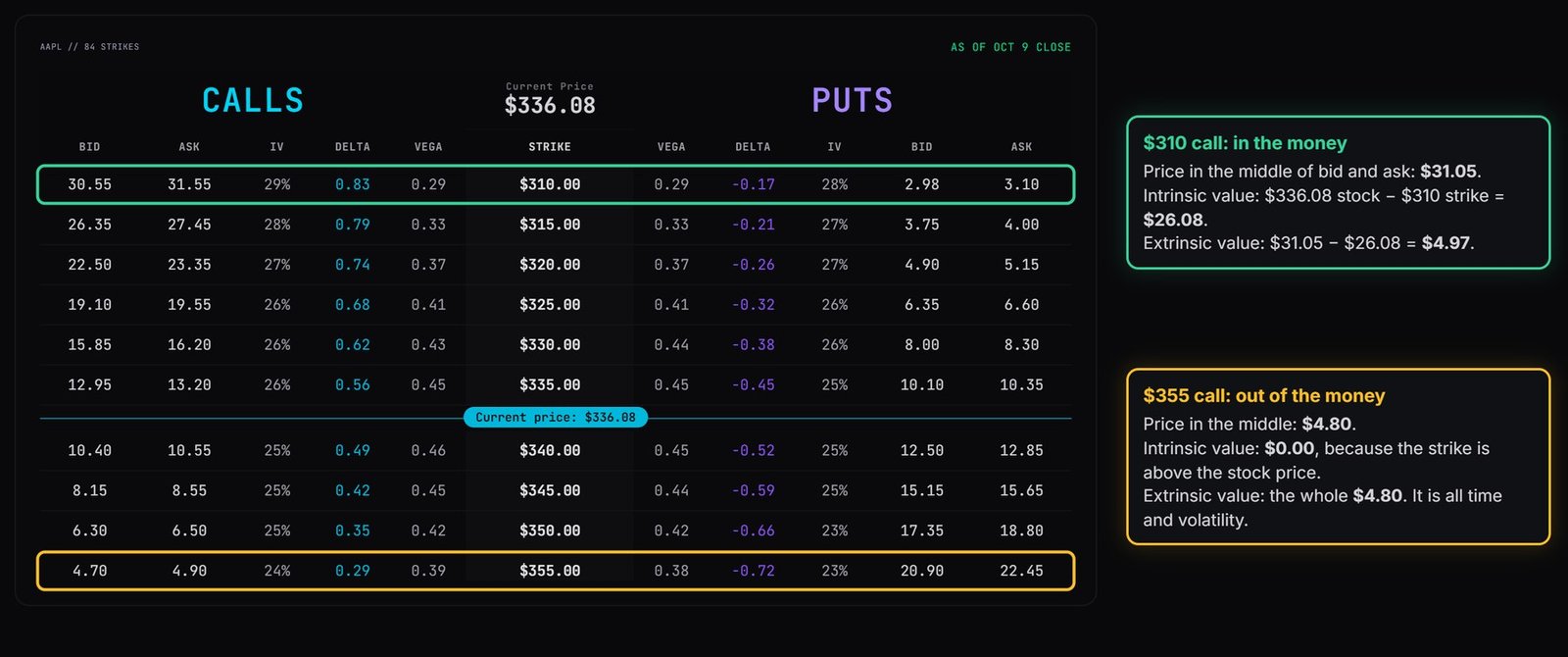
Open the Options page in Signal Desk and load a chain. Note the stock price. Pick three calls: one clearly in the money, one at the money and one clearly out of the money.
For each, calculate the intrinsic value with the formula from the lesson, then subtract it from the midpoint of the bid and ask to get the extrinsic value. Write all six numbers down.
Confirm two things: the out-of-the-money contract has zero intrinsic value, and the at-the-money contract carries the most extrinsic value of the three. Once you can do this decomposition in your head from a glance at a chain, you are reading options rather than guessing at them.
See it in Signal Desk
The Live Chain shows the bid, the ask and the stock price, which is all the lesson's formula needs (members see live quotes).
- 1
Open Options, load a ticker and pick an expiration about 45 days out. The current stock price is shown at the top and again as a line between strikes.
- 2
Read the bid and the ask for a call, and average them to get the midpoint. Signal Desk's Easy Chain also shows this as the mark when you tap a strike.
- 3
Subtract the strike from the stock price. If the result is positive, that is the intrinsic value; if it is negative, the intrinsic value is zero.
- 4
Subtract the intrinsic value from the midpoint. What is left is the extrinsic value, the part of the price that is time and volatility.
- 5
Repeat for an at-the-money and an out-of-the-money call, then for a closer expiration, and watch the extrinsic value shrink.
Try it with your own numbers
Free calculators, no account needed.
KNOWLEDGE RECONNAISSANCE
A put with a $50 strike trades for $4.50 while the stock is at $47. What is the intrinsic value?
Using the same example — $50 put at $4.50, stock at $47 — what is the extrinsic value?
Stock is at $103. What is the intrinsic value of the $105 call?
Why do At-the-Money options carry the most extrinsic value?
What is an option worth at the moment of expiration?
You buy a call, the stock rises, but your option barely gains value. What is the most likely explanation?
More lessons in this module
- 1.0: Introduction to Options & Contract Specifications
- 1.1: Call Options — Buying and Selling Mechanics
- 1.2: Put Options — Buying and Selling Mechanics
- 1.3: Option Moneyness & Value Structure
- 1.5: Reading an Option Chain
- 1.6: Choosing the Stock — Fundamentals and Technicals
Signal Desk is where you practice this on real stocks: real option chains (about 15 minutes delayed), the Trade Check and a paper-trading account that risks no real money. Join to add it, your progress tracking and PDF downloads.