
A hands-on options curriculum covering real trading concepts. Read the lessons, work through examples, and test your knowledge.
OVERALL ACADEMY PROGRESS
Free Lesson
Every lesson is free to read. Subscribe to add Signal Desk, progress tracking, PDF downloads and the lesson tutor.
Lesson 6: 10.5: Understanding Market Excess & Rejection
Identify buying and selling tails that signal swift institutional rejection of unfair prices.
1. The Concept of Excess
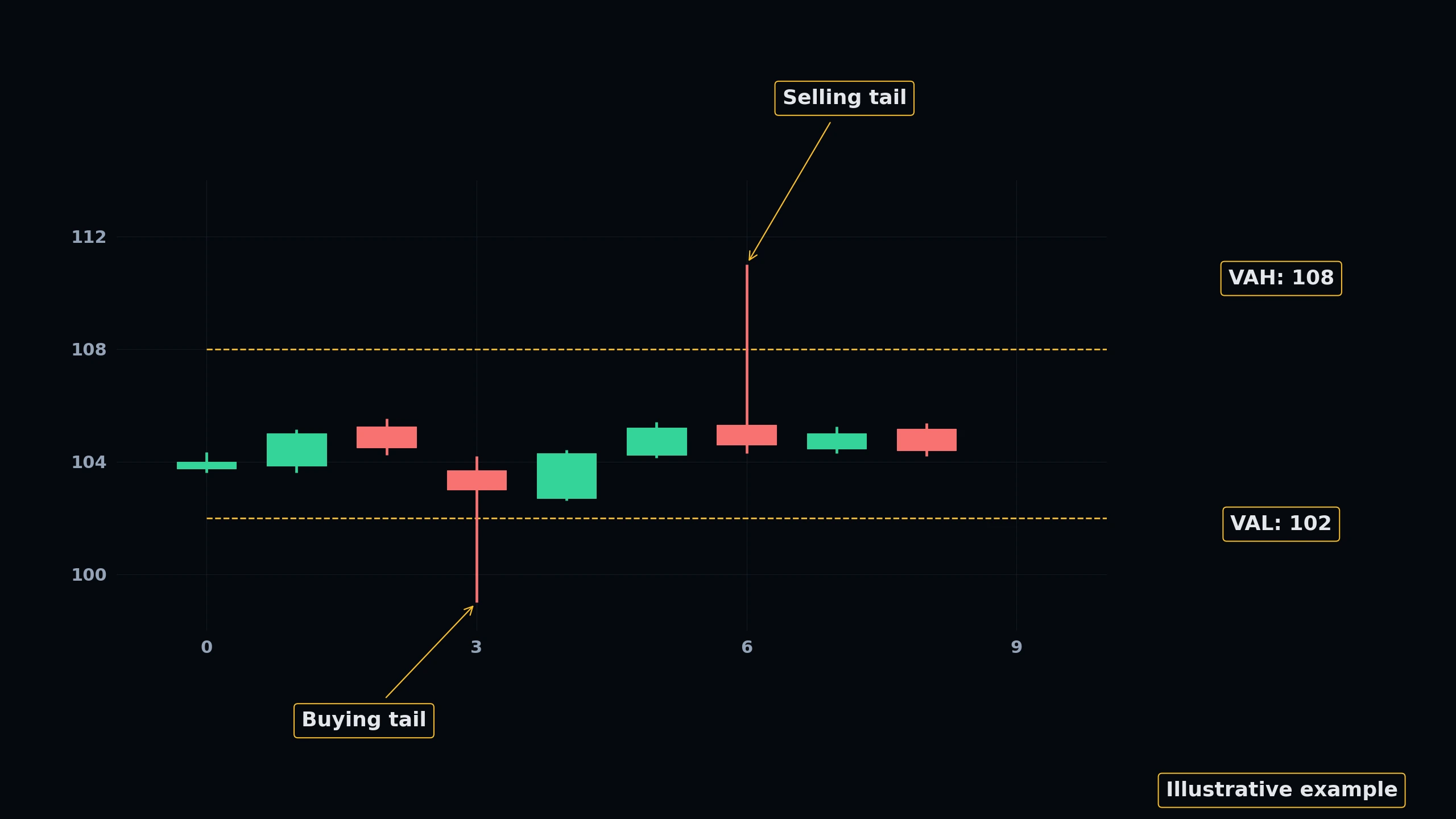
In an auction, Excess is represented by a sudden, violent rejection at the extremes of a trading range. It occurs when price enters an area of highly unfair valuation, causing longer-term institutional players to step in aggressively.
This swift action rejects the price, leaving behind long, thin wicks at the high or low of the session, known as buying or selling tails.
★ Key Concept: Excess marks the exact point where the auction has gone too far and is terminated, forming a highly secure structural boundary.
2. Spotting Tails on a Profile
• Buying Tail: Formed when price drops below VAL, aggressive buyers step in immediately, and price shoots back up. It appears as a long lower wick with minimal volume at the absolute bottom.
• Selling Tail: Formed when price rallies above VAH, aggressive sellers step in, and price crashes back down. It appears as a long upper wick.
 Click to enlarge
KNOWLEDGE RECONNAISSANCE
What does the presence of 'Excess' (long wicks/tails) at a range boundary indicate?
More lessons in this module
- 10.0: Introduction to Auction Market Theory
- 10.1: The Continuous Auction Process
- 10.2: Price Discovery and Valuation
- 10.3: Balance vs. Imbalance
- 10.4: Defining the Value Area (VAH, VAL, POC)
- 10.6: Initiative vs. Responsive Activity
- 10.7: Market Acceptance vs. Rejection
- 10.8: Constructing an Auction Market Framework
- 10.9: Practical Application: Profile Playbook
- 10.10: Summary & Auction Mastery
Signal Desk is where you practice this on real stocks: real option chains (about 15 minutes delayed), the Trade Check and a paper-trading account that risks no real money. Join to add it, your progress tracking and PDF downloads.