
A hands-on options curriculum covering real trading concepts. Read the lessons, work through examples, and test your knowledge.
OVERALL ACADEMY PROGRESS
Free Lesson
Every lesson is free to read. Subscribe to add Signal Desk, progress tracking, PDF downloads and the lesson tutor.
Key terms in this lesson
Lesson 2: 10.1: The Continuous Auction Process
Understand how limit orders and market orders interact continuously to drive the auction cycle.
1. The Auction Mechanics
The continuous auction relies on the constant interaction of two groups of market participants: passive traders and aggressive traders.
• Passive Traders: Place limit orders on the order book (bids and asks). They represent the passive liquidity holding the market together.
• Aggressive Traders: Use market orders to buy or sell immediately. They are the active force that crosses the spread and moves the price.
★ Key Concept: The auction only moves when aggressive market orders consume all passive limit orders at a specific price level, forcing the auction to the next level.
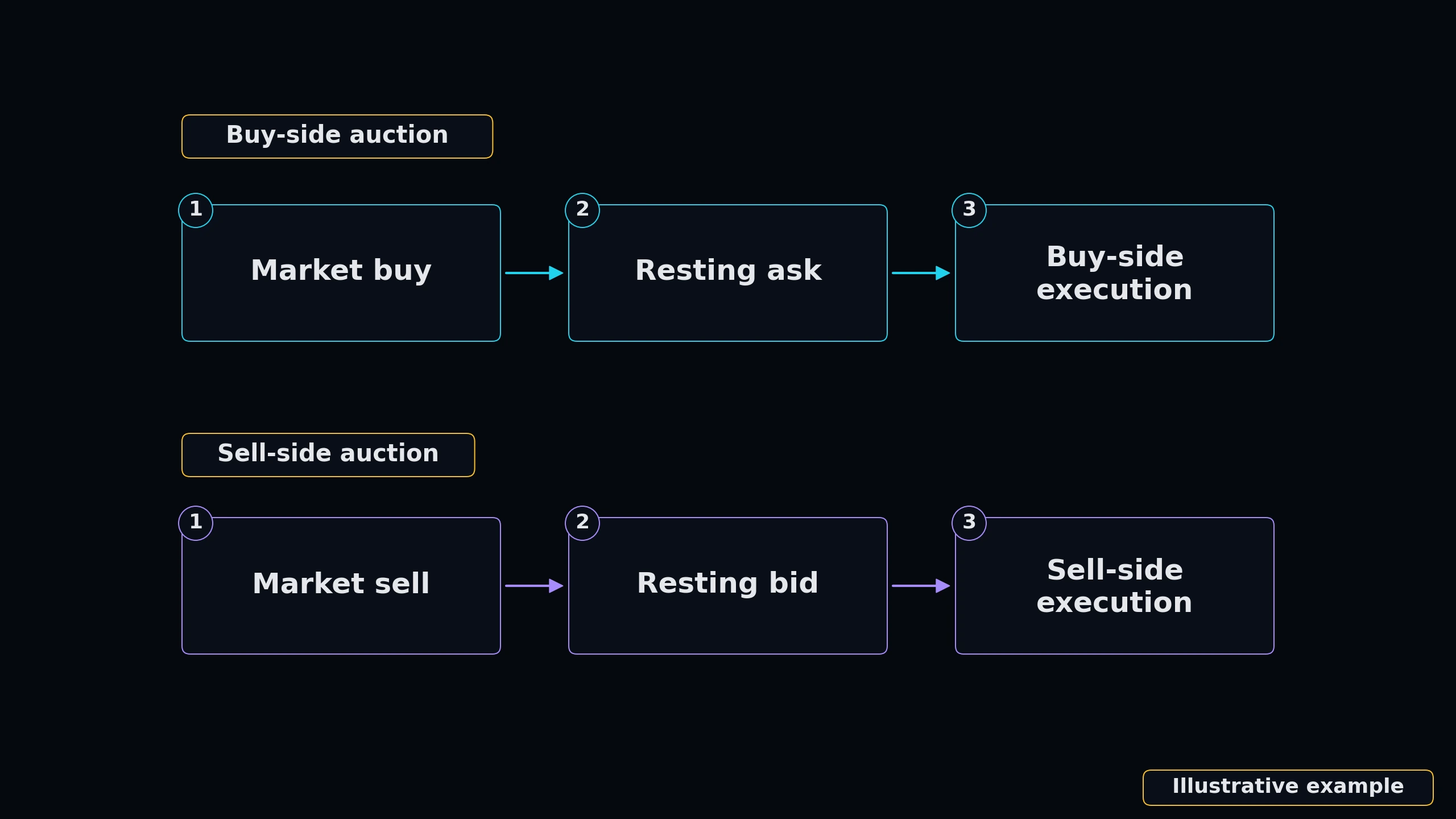
2. The Directional Auction
If aggressive buyers dominate, they consume limit sell orders (asks) and drive the price up. The auction goes higher to advertise for sellers.
If aggressive sellers dominate, they consume limit buy orders (bids) and drive the price down. The auction goes lower to advertise for buyers.
 Click to enlarge
KNOWLEDGE RECONNAISSANCE
Which market participants are directly responsible for causing the auction price to move?
More lessons in this module
- 10.0: Introduction to Auction Market Theory
- 10.2: Price Discovery and Valuation
- 10.3: Balance vs. Imbalance
- 10.4: Defining the Value Area (VAH, VAL, POC)
- 10.5: Understanding Market Excess & Rejection
- 10.6: Initiative vs. Responsive Activity
- 10.7: Market Acceptance vs. Rejection
- 10.8: Constructing an Auction Market Framework
- 10.9: Practical Application: Profile Playbook
- 10.10: Summary & Auction Mastery
Signal Desk is where you practice this on real stocks: real option chains (about 15 minutes delayed), the Trade Check and a paper-trading account that risks no real money. Join to add it, your progress tracking and PDF downloads.