
A hands-on options curriculum covering real trading concepts. Read the lessons, work through examples, and test your knowledge.
OVERALL ACADEMY PROGRESS
Free Lesson
Every lesson is free to read. Subscribe to add Signal Desk, progress tracking, PDF downloads and the lesson tutor.
Key terms in this lesson
Lesson 4: 10.3: Balance vs. Imbalance
Learn to distinguish between balanced ranging phases and unbalanced trending phases.
1. Balanced Markets (Ranges)
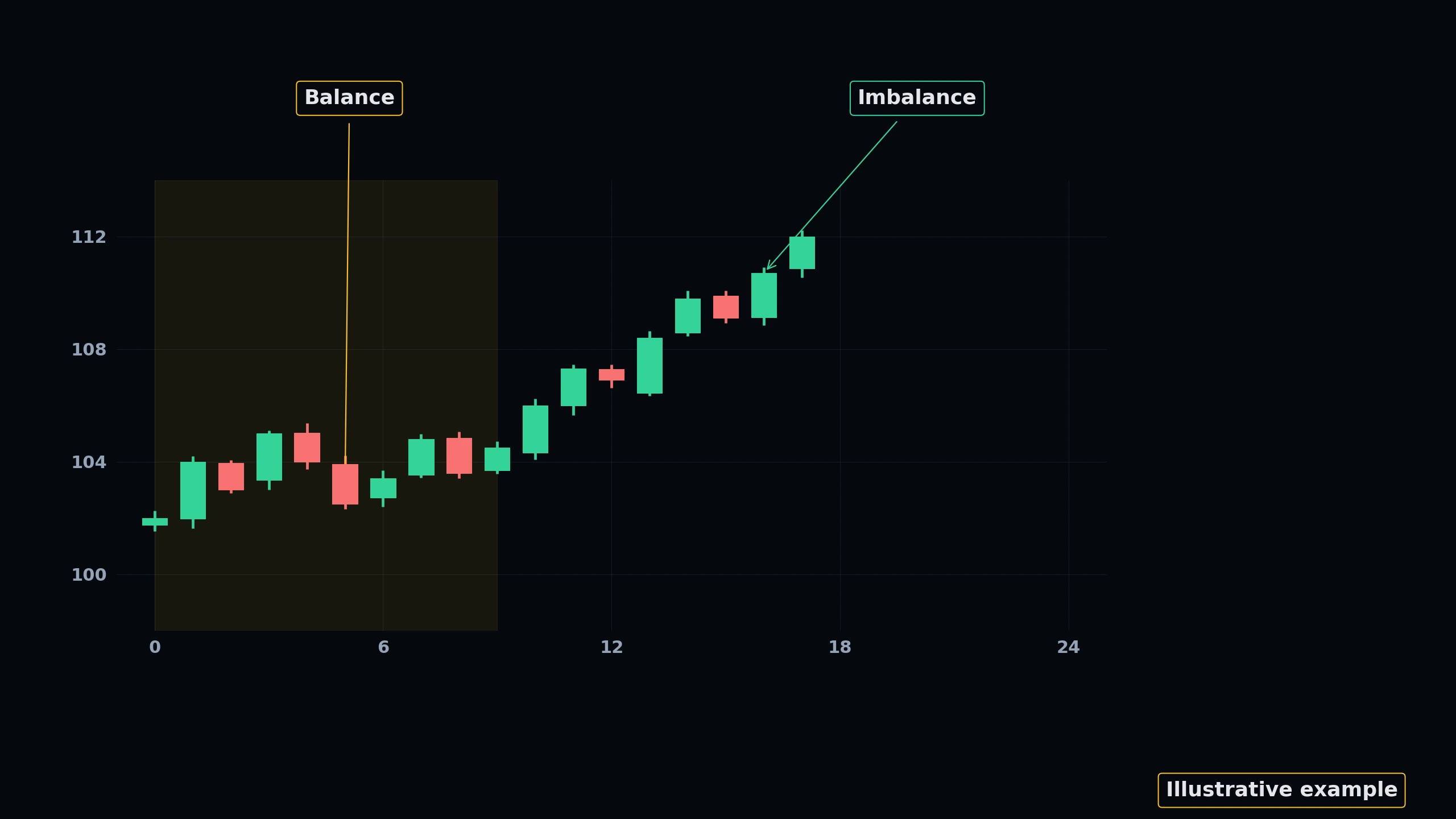
A market is in Balance when buyers and sellers agree on the current value of the asset. Price trades sideways within a defined range, and volume distribution forms a classic symmetric bell curve (normal distribution).
In a balanced market, price oscillates around a highly accepted central price, and deviations to the range boundaries are quickly rejected.
★ Market State: Approximately 70% to 80% of market time is spent in a state of balance.
2. Imbalanced Markets (Trends)
When new information enters the market, the agreement is broken, and the market enters Imbalance.
Aggressive participants drive price vertically in a search for new liquidity and value. The normal distribution curve is stretched, forming a trending market. Price will continue to run until it encounters sufficient counter-liquidity to halt the move and begin a new balance phase.
 Click to enlarge
KNOWLEDGE RECONNAISSANCE
What characterizes a market that has entered a state of 'Imbalance'?
More lessons in this module
- 10.0: Introduction to Auction Market Theory
- 10.1: The Continuous Auction Process
- 10.2: Price Discovery and Valuation
- 10.4: Defining the Value Area (VAH, VAL, POC)
- 10.5: Understanding Market Excess & Rejection
- 10.6: Initiative vs. Responsive Activity
- 10.7: Market Acceptance vs. Rejection
- 10.8: Constructing an Auction Market Framework
- 10.9: Practical Application: Profile Playbook
- 10.10: Summary & Auction Mastery
Signal Desk is where you practice this on real stocks: real option chains (about 15 minutes delayed), the Trade Check and a paper-trading account that risks no real money. Join to add it, your progress tracking and PDF downloads.