A hands-on options curriculum covering real trading concepts. Read the lessons, work through examples, and test your knowledge.
OVERALL ACADEMY PROGRESS
Free Lesson
Every lesson is free to read. Subscribe to add Signal Desk, progress tracking, PDF downloads and the lesson tutor.
Lesson 1: 1.0: Introduction to Financial Markets
An overview of how capital flows globally through financial markets to facilitate economic expansion.
1. Understanding Capital Allocation
Financial markets act as the nervous system of the global economy. They exist to facilitate the allocation of capital from savers and investors (who have surplus funds) to borrowers and issuers (who need capital for productive economic activities).
Without functioning financial markets, capital would remain idle. By connecting these two groups, markets lower transaction costs, determine asset prices, and enable businesses to expand, hire workers, and fund innovation.
★ Key Concept: The primary function of financial markets is to achieve efficient capital allocation, directing savings into the most productive investment opportunities.
2. Direct vs. Indirect Finance
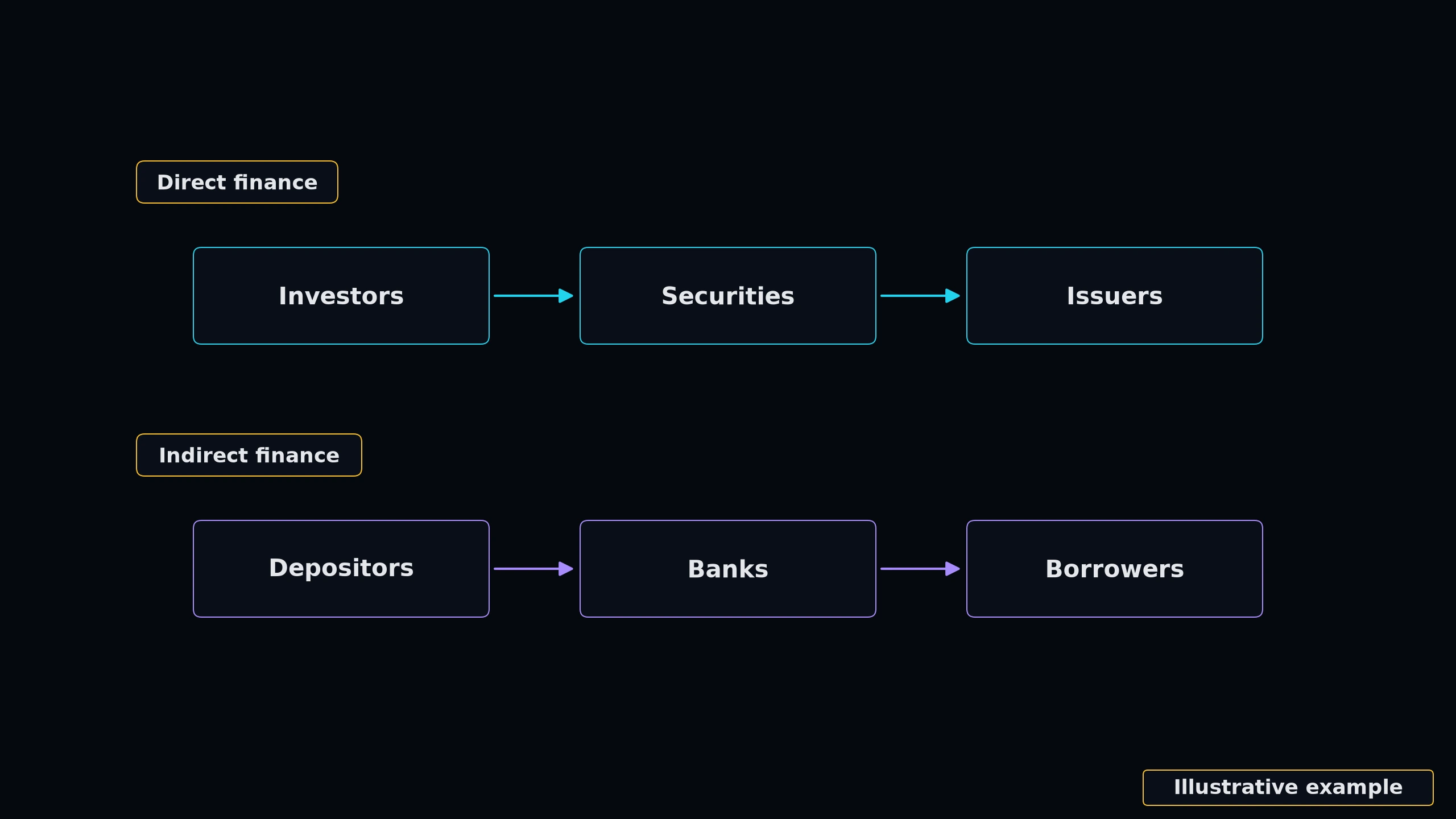
Capital flows through two main channels: direct finance and indirect finance.
• Direct Finance: Borrowers obtain funds directly from financial markets by selling securities (such as stocks or bonds) directly to investors. This process is highly visible on public exchanges.
• Indirect Finance: Financial intermediaries (such as banks or insurance companies) pool savings from depositors and then lend those funds to borrowers under separate contract terms.
By understanding these distinct paths, participants can better appreciate the structural significance of trading public instruments compared to traditional banking loans.
 Click to enlarge
KNOWLEDGE RECONNAISSANCE
What is the primary economic function of financial markets?
How does direct finance differ from indirect finance?
More lessons in this module
- 1.1: Equity Markets & Common Stock
- 1.2: Fixed Income & Debt Instruments
- 1.3: Foreign Exchange & Currency Markets
- 1.4: Commodity & Raw Materials Trading
- 1.5: Money Markets & Short-Term Debt
- 1.6: Primary vs. Secondary Markets
- 1.7: Market Indexes & Benchmarks
- 1.8: Trading Venues (Exchanges vs. OTC)
- 1.9: Market Microstructure & Order Types
Signal Desk is where you practice this on real stocks: real option chains (about 15 minutes delayed), the Trade Check and a paper-trading account that risks no real money. Join to add it, your progress tracking and PDF downloads.