
A hands-on options curriculum covering real trading concepts. Read the lessons, work through examples, and test your knowledge.
OVERALL ACADEMY PROGRESS
Free Lesson
Every lesson is free to read. Subscribe to add Signal Desk, progress tracking, PDF downloads and the lesson tutor.
Key terms in this lesson
Lesson 10: 1.9: Market Microstructure & Order Types
Dive into the order book mechanics, bid-ask spreads, and the execution details of various order types.
1. The Limit Order Book
Market microstructure refers to the detailed, tick-by-tick mechanics of how buy and sell interest is converted into transactions.
At the core of electronic markets is the Limit Order Book. This is a real-time ledger displaying resting buy orders (bids) and resting sell orders (asks), sorted by price level and execution priority.
★ Key Component: The spread is the difference between the highest bid and the lowest ask, representing the transaction cost of immediate execution.
2. Executing Order Types
Traders use different instructions to execute trades:
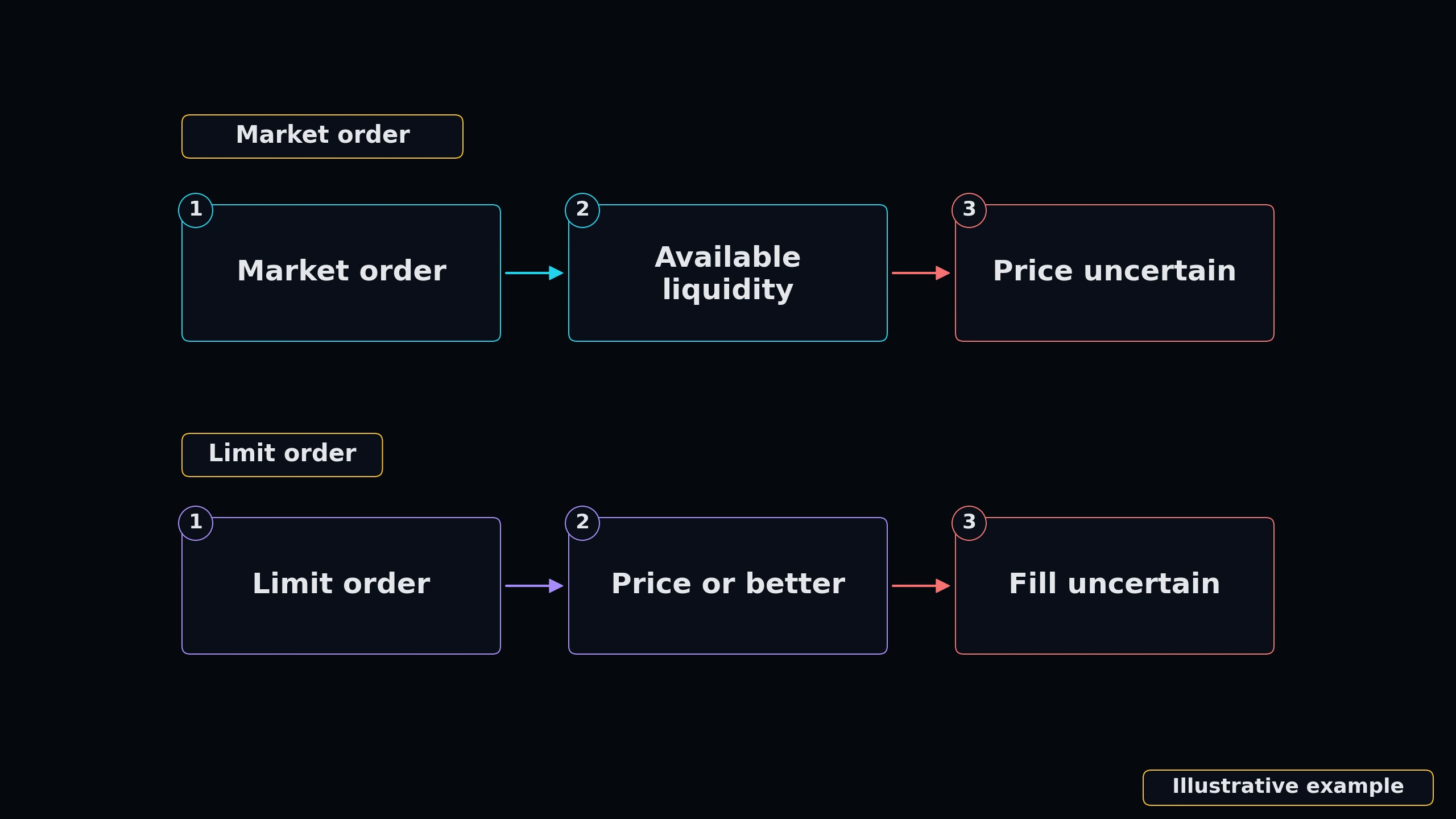
• Market Orders: Guarantee immediate execution by executing against resting limit orders, but do not guarantee a specific price.
• Limit Orders: Guarantee a specific execution price (or better) but do not guarantee that the order will actually be filled.
• Stop Orders: Trigger a market or limit order once a specified price threshold is crossed, often used as protective exit limits.
 Click to enlarge
KNOWLEDGE RECONNAISSANCE
What is the primary trade-off when using a limit order instead of a market order?
What does 'market depth' refer to in order book mechanics?
More lessons in this module
- 1.0: Introduction to Financial Markets
- 1.1: Equity Markets & Common Stock
- 1.2: Fixed Income & Debt Instruments
- 1.3: Foreign Exchange & Currency Markets
- 1.4: Commodity & Raw Materials Trading
- 1.5: Money Markets & Short-Term Debt
- 1.6: Primary vs. Secondary Markets
- 1.7: Market Indexes & Benchmarks
- 1.8: Trading Venues (Exchanges vs. OTC)
Signal Desk is where you practice this on real stocks: real option chains (about 15 minutes delayed), the Trade Check and a paper-trading account that risks no real money. Join to add it, your progress tracking and PDF downloads.