A hands-on options curriculum covering real trading concepts. Read the lessons, work through examples, and test your knowledge.
OVERALL ACADEMY PROGRESS
Free Lesson
Every lesson is free to read. Subscribe to add Signal Desk, progress tracking, PDF downloads and the lesson tutor.
Key terms in this lesson
Lesson 3: 1.2: Fixed Income & Debt Instruments
Analyze how governments and corporations borrow capital via bonds, notes, and fixed income vehicles.
1. The Bond Contract & Debt Mechanics
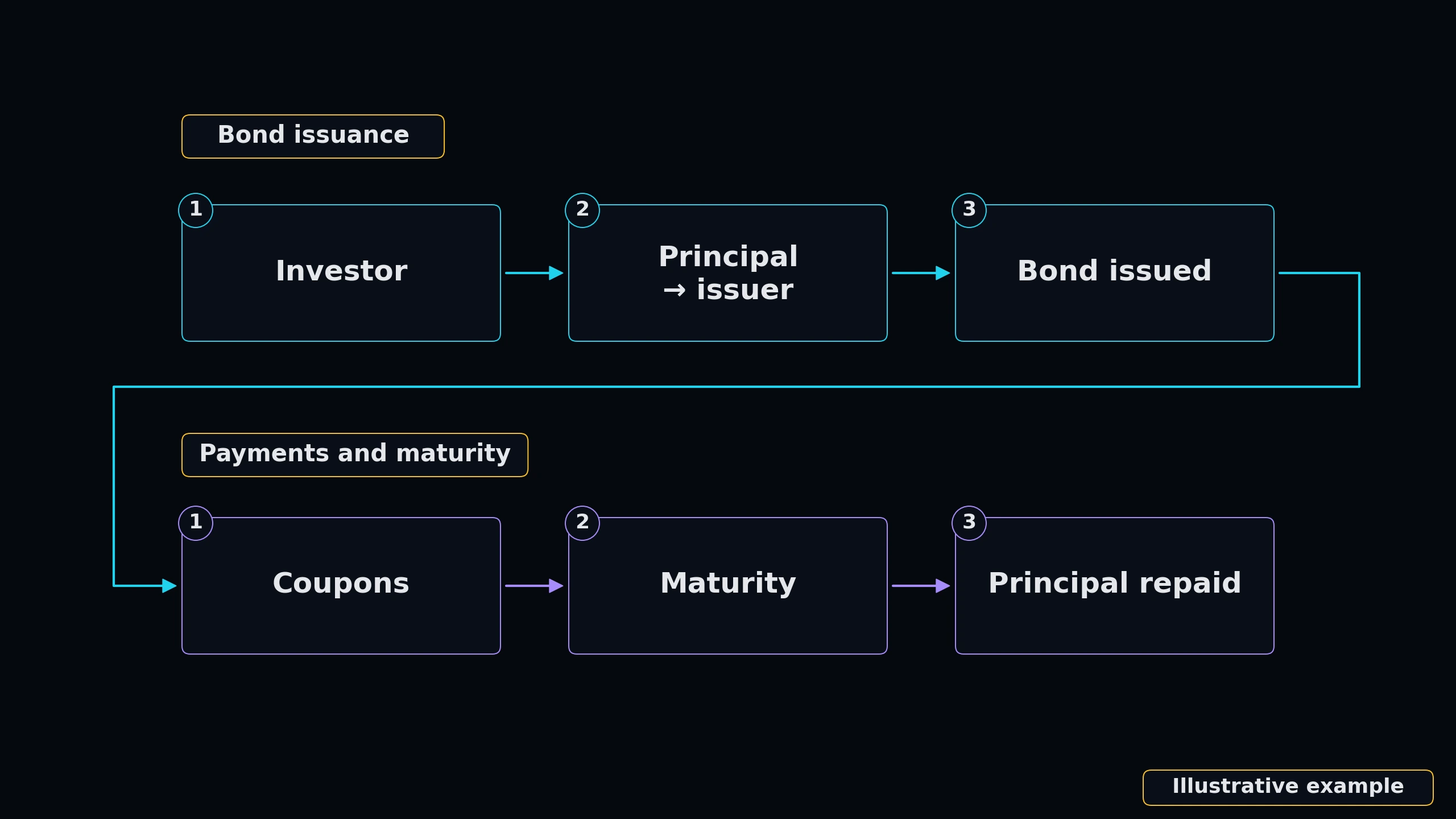
A bond is a formal contract representing a debt obligation. When an investor buys a bond, they lend capital to the issuer (a corporation, municipality, or sovereign government).
In return, the issuer commits to paying a fixed rate of interest (the coupon rate) periodically, and returning the original principal (par value or face value) to the investor at a specified maturity date.
★ Key Component: The par value is typically set at $1,000 per standard bond, and the maturity date represents when the principal must be repaid.
2. Yield to Maturity and the Price-Yield Inverse Relationship
Bond prices and interest rates have a fundamental, inverse relationship. When prevailing market interest rates rise, existing bonds with lower coupon rates become less attractive. To compete, their market prices must drop.
• Yield to Maturity (YTM): The total return anticipated on a bond if it is held until its expiration date, incorporating coupon payments, purchase price, and time to maturity.
Understanding this price sensitivity (referred to as duration) is essential for any institution managing fixed-income risk.
 Click to enlarge
KNOWLEDGE RECONNAISSANCE
What is the relationship between market interest rates and bond prices?
What does the 'coupon' of a bond represent?
More lessons in this module
- 1.0: Introduction to Financial Markets
- 1.1: Equity Markets & Common Stock
- 1.3: Foreign Exchange & Currency Markets
- 1.4: Commodity & Raw Materials Trading
- 1.5: Money Markets & Short-Term Debt
- 1.6: Primary vs. Secondary Markets
- 1.7: Market Indexes & Benchmarks
- 1.8: Trading Venues (Exchanges vs. OTC)
- 1.9: Market Microstructure & Order Types
Signal Desk is where you practice this on real stocks: real option chains (about 15 minutes delayed), the Trade Check and a paper-trading account that risks no real money. Join to add it, your progress tracking and PDF downloads.