
A hands-on options curriculum covering real trading concepts. Read the lessons, work through examples, and test your knowledge.
OVERALL ACADEMY PROGRESS
Free Lesson
Every lesson is free to read. Subscribe to add Signal Desk, progress tracking, PDF downloads and the lesson tutor.
Lesson 7: 1.6: Primary vs. Secondary Markets
Differentiate between the issuance of new securities (IPOs) and the subsequent public trading of existing assets.
1. Primary Markets: Capital Creation
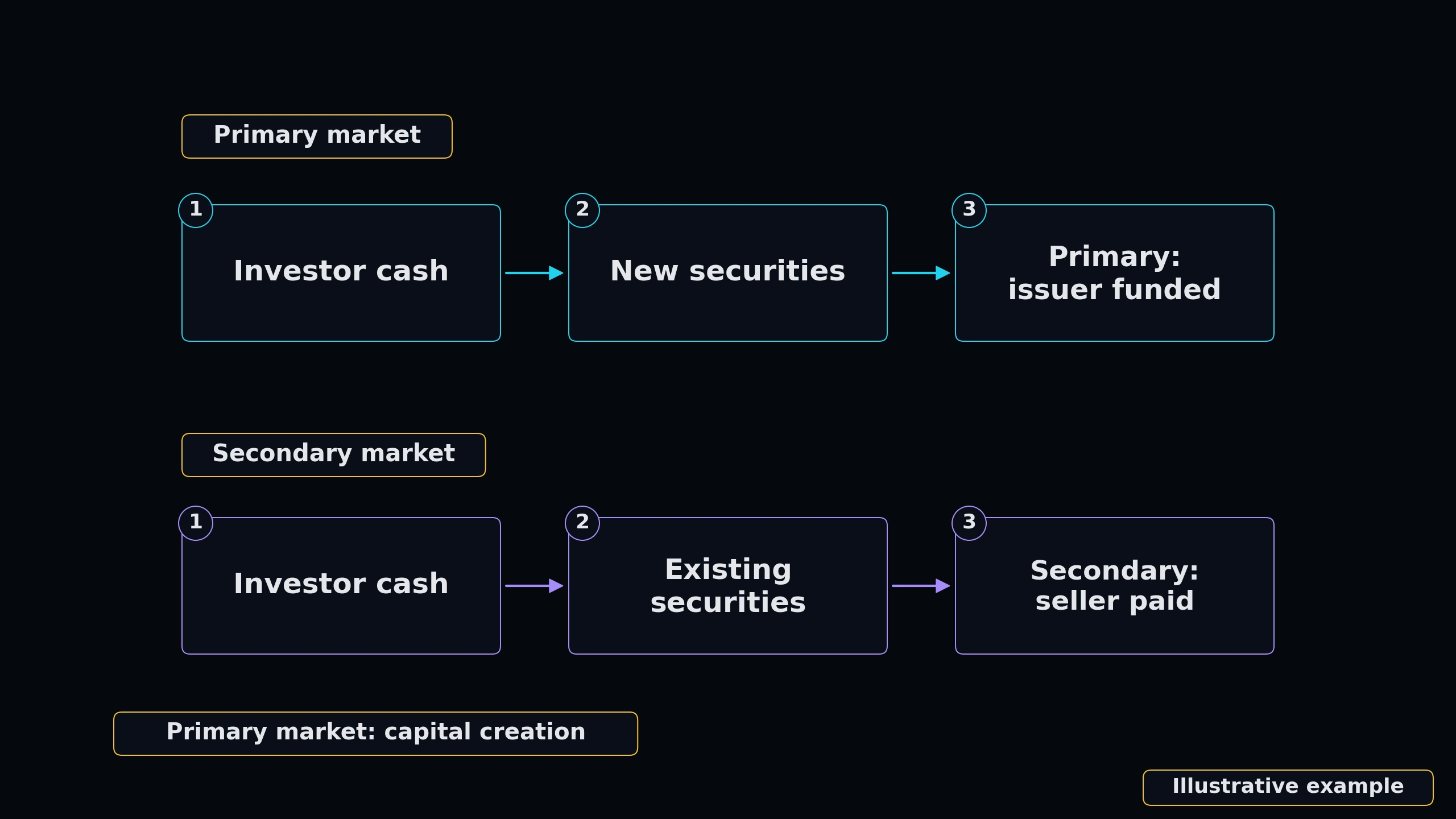
The primary market is where securities are created and sold for the first time. In this market, corporations, governments, or public bodies raise capital directly from investors.
When a private company goes public through an Initial Public Offering (IPO), or when a government issues new treasury bonds, it operates in the primary market. The capital paid by investors flows directly to the issuing entity.
★ Key Rule: The primary market is where capital creation occurs, mediated by investment banking syndicates.
2. Secondary Markets: Liquidity Provision
Once securities are issued, they enter the secondary market. This is where investors trade existing securities among themselves (e.g., NYSE, Nasdaq, or OTC bond networks).
In the secondary market, the issuing corporation receives no cash from the trades. Instead, the transactions are purely transfers of ownership between different investors, providing critical price discovery and liquidity.
 Click to enlarge
KNOWLEDGE RECONNAISSANCE
Where does a corporation receive direct capital from investors?
What is the main role of the secondary market?
More lessons in this module
- 1.0: Introduction to Financial Markets
- 1.1: Equity Markets & Common Stock
- 1.2: Fixed Income & Debt Instruments
- 1.3: Foreign Exchange & Currency Markets
- 1.4: Commodity & Raw Materials Trading
- 1.5: Money Markets & Short-Term Debt
- 1.7: Market Indexes & Benchmarks
- 1.8: Trading Venues (Exchanges vs. OTC)
- 1.9: Market Microstructure & Order Types
Signal Desk is where you practice this on real stocks: real option chains (about 15 minutes delayed), the Trade Check and a paper-trading account that risks no real money. Join to add it, your progress tracking and PDF downloads.