A hands-on options curriculum covering real trading concepts. Read the lessons, work through examples, and test your knowledge.
OVERALL ACADEMY PROGRESS
Free Lesson
Every lesson is free to read. Subscribe to add Signal Desk, progress tracking, PDF downloads and the lesson tutor.
Lesson 2: 1.1: Equity Markets & Common Stock
Understand ownership-based assets, the mechanics of common stock, dividends, and corporate governance.
1. The Nature of Equity Ownership
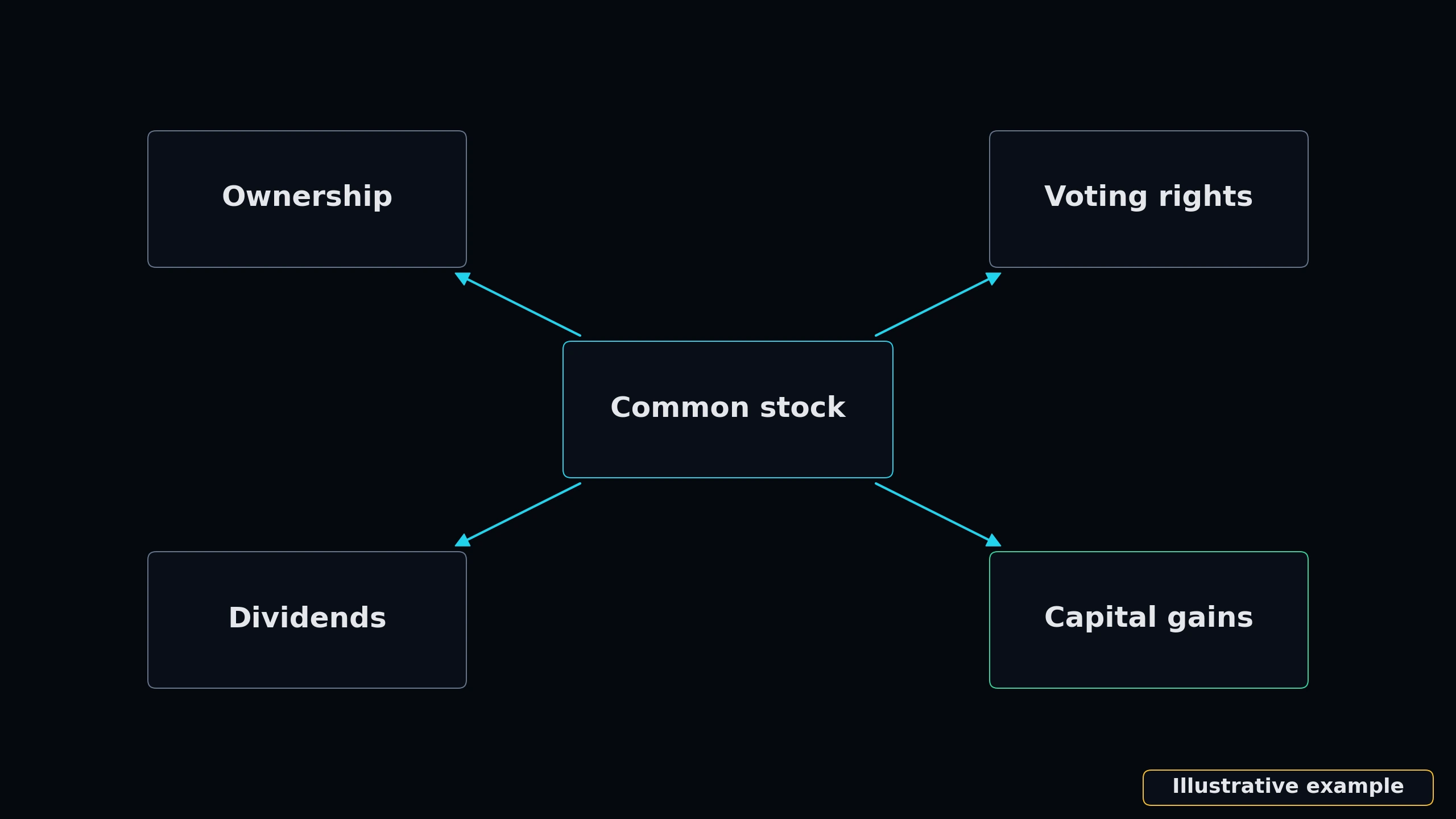
Equity represents ownership in a corporate entity. When an investor purchases a share of common stock, they acquire a fractional claim on the firm's assets, earnings, and voting rights.
Unlike debt holders who are creditors, equity holders are partial owners. They bear the residual risk of the business—if the firm fails, they can lose their entire investment; however, if the firm succeeds, their upside is theoretically unlimited.
★ Core Rule: Common stock sits at the bottom of the corporate capital structure, meaning common shareholders are paid last in the event of bankruptcy or liquidation.
2. Dividends and Capital Gains
Equity investors generate financial returns through two primary mechanisms:
• Dividends: Periodic cash payments distributed by a corporation to its shareholders, representing a share of the firm's net earnings.
• Capital Gains: Profit realized from selling a stock at a market price higher than its original purchase price.
Growth-oriented companies often reinvest all earnings into business expansion rather than paying dividends, relying on capital appreciation to attract investors.
 Click to enlarge
KNOWLEDGE RECONNAISSANCE
Which of the following represents a primary right of a common shareholder?
How do capital gains differ from dividends?
More lessons in this module
- 1.0: Introduction to Financial Markets
- 1.2: Fixed Income & Debt Instruments
- 1.3: Foreign Exchange & Currency Markets
- 1.4: Commodity & Raw Materials Trading
- 1.5: Money Markets & Short-Term Debt
- 1.6: Primary vs. Secondary Markets
- 1.7: Market Indexes & Benchmarks
- 1.8: Trading Venues (Exchanges vs. OTC)
- 1.9: Market Microstructure & Order Types
Signal Desk is where you practice this on real stocks: real option chains (about 15 minutes delayed), the Trade Check and a paper-trading account that risks no real money. Join to add it, your progress tracking and PDF downloads.