
A hands-on options curriculum covering real trading concepts. Read the lessons, work through examples, and test your knowledge.
OVERALL ACADEMY PROGRESS
Free Lesson
Every lesson is free to read. Subscribe to add Signal Desk, progress tracking, PDF downloads and the lesson tutor.
Lesson 8: 1.7: Market Indexes & Benchmarks
Understand how indices track aggregate market segments, index weighting methodologies, and benchmark performance.
1. The Function of Market Indices
A market index is a statistical measure that tracks the performance of a specific group of securities. It acts as a barometer for the overall economy, a particular market sector, or an asset class.
Indices serve as essential benchmarks. Fund managers and retail investors compare their portfolio performances against indexes to measure whether their active strategies are successfully beating the market.
★ Key Concept: The S&P 500, Dow Jones Industrial Average, and Nasdaq 100 are the most watched market indexes in the world.
2. Weighting Methodologies
An index's performance depends heavily on its weighting methodology:
• Market-Capitalization Weighted: Stocks are weighted based on their total market value (e.g., S&P 500). Larger companies (like Apple or Microsoft) have a disproportionately higher impact on the index's movements.
• Price-Weighted: Stocks are weighted solely by their share price (e.g., Dow Jones). A company with a $300 share price will affect the index more than a company with a $50 share price, regardless of their actual corporate sizes.
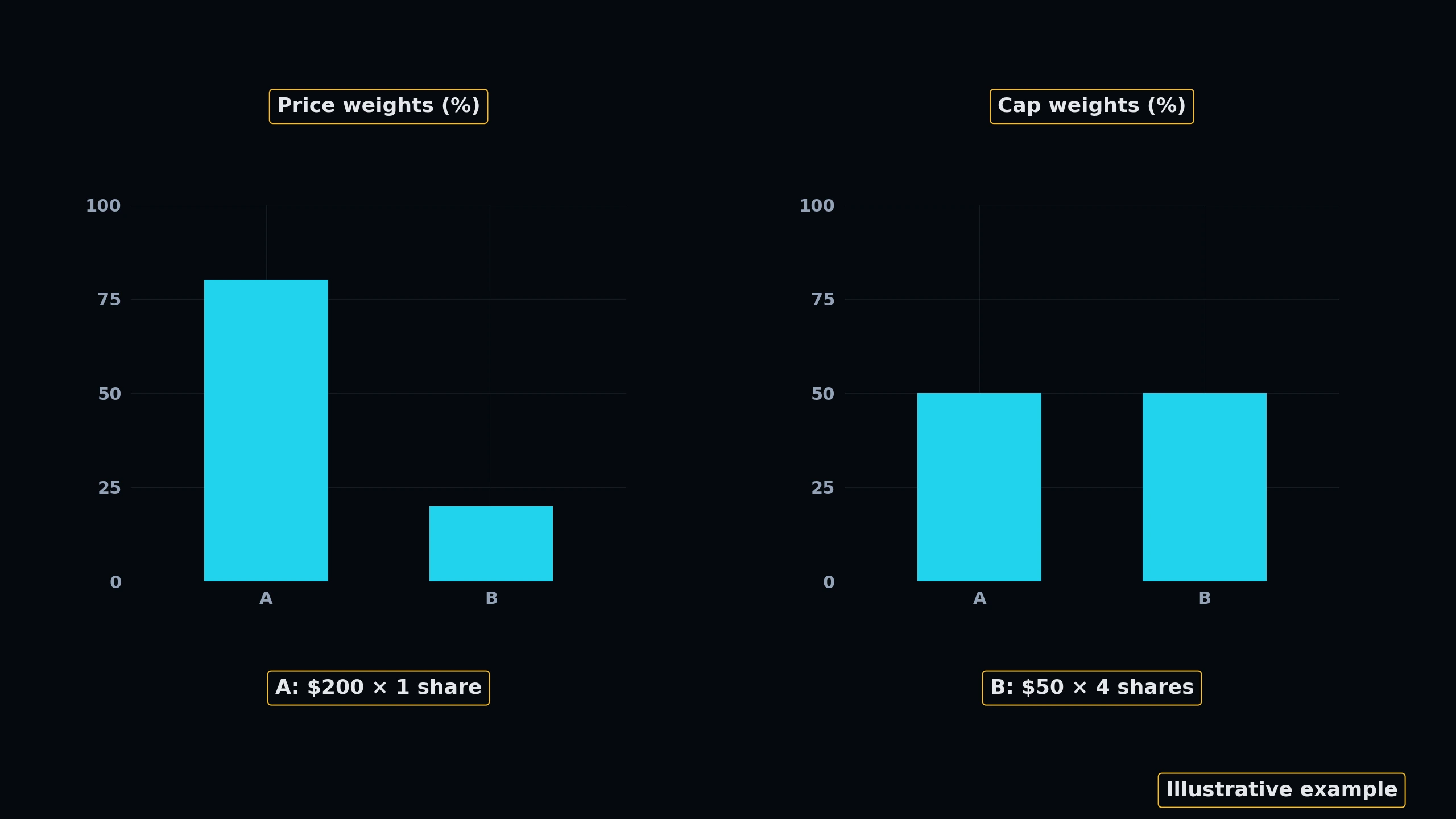 Click to enlarge
KNOWLEDGE RECONNAISSANCE
In a market-capitalization-weighted index, which stock has the greatest impact?
What is the primary purpose of a financial index?
More lessons in this module
- 1.0: Introduction to Financial Markets
- 1.1: Equity Markets & Common Stock
- 1.2: Fixed Income & Debt Instruments
- 1.3: Foreign Exchange & Currency Markets
- 1.4: Commodity & Raw Materials Trading
- 1.5: Money Markets & Short-Term Debt
- 1.6: Primary vs. Secondary Markets
- 1.8: Trading Venues (Exchanges vs. OTC)
- 1.9: Market Microstructure & Order Types
Signal Desk is where you practice this on real stocks: real option chains (about 15 minutes delayed), the Trade Check and a paper-trading account that risks no real money. Join to add it, your progress tracking and PDF downloads.