A hands-on options curriculum covering real trading concepts. Read the lessons, work through examples, and test your knowledge.
OVERALL ACADEMY PROGRESS
Free Lesson
Every lesson is free to read. Subscribe to add Signal Desk, progress tracking, PDF downloads and the lesson tutor.
Lesson 9: 1.8: Trading Venues (Exchanges vs. OTC)
Compare centralized physical/electronic exchanges with decentralized, over-the-counter dealer networks.
1. Centralized Exchanges
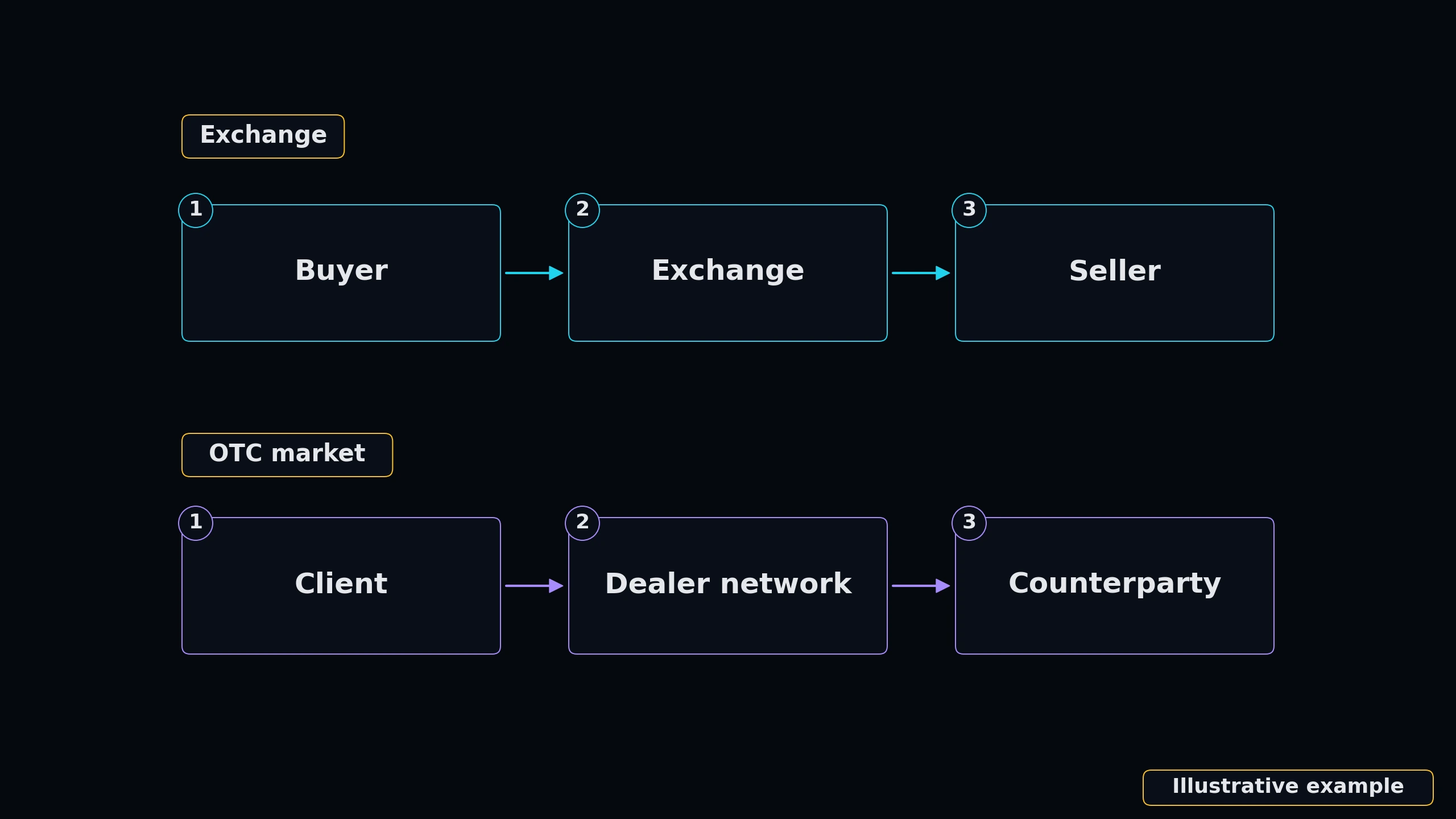
An exchange is a highly regulated, centralized marketplace where buyers and sellers transact. All trades on an exchange are cleared through a central clearinghouse.
Centralized clearing virtually eliminates counterparty risk—the risk that the other side of your trade defaults. Standardized rules, transparent pricing, and public disclosure are hallmarks of centralized exchanges.
★ Key Component: The New York Stock Exchange (NYSE) and Chicago Board Options Exchange (CBOE) are primary examples.
2. Over-the-Counter (OTC) Markets
The OTC market is a decentralized network of dealers, brokers, and market makers who negotiate transactions directly with each other, without a centralized exchange.
OTC trading is the predominant venue for sovereign bonds, corporate debt, and complex custom derivatives. Pricing is less transparent than on exchanges, and counterparty risk is managed through private collateral contracts.
 Click to enlarge
KNOWLEDGE RECONNAISSANCE
Which characteristic uniquely defines a centralized exchange compared to OTC?
Which asset class is predominantly traded over-the-counter (OTC) rather than on centralized exchanges?
More lessons in this module
- 1.0: Introduction to Financial Markets
- 1.1: Equity Markets & Common Stock
- 1.2: Fixed Income & Debt Instruments
- 1.3: Foreign Exchange & Currency Markets
- 1.4: Commodity & Raw Materials Trading
- 1.5: Money Markets & Short-Term Debt
- 1.6: Primary vs. Secondary Markets
- 1.7: Market Indexes & Benchmarks
- 1.9: Market Microstructure & Order Types
Signal Desk is where you practice this on real stocks: real option chains (about 15 minutes delayed), the Trade Check and a paper-trading account that risks no real money. Join to add it, your progress tracking and PDF downloads.