
A hands-on options curriculum covering real trading concepts. Read the lessons, work through examples, and test your knowledge.
OVERALL ACADEMY PROGRESS
Free Lesson
Every lesson is free to read. Subscribe to add Signal Desk, progress tracking, PDF downloads and the lesson tutor.
Key terms in this lesson
Lesson 1: 3.0: Limit Order Books and Bid-Ask Spreads
Examine the fundamental mechanics of the limit order book, bid-ask spread formation, and the cost of immediate execution.
1. The Limit Order Book (LOB) Architecture
The limit order book is a continuous double-auction mechanism that records all outstanding, unexecuted buy and sell orders. It is divided into two primary sides: the Bid side (buyers proposing prices they are willing to pay) and the Ask side (sellers proposing prices they are willing to accept).
Passive traders provide liquidity by placing limit orders, which sit in the book awaiting execution. Active traders consume liquidity by executing market orders, which match immediately with the best available limit price.
★ Key Insight: The highest price bid is the 'Best Bid' and the lowest price ask is the 'Best Ask'. The distance between them is the bid-ask spread, representing the primary transaction friction in active markets.
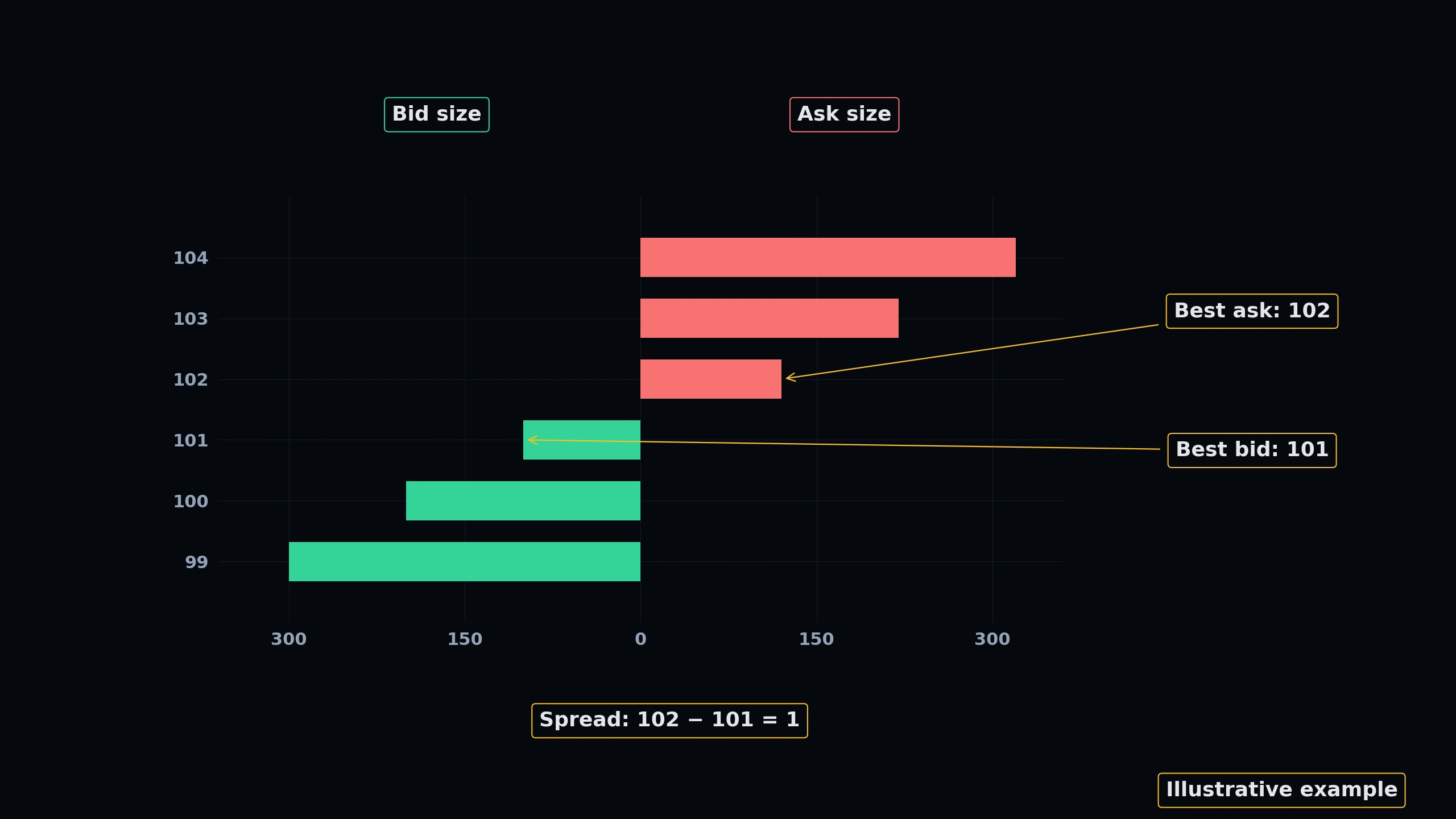 Click to enlarge
Options Structure Exploration
Options are contracts cleared in the bid-ask auction market. Interact with the Order Book below to understand how buy offers (bids) and sell offers (asks) intersect, and inspect the structural breakdown between Call and Put contracts.
Limit Order Book & Spread Interface
Hover over ASK or BID to dissect the auction market dynamics.
Right to Buy
- Outlook: Bullish (Goes up)
- Risk: Capped to premium paid
- Profit: Scales as stock surges
Right to Sell
- Outlook: Bearish (Goes down)
- Risk: Capped to premium paid
- Profit: Scales as stock falls
KNOWLEDGE RECONNAISSANCE
Which market participant consumes liquidity immediately?
More lessons in this module
- 3.1: Understanding Market Depth & Level II Data
- 3.2: Market Impact and Slippage Mechanics
- 3.3: Order Flow Imbalance (OFI) & Price Discovery
- 3.4: Adverse Selection & Toxic Order Flow (VPIN)
- 3.5: Market Making Mechanics and Inventory Risk
- 3.6: Dark Pools and Block Trading Execution
- 3.7: High-Frequency Trading (HFT) and Microstructure
- 3.8: Limit Order Book Modeling & Queue Position
Signal Desk is where you practice this on real stocks: real option chains (about 15 minutes delayed), the Trade Check and a paper-trading account that risks no real money. Join to add it, your progress tracking and PDF downloads.