
A hands-on options curriculum covering real trading concepts. Read the lessons, work through examples, and test your knowledge.
OVERALL ACADEMY PROGRESS
Free Lesson
Every lesson is free to read. Subscribe to add Signal Desk, progress tracking, PDF downloads and the lesson tutor.
Lesson 8: 14.8: Analyzing HFT Impact on Market Quality & Liquidity
Assess the empirical debate on HFT: bid-ask spread compression, market efficiency, phantom liquidity, and systemic stability.
1. The HFT Market Quality Debate
The rise of high-frequency trading over the past two decades has fundamentally transformed global financial markets, sparking intense debate among regulators, academics, and investors.
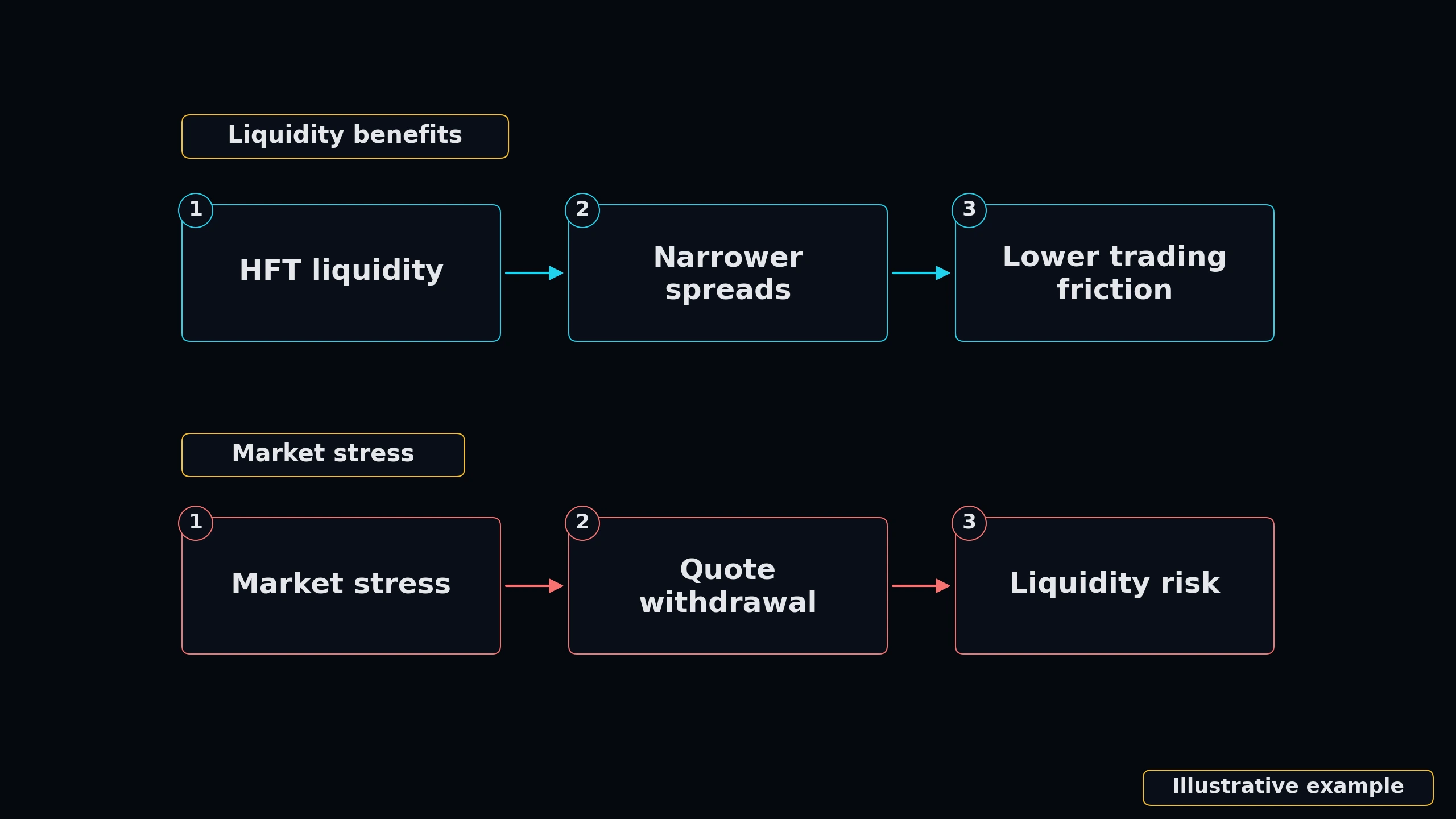
• Benefits: Empirical studies show HFT has significantly narrowed bid-ask spreads, lowered transaction costs for retail investors, and accelerated price discovery across fragmented markets.
• Criticisms: Critics highlight 'phantom liquidity' (quotes that vanish when large orders enter), potential spoofing/quote stuffing abuses, and increased tail-risk fragility during flash crash events.
2. The Future of Microsecond Market Design
Regulatory bodies are exploring batch auction mechanisms (e.g., frequent batch auctions every 100ms) and speed bumps (like IEX's 350-microsecond delay coil) to eliminate latency arbitrage while preserving market efficiency.
 Click to enlarge
GEX Heatmap & Dealer Hedging Profile
The Gamma Exposure (GEX) profile dictates the hedging loops of market-makers. Slide the price pointer below to see how institutional hedging flows suppress volatility or trigger cascading market trends.
Price Controller
Gamma Transition Zone (Near $100): Resting near the Volatility Flip Line. Dealer hedging is transitioning, making the price range choppy as dealer flows oscillate. Expect choppy intraday price ranges.
KNOWLEDGE RECONNAISSANCE
What market design mechanism does the IEX exchange use to neutralize latency arbitrage?
More lessons in this module
- 14.0: Introduction to High-Frequency Trading (HFT)
- 14.1: Microsecond Hardware, FPGAs & Kernel Bypass
- 14.2: Exchange Matching Engines & Order Gateways
- 14.3: Co-Location & Microwave Transmission Networks
- 14.4: Market Making Algorithms & Inventory Risk
- 14.5: Latency Arbitrage & Cross-Venue Arbitrage
- 14.6: Dark Pools, Internalization & Payment for Order Flow (PFOF)
- 14.7: HFT Risk Controls, Circuit Breakers & Kill Switches
Signal Desk is where you practice this on real stocks: real option chains (about 15 minutes delayed), the Trade Check and a paper-trading account that risks no real money. Join to add it, your progress tracking and PDF downloads.