
A hands-on options curriculum covering real trading concepts. Read the lessons, work through examples, and test your knowledge.
OVERALL ACADEMY PROGRESS
Free Lesson
Every lesson is free to read. Subscribe to add Signal Desk, progress tracking, PDF downloads and the lesson tutor.
Key terms in this lesson
Lesson 0: 14.0: Introduction to High-Frequency Trading (HFT)
Explore the modern microstructure of algorithmic HFT, sub-millisecond execution, and quantitative market design.
1. Defining High-Frequency Trading
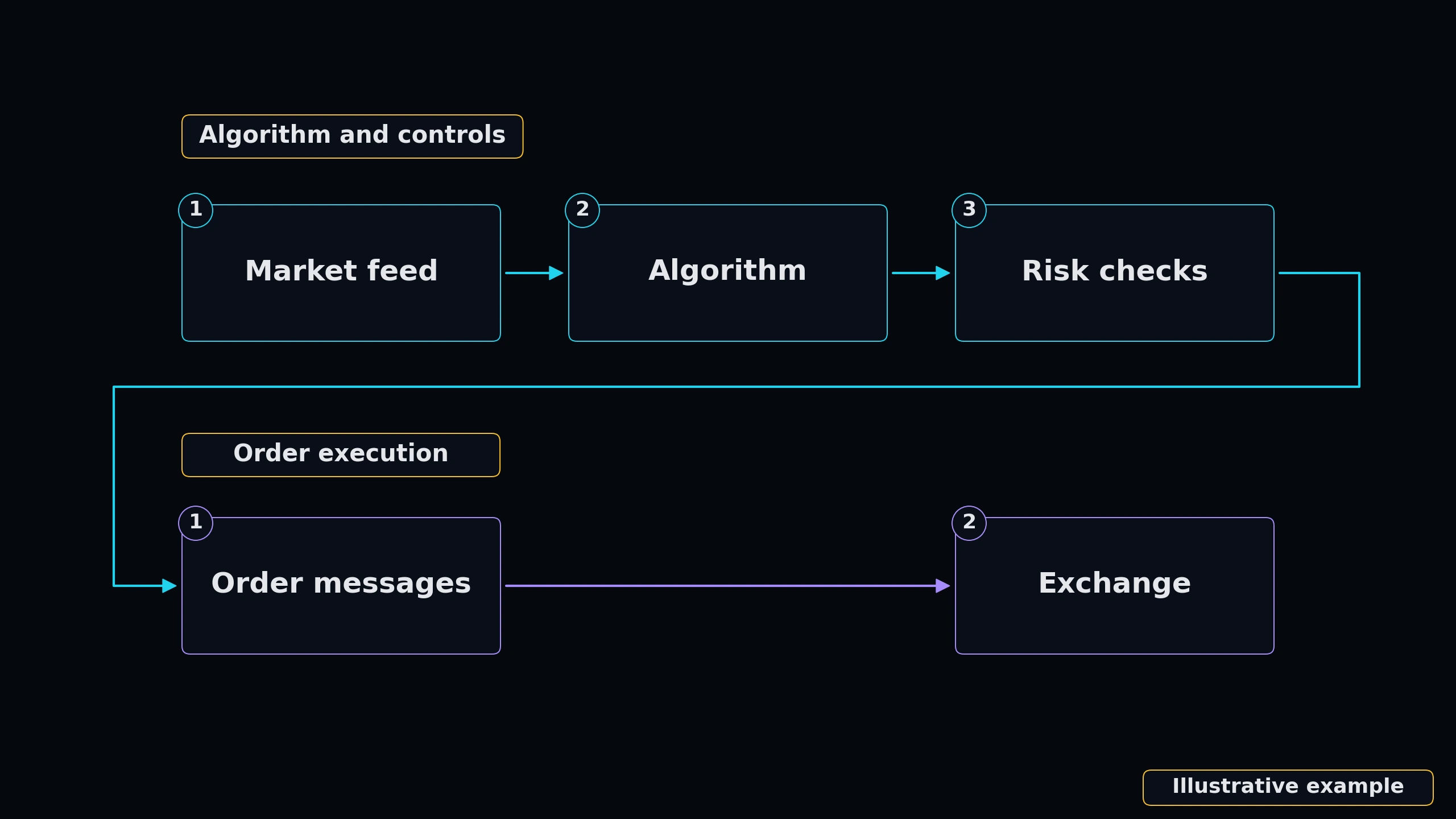
High-Frequency Trading (HFT) refers to automated trading strategies executed by specialized quantitative firms utilizing ultra-low latency infrastructure, high-speed networks, and high message-to-trade ratios.
HFT firms hold positions for extremely short timeframes (seconds to milliseconds) and rarely hold unhedged overnight positions. They generate profits by capturing microscopic pricing discrepancies millions of times per day.
★ Market Footprint: HFT firms account for approximately 50% of US equity trading volume and over 60% of futures volume.
2. Key HFT Strategy Archetypes
• Automated Market Making: Continuously placing passive limit orders on both sides of the order book to capture the bid-ask spread.
• Statistical & Cross-Venue Arbitrage: Exploiting temporary price dislocations for the same asset across different exchanges.
• Momentum Ignition & Order Flow Sensing: Identifying large institutional order execution footprints in real time.
 Click to enlarge
GEX Heatmap & Dealer Hedging Profile
The Gamma Exposure (GEX) profile dictates the hedging loops of market-makers. Slide the price pointer below to see how institutional hedging flows suppress volatility or trigger cascading market trends.
Price Controller
Gamma Transition Zone (Near $100): Resting near the Volatility Flip Line. Dealer hedging is transitioning, making the price range choppy as dealer flows oscillate. Expect choppy intraday price ranges.
KNOWLEDGE RECONNAISSANCE
What is a defining characteristic of High-Frequency Trading firms regarding overnight position holding?
More lessons in this module
- 14.1: Microsecond Hardware, FPGAs & Kernel Bypass
- 14.2: Exchange Matching Engines & Order Gateways
- 14.3: Co-Location & Microwave Transmission Networks
- 14.4: Market Making Algorithms & Inventory Risk
- 14.5: Latency Arbitrage & Cross-Venue Arbitrage
- 14.6: Dark Pools, Internalization & Payment for Order Flow (PFOF)
- 14.7: HFT Risk Controls, Circuit Breakers & Kill Switches
- 14.8: Analyzing HFT Impact on Market Quality & Liquidity
Signal Desk is where you practice this on real stocks: real option chains (about 15 minutes delayed), the Trade Check and a paper-trading account that risks no real money. Join to add it, your progress tracking and PDF downloads.