
A hands-on options curriculum covering real trading concepts. Read the lessons, work through examples, and test your knowledge.
OVERALL ACADEMY PROGRESS
Free Lesson
Every lesson is free to read. Subscribe to add Signal Desk, progress tracking, PDF downloads and the lesson tutor.
Lesson 7: 14.7: HFT Risk Controls, Circuit Breakers & Kill Switches
Evaluate risk safeguards, pre-trade risk checks, automated hardware kill switches, and flash crash prevention.
1. Preventing Runaway Algorithms
Because HFT algorithms execute thousands of orders per second, a software bug can cause catastrophic financial losses in seconds (e.g., the 2012 Knight Capital glitch lost $440M in 45 minutes).
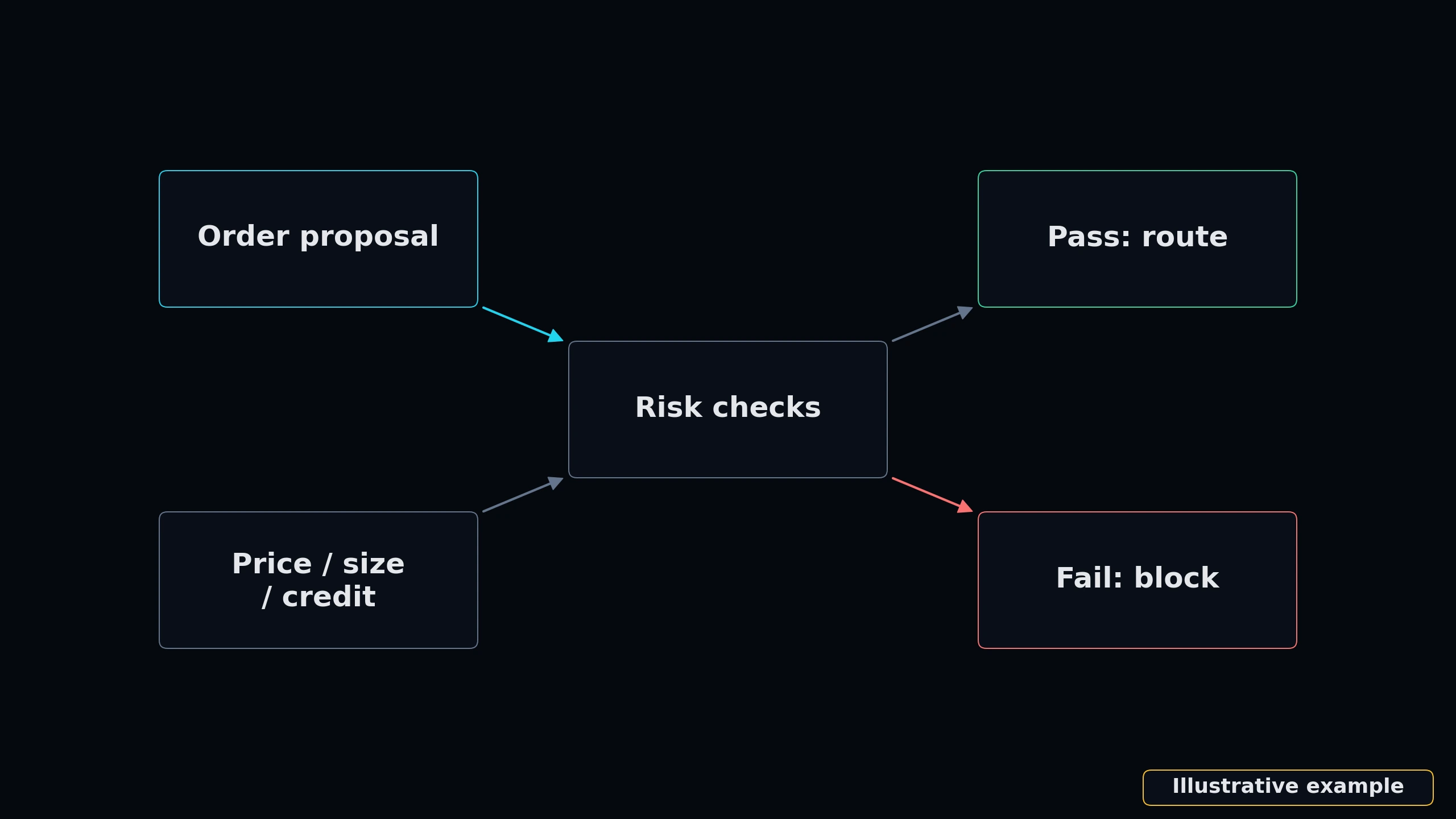
• Pre-Trade Risk Controls: SEC Rule 15c3-5 requires brokers and direct access firms to enforce automated pre-trade risk checks (verifying price collars, maximum order sizes, and credit limits).
• Hardware Kill Switches: Dedicated physical circuit breakers that automatically disconnect exchange sessions if trade frequency or capital loss metrics exceed safe thresholds.
2. Market-Wide Circuit Breakers
Exchanges employ Limit-Up Limit-Down (LULD) bands and market-wide circuit breakers (7%, 13%, and 20% drops in the S&P 500) to halt trading during systemic panic events.
 Click to enlarge
GEX Heatmap & Dealer Hedging Profile
The Gamma Exposure (GEX) profile dictates the hedging loops of market-makers. Slide the price pointer below to see how institutional hedging flows suppress volatility or trigger cascading market trends.
Price Controller
Gamma Transition Zone (Near $100): Resting near the Volatility Flip Line. Dealer hedging is transitioning, making the price range choppy as dealer flows oscillate. Expect choppy intraday price ranges.
KNOWLEDGE RECONNAISSANCE
What is the primary function of SEC Rule 15c3-5 regarding Direct Market Access?
More lessons in this module
- 14.0: Introduction to High-Frequency Trading (HFT)
- 14.1: Microsecond Hardware, FPGAs & Kernel Bypass
- 14.2: Exchange Matching Engines & Order Gateways
- 14.3: Co-Location & Microwave Transmission Networks
- 14.4: Market Making Algorithms & Inventory Risk
- 14.5: Latency Arbitrage & Cross-Venue Arbitrage
- 14.6: Dark Pools, Internalization & Payment for Order Flow (PFOF)
- 14.8: Analyzing HFT Impact on Market Quality & Liquidity
Signal Desk is where you practice this on real stocks: real option chains (about 15 minutes delayed), the Trade Check and a paper-trading account that risks no real money. Join to add it, your progress tracking and PDF downloads.