
A hands-on options curriculum covering real trading concepts. Read the lessons, work through examples, and test your knowledge.
OVERALL ACADEMY PROGRESS
Free Lesson
Every lesson is free to read. Subscribe to add Signal Desk, progress tracking, PDF downloads and the lesson tutor.
Lesson 2: 14.2: Exchange Matching Engines & Order Gateways
Deconstruct exchange architecture, binary order protocols (FIX vs. ITCH/OUCH), and matching engine order priority.
1. High-Speed Binary Protocols
Traditional financial messaging relies on the Financial Information eXchange (FIX) protocol, which uses human-readable ASCII tags. While flexible, FIX parsing is too slow for sub-millisecond execution.
Exchanges provide custom binary protocols (e.g., NASDAQ's ITCH for market data and OUCH for order execution). Binary messages are structured in fixed byte formats that require zero string parsing.
★ Order Priority: Matching engines assign priority based on Price-Time queue position. Securing the head of the queue at the best bid or ask is critical for passive market makers.
2. Cancel-and-Replace Mechanics
When market conditions change, market makers must cancel outdated quotes and submit new ones instantly. Modifying an order price forfeits time priority in the matching engine queue.
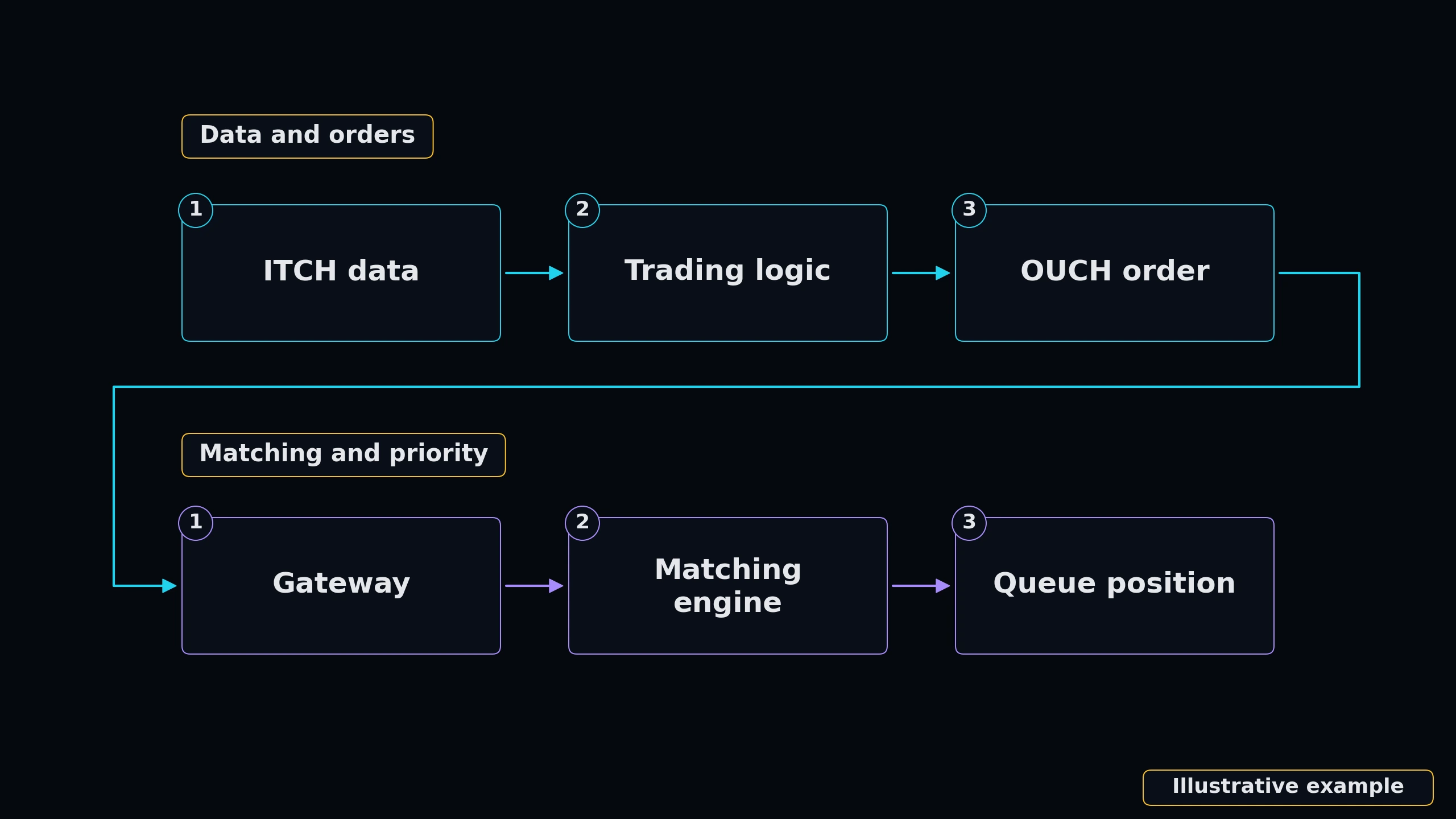 Click to enlarge
GEX Heatmap & Dealer Hedging Profile
The Gamma Exposure (GEX) profile dictates the hedging loops of market-makers. Slide the price pointer below to see how institutional hedging flows suppress volatility or trigger cascading market trends.
Price Controller
Gamma Transition Zone (Near $100): Resting near the Volatility Flip Line. Dealer hedging is transitioning, making the price range choppy as dealer flows oscillate. Expect choppy intraday price ranges.
KNOWLEDGE RECONNAISSANCE
How do binary market protocols like NASDAQ's ITCH/OUCH differ from standard FIX protocol messages?
More lessons in this module
- 14.0: Introduction to High-Frequency Trading (HFT)
- 14.1: Microsecond Hardware, FPGAs & Kernel Bypass
- 14.3: Co-Location & Microwave Transmission Networks
- 14.4: Market Making Algorithms & Inventory Risk
- 14.5: Latency Arbitrage & Cross-Venue Arbitrage
- 14.6: Dark Pools, Internalization & Payment for Order Flow (PFOF)
- 14.7: HFT Risk Controls, Circuit Breakers & Kill Switches
- 14.8: Analyzing HFT Impact on Market Quality & Liquidity
Signal Desk is where you practice this on real stocks: real option chains (about 15 minutes delayed), the Trade Check and a paper-trading account that risks no real money. Join to add it, your progress tracking and PDF downloads.