
A hands-on options curriculum covering real trading concepts. Read the lessons, work through examples, and test your knowledge.
OVERALL ACADEMY PROGRESS
Free Lesson
Every lesson is free to read. Subscribe to add Signal Desk, progress tracking, PDF downloads and the lesson tutor.
Lesson 4: 12.4: Limit Orders
Understand the passive side of order flow: resting orders that act as support, resistance, and liquidity barriers.
1. Passive Liquidity and Price Control
Limit orders are instructions to buy or sell at a specific price or better. They prioritize price control over execution certainty, resting in the book until hit.
These resting orders form the passive 'liquidity' of the market. They act as protective buffers or roadblocks. A thick block of resting buy limit orders will absorb selling pressure, preventing price from falling easily.
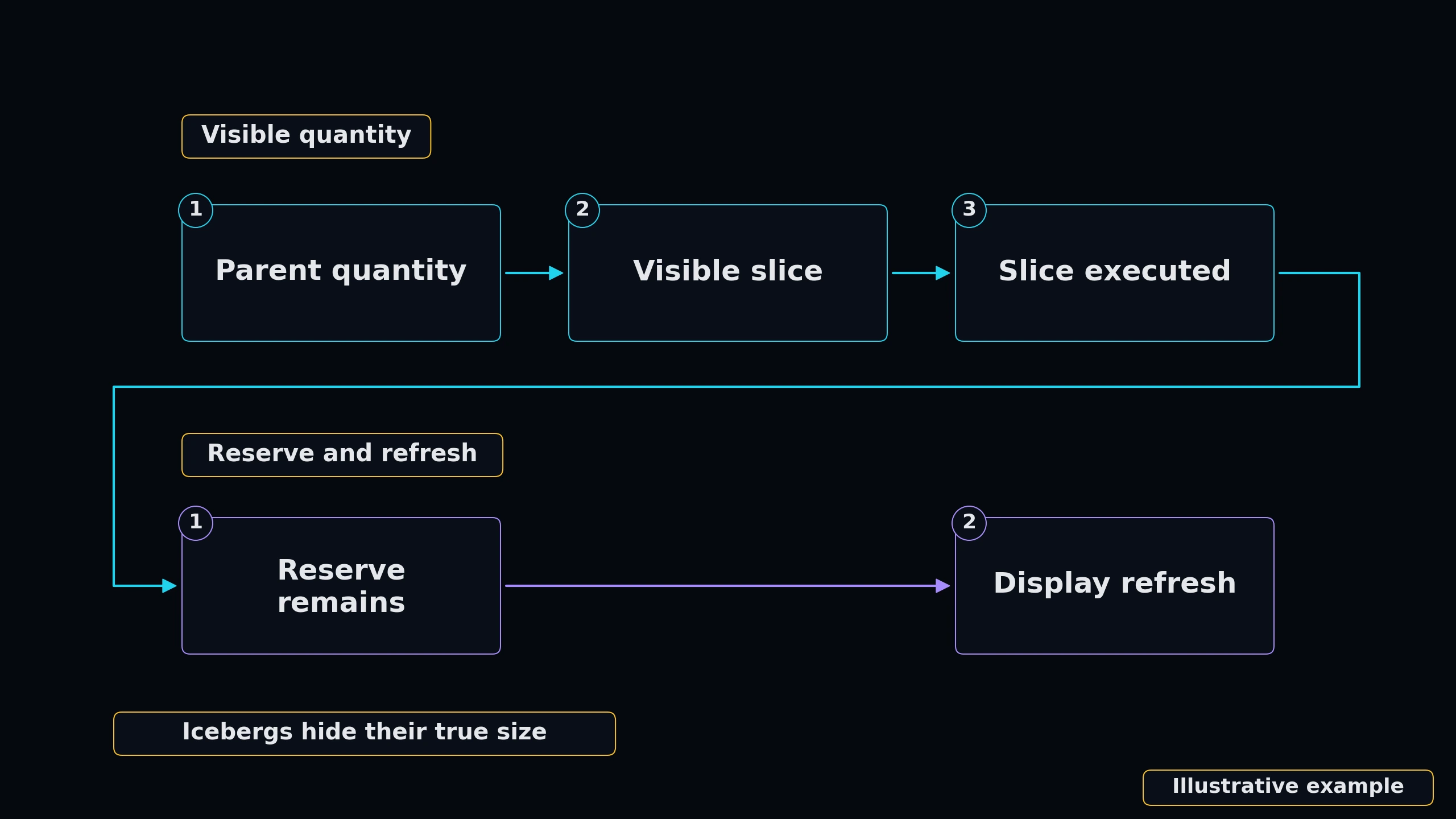
★ Iceberg Orders: Large institutional limit orders are often broken into tiny visible chunks (icebergs) to hide their true size from other participants.
2. Order Book Spoofing
Because limit orders can be cancelled at any time before execution, market participants often submit large limit orders far from the current price to create the illusion of support or resistance, only to cancel them as price approaches. This manipulative practice is known as spoofing.
 Click to enlarge
Options Structure Exploration
Options are contracts cleared in the bid-ask auction market. Interact with the Order Book below to understand how buy offers (bids) and sell offers (asks) intersect, and inspect the structural breakdown between Call and Put contracts.
Limit Order Book & Spread Interface
Hover over ASK or BID to dissect the auction market dynamics.
Right to Buy
- Outlook: Bullish (Goes up)
- Risk: Capped to premium paid
- Profit: Scales as stock surges
Right to Sell
- Outlook: Bearish (Goes down)
- Risk: Capped to premium paid
- Profit: Scales as stock falls
KNOWLEDGE RECONNAISSANCE
What is an 'Iceberg' order in institutional order flow trading?
More lessons in this module
- 12.0: Introduction to Order Flow
- 12.1: Order Flow Basics
- 12.2: Bid vs. Ask Mechanics
- 12.3: Market Orders
- 12.5: Footprint Charts
- 12.6: Delta
- 12.7: Absorption
- 12.8: Order Flow Trading Strategies
Signal Desk is where you practice this on real stocks: real option chains (about 15 minutes delayed), the Trade Check and a paper-trading account that risks no real money. Join to add it, your progress tracking and PDF downloads.