
A hands-on options curriculum covering real trading concepts. Read the lessons, work through examples, and test your knowledge.
OVERALL ACADEMY PROGRESS
Free Lesson
Every lesson is free to read. Subscribe to add Signal Desk, progress tracking, PDF downloads and the lesson tutor.
Lesson 3: 12.3: Market Orders
Explore the role of market orders as the source of market urgency and initiative pressure.
1. Market Orders and Urgency
Market orders are instructions to buy or sell immediately at the best available current market price. They prioritize speed and execution certainty over price control.
Because market orders demand instant execution, they are the primary source of 'initiative' pressure in the market. They consume resting liquidity, clearing out price levels and forcing price to move.
★ Slippage Risk: In fast-moving or thin markets, large market orders can clear out multiple rows of the order book, resulting in execution slippage.
2. The Momentum Driver
Institutional algorithms often use market orders (or high-speed marketable limit orders) to aggressive build or liquidate positions. By tracking surges in market orders, we can spot institutional momentum as it happens, rather than waiting for candle closes.
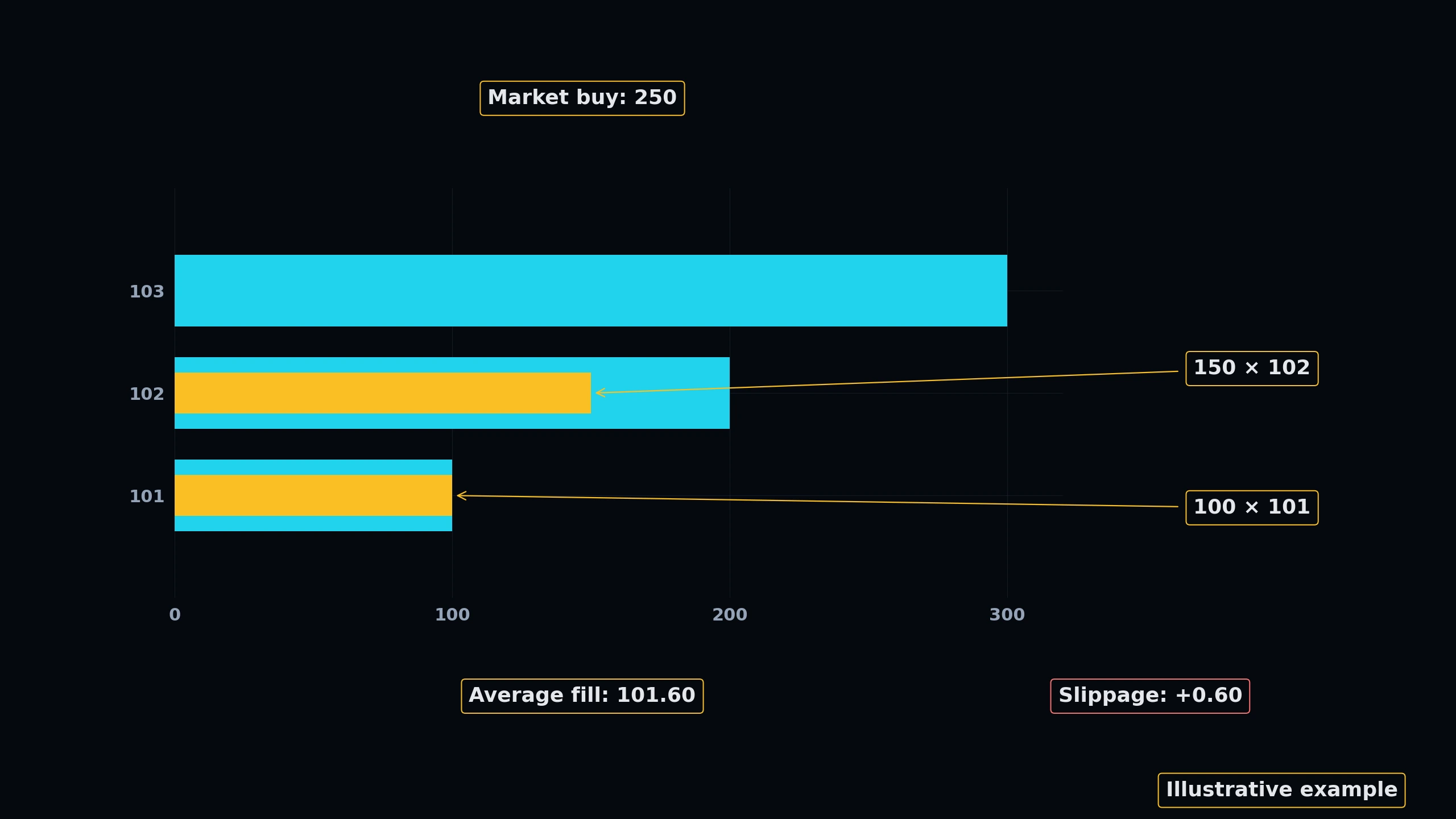 Click to enlarge
Options Structure Exploration
Options are contracts cleared in the bid-ask auction market. Interact with the Order Book below to understand how buy offers (bids) and sell offers (asks) intersect, and inspect the structural breakdown between Call and Put contracts.
Limit Order Book & Spread Interface
Hover over ASK or BID to dissect the auction market dynamics.
Right to Buy
- Outlook: Bullish (Goes up)
- Risk: Capped to premium paid
- Profit: Scales as stock surges
Right to Sell
- Outlook: Bearish (Goes down)
- Risk: Capped to premium paid
- Profit: Scales as stock falls
KNOWLEDGE RECONNAISSANCE
Why do market orders cause prices to move?
More lessons in this module
- 12.0: Introduction to Order Flow
- 12.1: Order Flow Basics
- 12.2: Bid vs. Ask Mechanics
- 12.4: Limit Orders
- 12.5: Footprint Charts
- 12.6: Delta
- 12.7: Absorption
- 12.8: Order Flow Trading Strategies
Signal Desk is where you practice this on real stocks: real option chains (about 15 minutes delayed), the Trade Check and a paper-trading account that risks no real money. Join to add it, your progress tracking and PDF downloads.