
A hands-on options curriculum covering real trading concepts. Read the lessons, work through examples, and test your knowledge.
OVERALL ACADEMY PROGRESS
Free Lesson
Every lesson is free to read. Subscribe to add Signal Desk, progress tracking, PDF downloads and the lesson tutor.
Key terms in this lesson
Lesson 5: 7.4: Trend Reversals vs. Pullbacks
Differentiate between a healthy trend retracement (pullback) and a structural trend reversal.
1. Defining Retracements (Pullbacks)
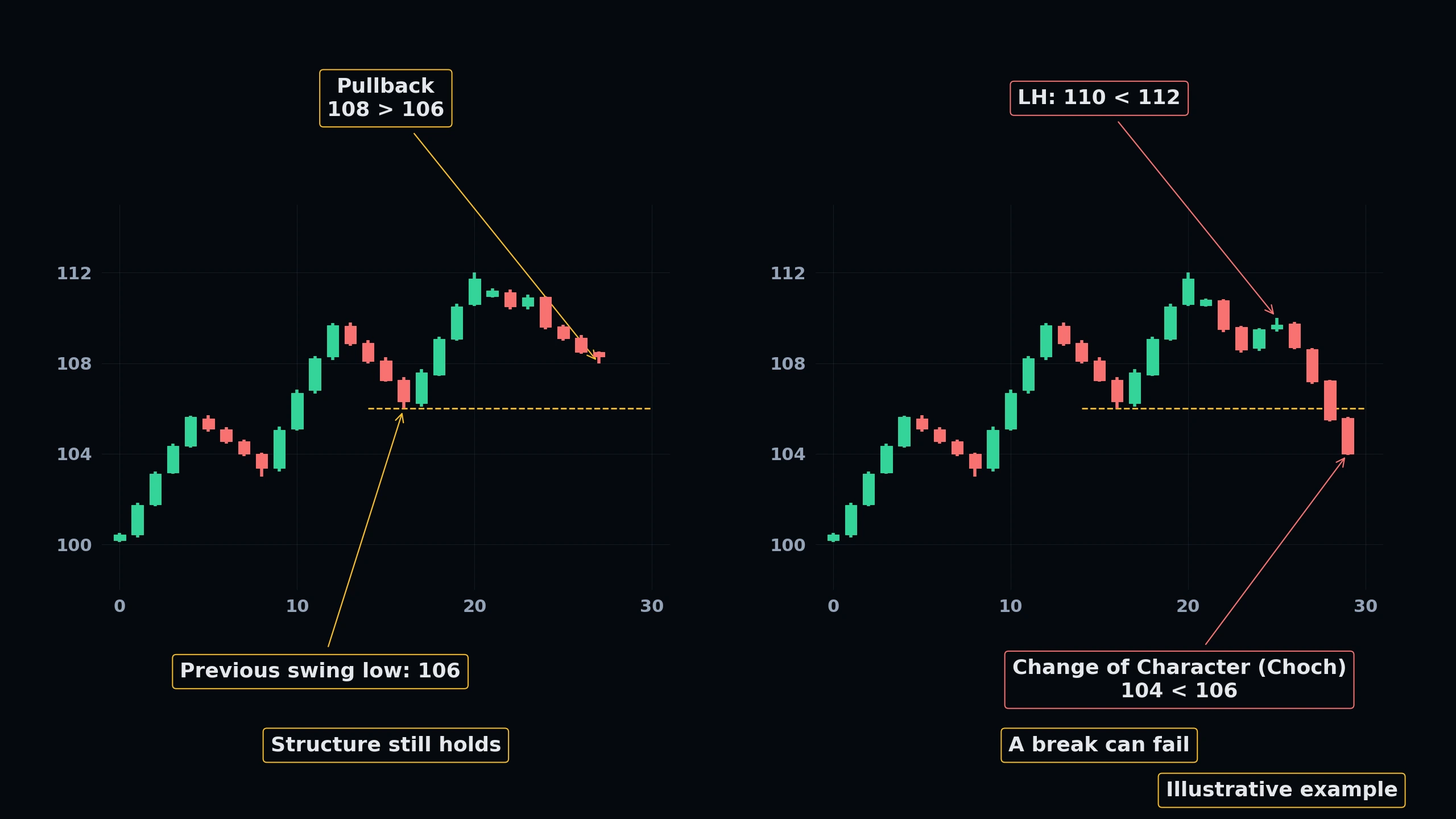
A pullback is a temporary counter-trend move that does not violate the underlying trend structure. Pullbacks represent profit-taking and offer low-risk entry points in the direction of the dominant trend.
Traders use tools like Fibonacci Retracements (specifically the 38.2%, 50%, and 61.8% levels) and key volume nodes to predict where a pullback will end and the trend will resume.
★ Golden Rule: Pullbacks should occur on decreasing volume, signaling a lack of conviction from counter-trend sellers.
2. Identifying Reversals (Change of Character)
A reversal occurs when the trend structure is permanently broken. In an uptrend, this happens when price makes a lower high and then breaks below the previous swing low (a Change of Character, or Choch).
Reversals are typically accompanied by heavy volume on the break, confirming institutional capital is rotating out of the asset.
 Click to enlarge
KNOWLEDGE RECONNAISSANCE
What is a key volume characteristic of a healthy pullback within an uptrend?
More lessons in this module
- 7.0: Foundations of Trend Theory
- 7.1: Moving Averages as Dynamic Support & Resistance
- 7.2: Trendlines, Channels & Acceleration
- 7.3: Average Directional Index (ADX) & Momentum
Signal Desk is where you practice this on real stocks: real option chains (about 15 minutes delayed), the Trade Check and a paper-trading account that risks no real money. Join to add it, your progress tracking and PDF downloads.