
A hands-on options curriculum covering real trading concepts. Read the lessons, work through examples, and test your knowledge.
OVERALL ACADEMY PROGRESS
Free Lesson
Every lesson is free to read. Subscribe to add Signal Desk, progress tracking, PDF downloads and the lesson tutor.
Key terms in this lesson
Lesson 1: 7.0: Foundations of Trend Theory
Master the baseline principles of trend definition, Dow Theory, and the core structural phases of market cycles.
1. What is a Trend?
A market trend is the general direction in which an asset's price is moving. Under classical Dow Theory, trends are defined by the relationship of price peaks and troughs.
An Uptrend is a series of higher highs (HH) and higher lows (HL). A Downtrend is a series of lower highs (LH) and lower lows (LL). When price fails to make consecutive higher highs or lower lows, the market is in a Sideways (ranging) phase.
★ Key Principle: Trends exist across multiple timeframes. A daily uptrend can contain an intraday hourly downtrend.
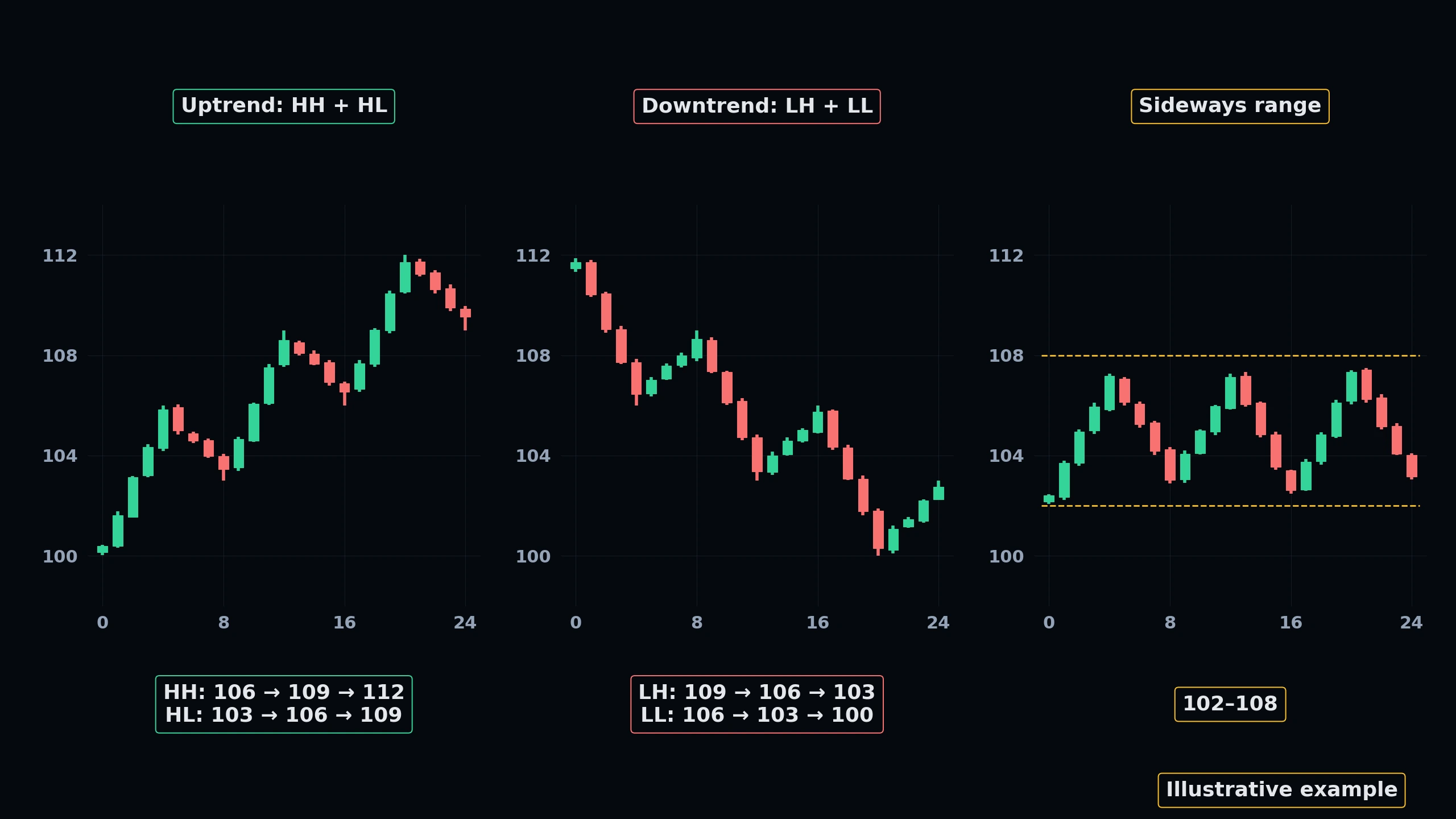 Click to enlarge
2. The Four Market Phases
Every trend moves through four distinct structural phases:
• Accumulation: Smart money and institutional buyers build positions quietly while price ranges.
• Markup: Price breaks out of accumulation, establishing a strong, visible uptrend as the public buys in.
• Distribution: Institutions distribute (sell) their positions to late-entering retail buyers, creating a choppy top range.
• Markdown: Price breaks down from distribution, embarking on a sharp downtrend as capitulation sets in.
KNOWLEDGE RECONNAISSANCE
According to Dow Theory, how is a structural uptrend defined?
What happens during the 'Distribution' phase of a market cycle?
More lessons in this module
- 7.1: Moving Averages as Dynamic Support & Resistance
- 7.2: Trendlines, Channels & Acceleration
- 7.3: Average Directional Index (ADX) & Momentum
- 7.4: Trend Reversals vs. Pullbacks
Signal Desk is where you practice this on real stocks: real option chains (about 15 minutes delayed), the Trade Check and a paper-trading account that risks no real money. Join to add it, your progress tracking and PDF downloads.