
A hands-on options curriculum covering real trading concepts. Read the lessons, work through examples, and test your knowledge.
OVERALL ACADEMY PROGRESS
Free Lesson
Every lesson is free to read. Subscribe to add Signal Desk, progress tracking, PDF downloads and the lesson tutor.
Lesson 4: 16.4: Smart Order Routing Architecture & Exchange Fee Schedules
Examine multi-venue Smart Order Router (SOR) logic, maker-taker rebate schedules, inverted fee venues, and routing latency.
1. Smart Order Router (SOR) Architecture
Equity markets are highly fragmented across dozens of lit exchanges (NYSE, NASDAQ, Cboe, IEX). A Smart Order Router (SOR) scans real-time consolidated depth (NBBO) across all venues.
SOR algorithms dynamically split and route child orders to venues offering the best price, deepest liquidity, and lowest execution latency.
★ Fee Schedule Arbitrage: Exchanges operate Maker-Taker or Taker-Maker (inverted) fee models. Providing liquidity yields rebates (~$0.0020/share), whereas taking liquidity incurs fees.
2. Sweep and Router Latency
When sweeping liquidity across multiple venues simultaneously, SORs calculate optical travel times to ensure child orders arrive at different exchanges at the exact same microsecond, preventing HFT front-running.
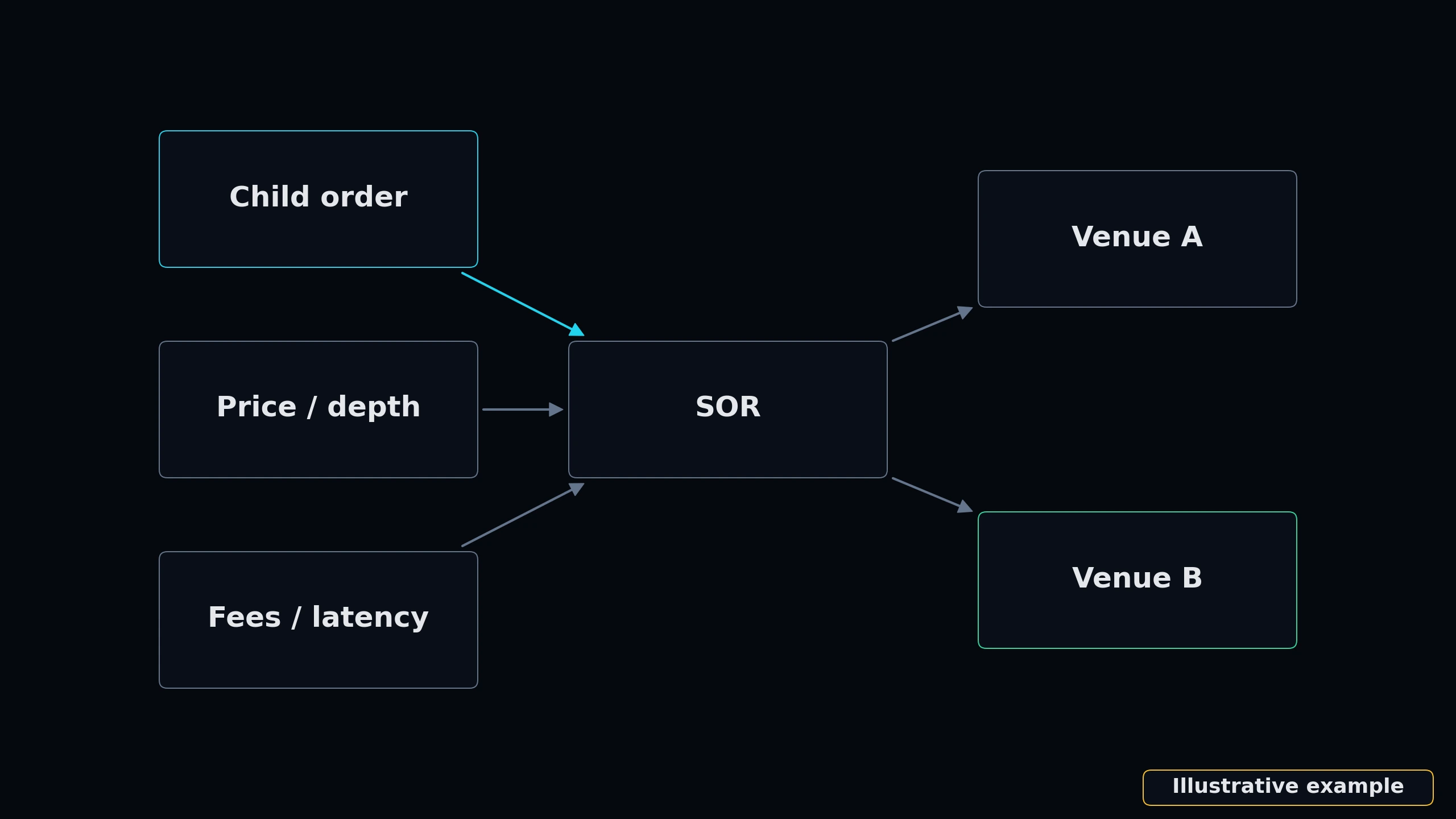 Click to enlarge
Options Structure Exploration
Options are contracts cleared in the bid-ask auction market. Interact with the Order Book below to understand how buy offers (bids) and sell offers (asks) intersect, and inspect the structural breakdown between Call and Put contracts.
Limit Order Book & Spread Interface
Hover over ASK or BID to dissect the auction market dynamics.
Right to Buy
- Outlook: Bullish (Goes up)
- Risk: Capped to premium paid
- Profit: Scales as stock surges
Right to Sell
- Outlook: Bearish (Goes down)
- Risk: Capped to premium paid
- Profit: Scales as stock falls
KNOWLEDGE RECONNAISSANCE
What is the function of a Maker-Taker fee schedule on financial exchanges?
More lessons in this module
- 16.0: Overview of Institutional Algorithmic Execution Strategies
- 16.1: TWAP & Volume Trajectory Algorithms
- 16.2: VWAP Engineering & Tracking Error
- 16.3: Implementation Shortfall & Arrival Price Algorithms
- 16.5: Dark Pool Aggregation & Anti-Gaming Execution Tactics
- 16.6: Market Impact Models & Transaction Cost Analysis (TCA)
- 16.7: Dynamic Adaptive Algorithms
- 16.8: Institutional TCA Reporting & Execution Optimization
Signal Desk is where you practice this on real stocks: real option chains (about 15 minutes delayed), the Trade Check and a paper-trading account that risks no real money. Join to add it, your progress tracking and PDF downloads.