
A hands-on options curriculum covering real trading concepts. Read the lessons, work through examples, and test your knowledge.
OVERALL ACADEMY PROGRESS
Free Lesson
Every lesson is free to read. Subscribe to add Signal Desk, progress tracking, PDF downloads and the lesson tutor.
Lesson 1: 15.1: Prospect Theory & Mental Accounting in Portfolio Decisions
Examine Kahneman-Tversky prospect theory, asymmetric value functions, and mental accounting buckets.
1. The Foundations of Prospect Theory
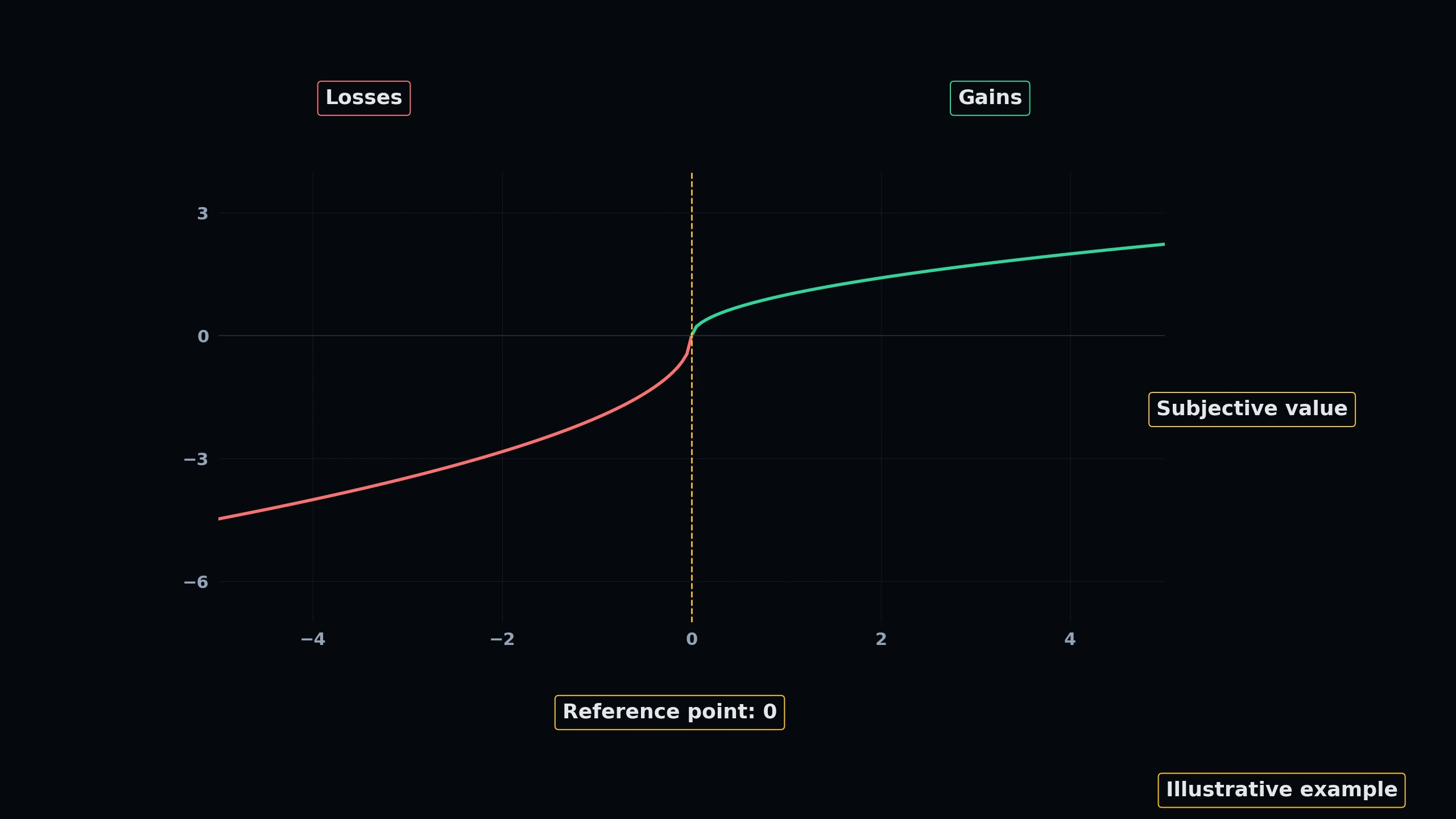
Developed by Daniel Kahneman and Amos Tversky, Prospect Theory replaces Expected Utility Theory by showing that individuals evaluate outcomes based on perceived gains and losses relative to a reference point, rather than total wealth.
The value function is S-shaped: concave for gains (risk-averse) and convex for losses (risk-seeking when facing guaranteed losses).
★ Probability Weighting: Decision makers overweight small probabilities (buying lottery-ticket style options) and underweight moderate-to-high probabilities.
2. Mental Accounting Buckets
Traders separate money into distinct non-fungible 'mental accounts' (e.g., house money effect after a big win vs. principal capital).
This separation leads to irrational risk-taking, as traders treat accrued profits far more carelessly than initial deposits.
 Click to enlarge
IV Crush Scenario Visualizer
Implied Volatility (IV) Crush is the primary account-killer for option buyers after earnings announcements. Play with the controls below to see how option premium collapses depending on Vega.
Scenario Modeling
KNOWLEDGE RECONNAISSANCE
Under Prospect Theory, how do individuals behave when facing a choices between guaranteed losses and high-risk gambles?
More lessons in this module
- 15.0: Cognitive Biases in Trading
- 15.2: Sentiment Analysis Frameworks
- 15.3: Social Media & NLP Sentiment Signals
- 15.4: Market Psychology & Herd Behavior
- 15.5: Institutional Positioning Metrics
- 15.6: Quantitative Sentiment Modeling
- 15.7: Neurofinance & Decision Making Under Risk
- 15.8: Building Sentiment-Driven Algorithmic Strategies & Risk Rules
Signal Desk is where you practice this on real stocks: real option chains (about 15 minutes delayed), the Trade Check and a paper-trading account that risks no real money. Join to add it, your progress tracking and PDF downloads.