
A hands-on options curriculum covering real trading concepts. Read the lessons, work through examples, and test your knowledge.
OVERALL ACADEMY PROGRESS
Free Lesson
Every lesson is free to read. Subscribe to add Signal Desk, progress tracking, PDF downloads and the lesson tutor.
Lesson 7: 13.7: Counterparty Risk, ISDA Agreements & Collateral (CSA)
Mitigate credit risk through ISDA Master Agreements, Credit Support Annex (CSA), initial margin, and variation margin.
1. Frameworks for Bilateral OTC Contracting
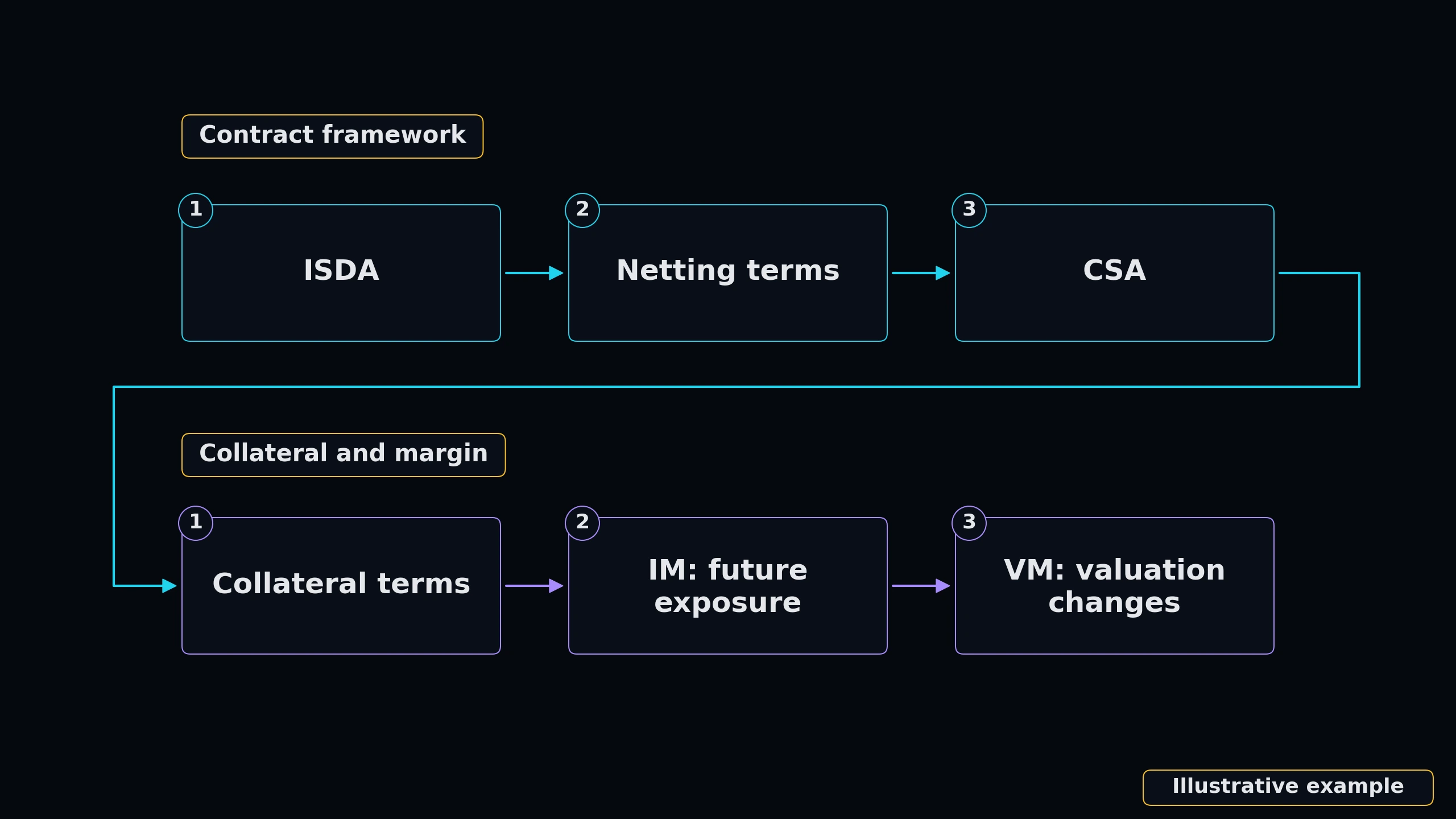
To mitigate counterparty default risk in the multi-trillion dollar OTC derivatives market, institutions utilize standardized contracts created by the International Swaps and Derivatives Association (ISDA).
• ISDA Master Agreement: Sets forth standard terms, legal definitions, netting provisions, and event-of-default procedures for all derivative trades between two institutions.
• Credit Support Annex (CSA): Regulates collateral posting requirements. It defines threshold amounts, acceptable collateral types (cash, Treasuries), and daily valuation procedures.
2. Initial Margin (IM) & Variation Margin (VM)
• Variation Margin (VM): Transferred daily to reflect mark-to-market fluctuations in trade value.
• Initial Margin (IM): Held separately as a risk buffer to protect against potential future exposure during a counterparty default liquidation window.
 Click to enlarge
Options Structure Exploration
Options are contracts cleared in the bid-ask auction market. Interact with the Order Book below to understand how buy offers (bids) and sell offers (asks) intersect, and inspect the structural breakdown between Call and Put contracts.
Limit Order Book & Spread Interface
Hover over ASK or BID to dissect the auction market dynamics.
Right to Buy
- Outlook: Bullish (Goes up)
- Risk: Capped to premium paid
- Profit: Scales as stock surges
Right to Sell
- Outlook: Bearish (Goes down)
- Risk: Capped to premium paid
- Profit: Scales as stock falls
KNOWLEDGE RECONNAISSANCE
What is the primary role of the Credit Support Annex (CSA) within an ISDA Master Agreement?
More lessons in this module
- 13.0: Introduction to Swaps & Derivatives Architecture
- 13.1: Interest Rate Swaps (IRS) Mechanics
- 13.2: Credit Default Swaps (CDS) & Default Protection
- 13.3: Total Return Swaps (TRS) & Synthetic Exposure
- 13.4: Foreign Exchange Swaps & Cross-Currency Swaps
- 13.5: Exotic Options: Barrier, Digital & Lookback Options
- 13.6: Structured Notes & Capital Protection Products
- 13.8: Practical Derivatives Application: Corporate Risk Playbook
Signal Desk is where you practice this on real stocks: real option chains (about 15 minutes delayed), the Trade Check and a paper-trading account that risks no real money. Join to add it, your progress tracking and PDF downloads.