
A hands-on options curriculum covering real trading concepts. Read the lessons, work through examples, and test your knowledge.
OVERALL ACADEMY PROGRESS
Free Lesson
Every lesson is free to read. Subscribe to add Signal Desk, progress tracking, PDF downloads and the lesson tutor.
Key terms in this lesson
Lesson 3: 13.3: Total Return Swaps (TRS) & Synthetic Exposure
Explore total return swaps where cash flows are tied to capital gains and income of underlying assets without physical ownership.
1. Synthetic Asset Ownership via TRS
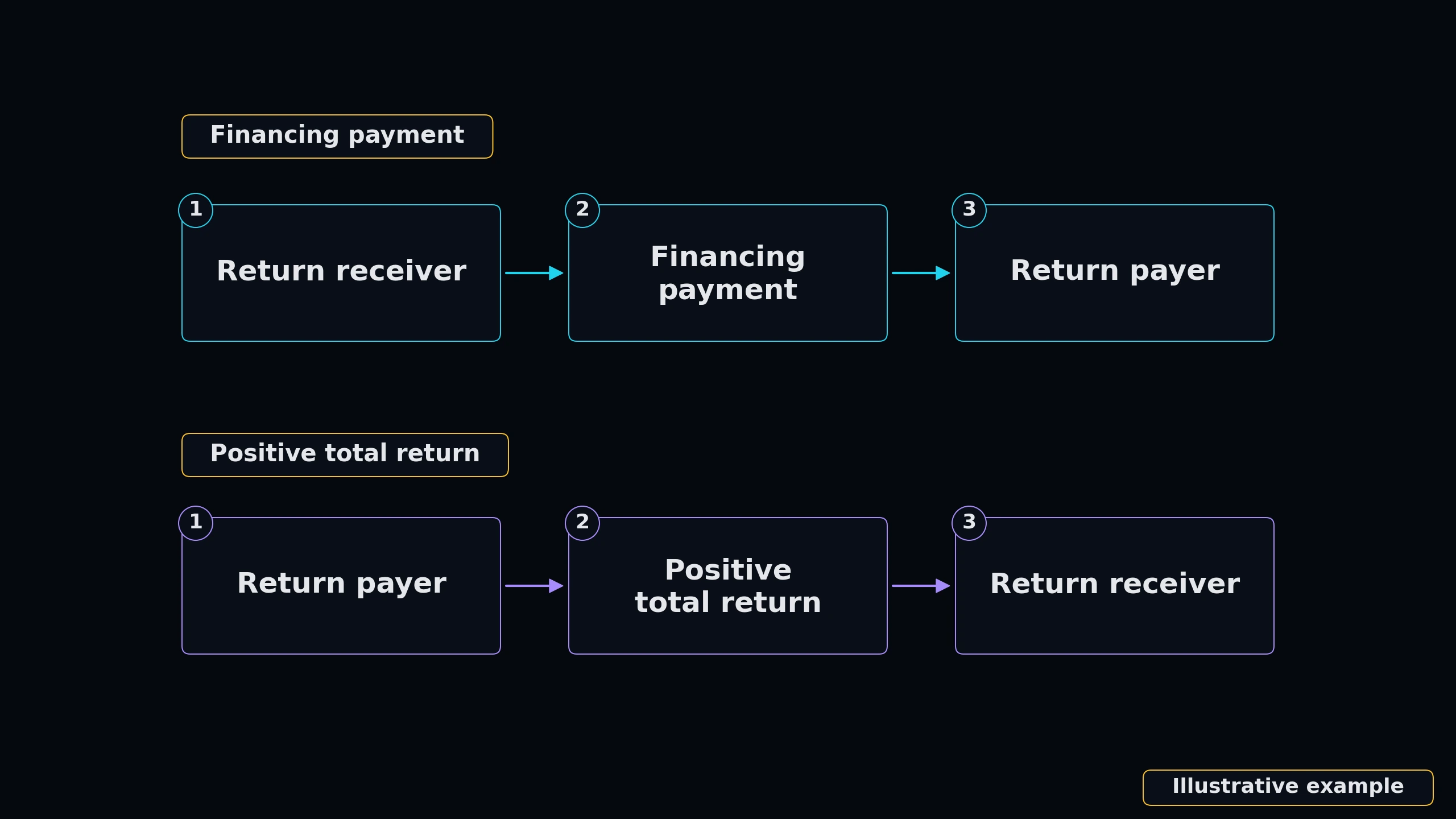
In a Total Return Swap (TRS), Party A (the total return receiver) pays a set floating interest rate (e.g., SOFR + spread) to Party B (the total return payer).
In exchange, Party B pays Party A the total economic return of a reference asset—including all price appreciation plus interest or dividend payouts. Conversely, if the asset loses value, Party A must pay Party B the capital loss.
★ Key Benefit: TRS allows institutional investors and hedge funds to gain 100% economic exposure to equities, bonds, or commodities without taking physical delivery or balance-sheet ownership.
2. Balance Sheet & Leverage Implications
Prime brokerages frequently use TRS to provide synthetic leverage to hedge funds. Because the bank holds the physical asset on its balance sheet while passing through economic performance, the fund avoids borrowing cash directly to purchase shares.
However, unhedged TRS concentrations can cause rapid margin calls if the reference asset drops sharply.
 Click to enlarge
Options Structure Exploration
Options are contracts cleared in the bid-ask auction market. Interact with the Order Book below to understand how buy offers (bids) and sell offers (asks) intersect, and inspect the structural breakdown between Call and Put contracts.
Limit Order Book & Spread Interface
Hover over ASK or BID to dissect the auction market dynamics.
Right to Buy
- Outlook: Bullish (Goes up)
- Risk: Capped to premium paid
- Profit: Scales as stock surges
Right to Sell
- Outlook: Bearish (Goes down)
- Risk: Capped to premium paid
- Profit: Scales as stock falls
KNOWLEDGE RECONNAISSANCE
What does the receiver of a Total Return Swap pay to the total return payer in exchange for asset performance?
More lessons in this module
- 13.0: Introduction to Swaps & Derivatives Architecture
- 13.1: Interest Rate Swaps (IRS) Mechanics
- 13.2: Credit Default Swaps (CDS) & Default Protection
- 13.4: Foreign Exchange Swaps & Cross-Currency Swaps
- 13.5: Exotic Options: Barrier, Digital & Lookback Options
- 13.6: Structured Notes & Capital Protection Products
- 13.7: Counterparty Risk, ISDA Agreements & Collateral (CSA)
- 13.8: Practical Derivatives Application: Corporate Risk Playbook
Signal Desk is where you practice this on real stocks: real option chains (about 15 minutes delayed), the Trade Check and a paper-trading account that risks no real money. Join to add it, your progress tracking and PDF downloads.