
A hands-on options curriculum covering real trading concepts. Read the lessons, work through examples, and test your knowledge.
OVERALL ACADEMY PROGRESS
Free Lesson
Every lesson is free to read. Subscribe to add Signal Desk, progress tracking, PDF downloads and the lesson tutor.
Lesson 1: 13.1: Interest Rate Swaps (IRS) Mechanics
Master plain vanilla interest rate swaps, fixed-for-floating cash flow calculations, and benchmark curves.
1. Plain Vanilla Interest Rate Swaps
In a standard 'plain vanilla' Interest Rate Swap (IRS), Party A agrees to pay a fixed interest rate (the swap rate) to Party B, while Party B agrees to pay a floating interest rate (benchmarked to SOFR or EURIBOR) to Party A on agreed payment dates.
The fixed-rate payer is effectively 'short' interest rates (benefiting when floating rates rise), while the floating-rate payer is 'long' rates.
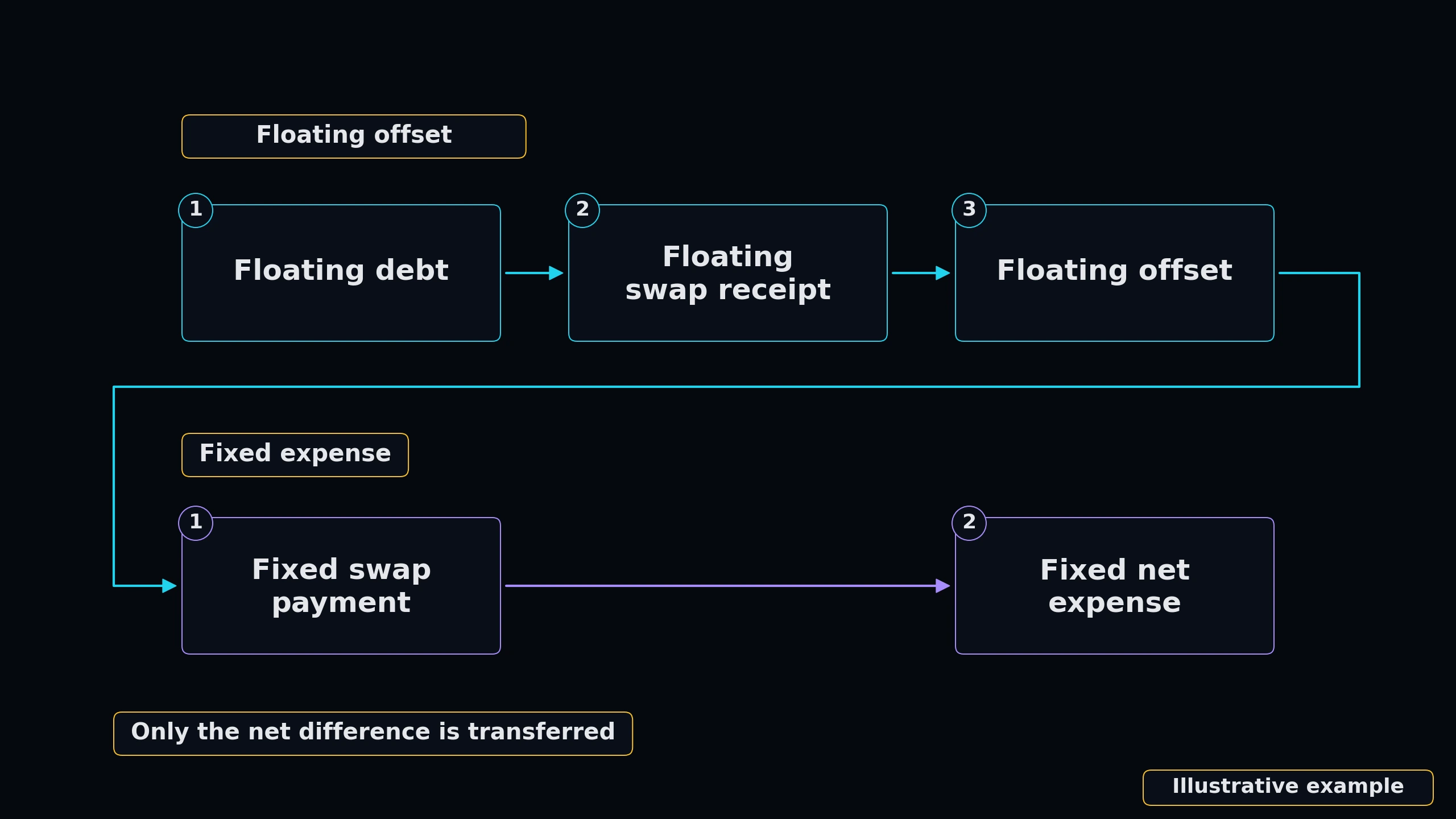
★ Netting Mechanics: On payment dates, the two cash flows are netted against each other so that only the single net difference is wire-transferred between banks.
2. Corporate Debt Hedging Example
Consider a corporation that issued $100M in floating-rate corporate debt. If market interest rates spike, their interest expenses explode. To eliminate this risk, the firm enters an IRS as the fixed-rate payer.
The floating payments received from the swap cancel out their variable debt obligations, effectively locking in a predictable, fixed interest expense.
 Click to enlarge
Options Structure Exploration
Options are contracts cleared in the bid-ask auction market. Interact with the Order Book below to understand how buy offers (bids) and sell offers (asks) intersect, and inspect the structural breakdown between Call and Put contracts.
Limit Order Book & Spread Interface
Hover over ASK or BID to dissect the auction market dynamics.
Right to Buy
- Outlook: Bullish (Goes up)
- Risk: Capped to premium paid
- Profit: Scales as stock surges
Right to Sell
- Outlook: Bearish (Goes down)
- Risk: Capped to premium paid
- Profit: Scales as stock falls
KNOWLEDGE RECONNAISSANCE
Why would a corporation with floating-rate debt enter an interest rate swap as a fixed-rate payer?
More lessons in this module
- 13.0: Introduction to Swaps & Derivatives Architecture
- 13.2: Credit Default Swaps (CDS) & Default Protection
- 13.3: Total Return Swaps (TRS) & Synthetic Exposure
- 13.4: Foreign Exchange Swaps & Cross-Currency Swaps
- 13.5: Exotic Options: Barrier, Digital & Lookback Options
- 13.6: Structured Notes & Capital Protection Products
- 13.7: Counterparty Risk, ISDA Agreements & Collateral (CSA)
- 13.8: Practical Derivatives Application: Corporate Risk Playbook
Signal Desk is where you practice this on real stocks: real option chains (about 15 minutes delayed), the Trade Check and a paper-trading account that risks no real money. Join to add it, your progress tracking and PDF downloads.