
A hands-on options curriculum covering real trading concepts. Read the lessons, work through examples, and test your knowledge.
OVERALL ACADEMY PROGRESS
Free Lesson
Every lesson is free to read. Subscribe to add Signal Desk, progress tracking, PDF downloads and the lesson tutor.
Lesson 2: 19.2: Convertible Bond Arbitrage & Delta-Neutral Volatility Trading
Deconstruct convertible bond pricing, embedded equity options, delta-neutral hedging, gamma trading, and credit risk.
1. Structure of Convertible Bond Arbitrage
Convertible bonds are corporate bonds that can be converted into a fixed number of equity shares.
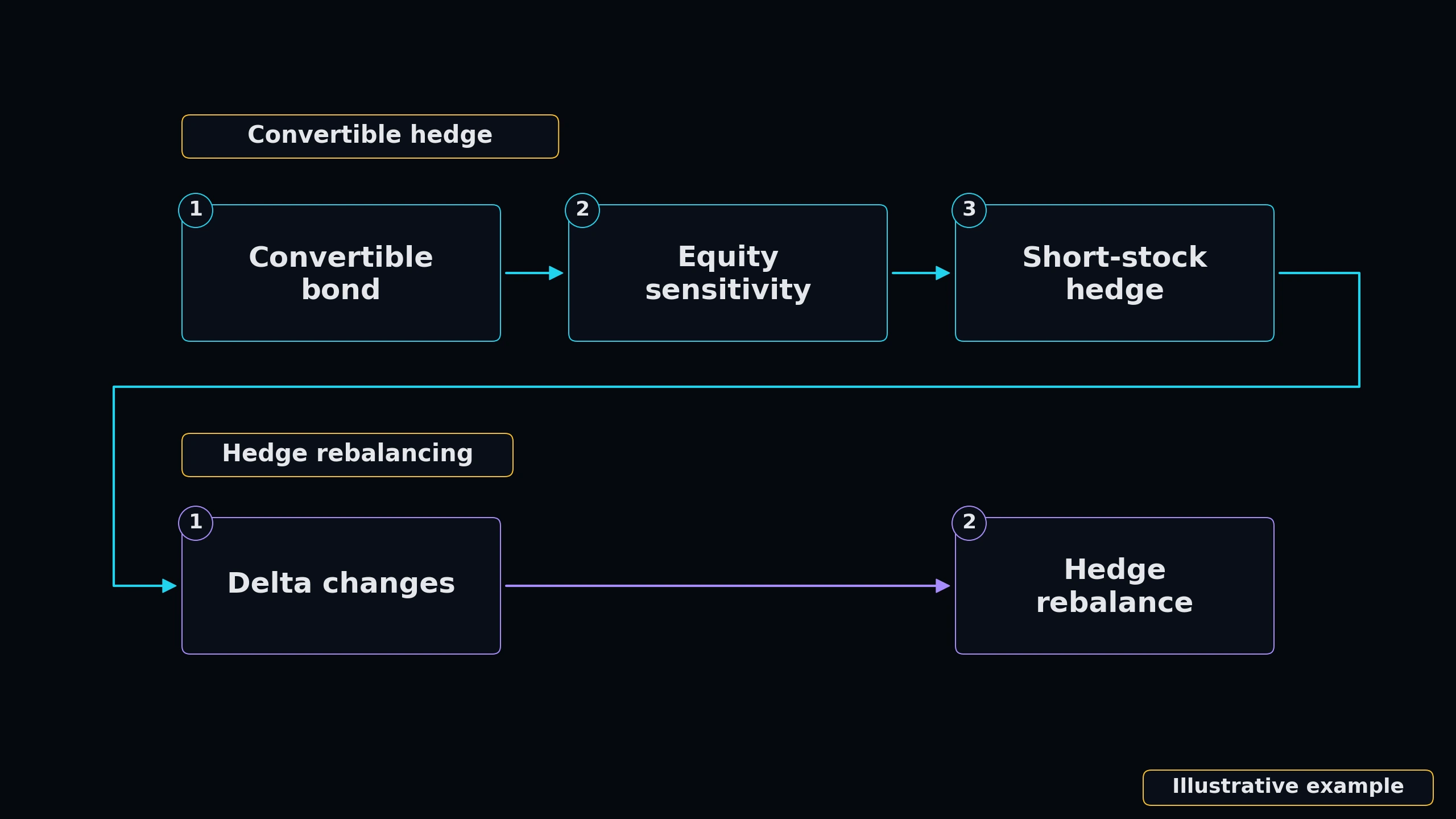
Convertible Arbitrage involves buying the underpriced convertible bond and shorting the underlying common stock to isolate the embedded equity option.
★ Delta-Neutral Hedging: The short stock position is sized to the bond's share-equivalent delta: Short Shares = Number of Bonds × Conversion Ratio (shares per bond) × Delta.
2. Gamma Trading & Credit Protection
As the underlying stock price fluctuates, the arbitrageur dynamically rebalances the short hedge (gamma trading)—selling stock as it rises and buying stock as it falls.
Credit risk is hedged using Credit Default Swaps (CDS).
 Click to enlarge
Options Structure Exploration
Options are contracts cleared in the bid-ask auction market. Interact with the Order Book below to understand how buy offers (bids) and sell offers (asks) intersect, and inspect the structural breakdown between Call and Put contracts.
Limit Order Book & Spread Interface
Hover over ASK or BID to dissect the auction market dynamics.
Right to Buy
- Outlook: Bullish (Goes up)
- Risk: Capped to premium paid
- Profit: Scales as stock surges
Right to Sell
- Outlook: Bearish (Goes down)
- Risk: Capped to premium paid
- Profit: Scales as stock falls
KNOWLEDGE RECONNAISSANCE
How does a convertible bond arbitrageur establish a initial delta-neutral position?
More lessons in this module
- 19.0: Overview of Global Arbitrage & Event-Driven Strategies
- 19.1: Merger & Risk Arbitrage (M&A Deal Structures & Break Spreads)
- 19.3: Fixed Income & Yield Curve Arbitrage (Treasury-Swap Spreads, Basis Trades)
- 19.4: Index Arbitrage & Program Trading Mechanics
- 19.5: Distressed Debt, Restructuring, & Bankruptcy Investing
- 19.6: Corporate Actions & Special Situations (Spin-offs, Tender Offers, Rights Offerings)
- 19.7: Cross-Border & ADR Arbitrage (FX & Capital Control Dynamics)
- 19.8: Quantitative Event-Driven Strategies (Earning Surprises, NLP Catalyst Feeds)
Signal Desk is where you practice this on real stocks: real option chains (about 15 minutes delayed), the Trade Check and a paper-trading account that risks no real money. Join to add it, your progress tracking and PDF downloads.