
Risk · November 4, 2026 · 7 min read
Short Call Option Explained: Limited Profit, Unlimited Loss
By Gerson Yoss
A short call is a call option you have sold and still owe under. If it is uncovered, the option premium is the most the option can earn, while the potential loss is unlimited.
This guide explains the obligation, contrasts an uncovered call with a covered call and calculates a made-up expiration example. It is education, not a recommendation to sell options.
The short version
- Short identifies a sold option, not a prediction or an order to short shares.
- An uncovered short call has unlimited potential loss.
- Maximum option profit is the premium received, excluding costs.
- Owning matching shares changes the combined position, but leaves stock downside risk.
What the seller owes
The OIC naked call page describes an uncovered sold call and explicitly identifies unlimited maximum loss. A call seller can be required to deliver shares at the strike upon assignment. The glossary calls this an uncovered or naked option. A premium receipt does not remove that obligation.
The opening cash flow and the eventual result answer different questions. Receiving cash records what came in at entry. Profit also requires accounting for what the position later costs to close or settle. The example therefore begins with a premium receipt but does not label that receipt as a completed profit. This distinction matters even in a worksheet with no commissions or other charges.
Define the inventory before calculating
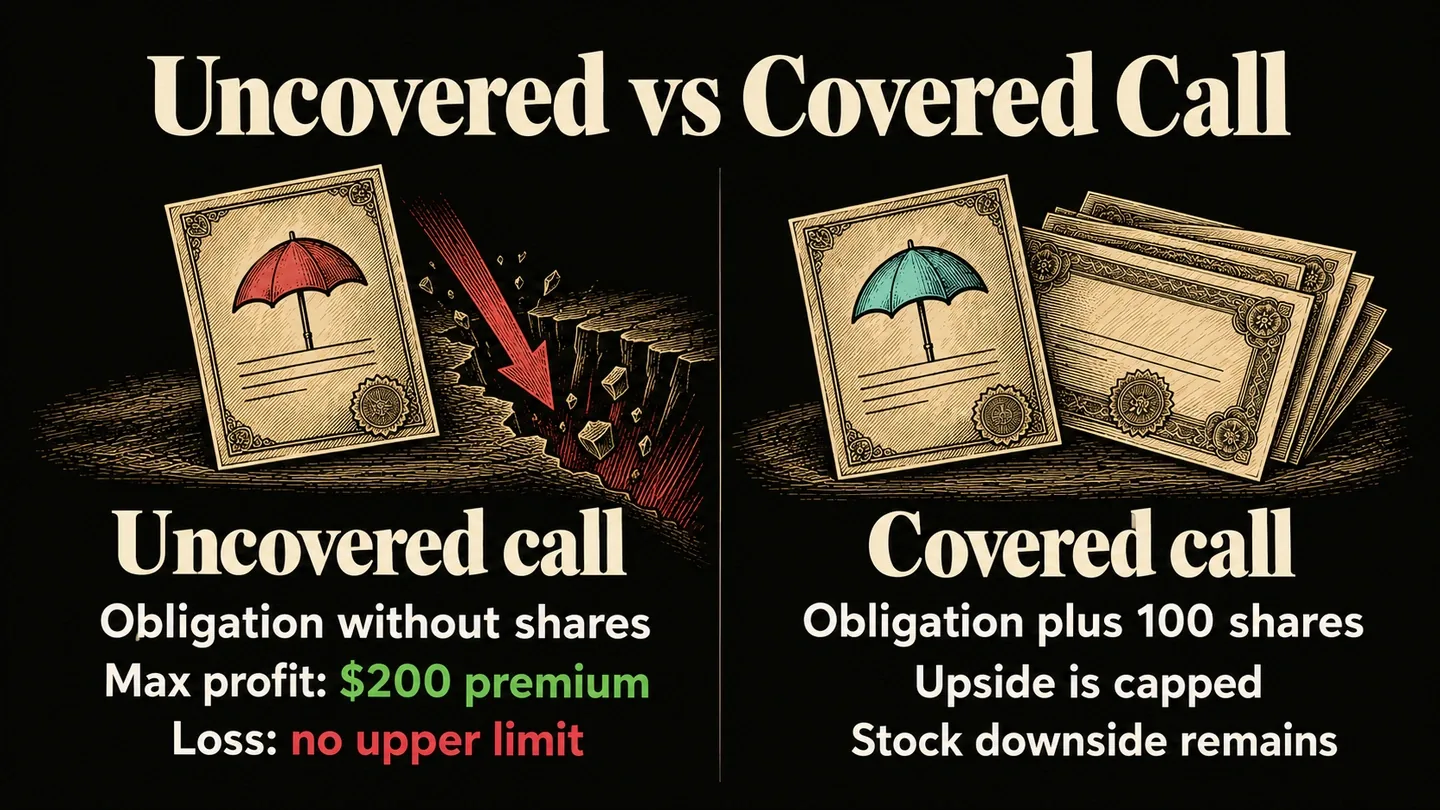
This illustration sells one $105 call for $2 per share. One contract controls 100 shares. It starts with no owned stock and no purchased option hedge. The hypothetical stock begins at $100. The contract brings in $2 × 100 = $200. All prices are made up, and fees, dividends, financing and taxes are omitted.
- Sold call strike: $105.
- Premium received: $2 per share, or $200.
- Shares owned at entry: zero.
- Maximum profit on the option: $200; potential loss: unlimited.
The word uncovered describes the missing matching stock holding in this illustration. It is not a statement about whether a broker permits the position. Permission, margin and buying power require separate information. The $200 premium is also not a deposit that defines the largest possible loss. The later rows demonstrate why a small opening receipt can accompany a much larger negative outcome.
Worked example and payoff chart
At expiration, let S mean the stock price. The sold call’s result is [$2 - max(S - $105, $0)] × 100. The second term is the call’s exercise value, which is owed by the seller in this payoff calculation. It is subtracted from the premium rather than added to it.
| Stock at expiration | Call exercise value per share | Premium retained less value owed |
|---|---|---|
| $90 | $0 | +$200 |
| $105 | $0 | +$200 |
| $107 | $2 | $0 |
| $110 | $5 | -$300 |
| $120 | $15 | -$1,300 |
| $150 | $45 | -$4,300 |
The right edge is only the edge of the drawing. It is not a loss cap. A chart must stop somewhere on a page, but this formula has no upper bound on S and therefore no lower bound on the result. No maximum-loss marker appears because there is no finite maximum-loss amount for the uncovered call.
Check the arithmetic in both directions
At $110, the call exercise value is $110 - $105 = $5 per share. The $2 premium offsets part of that amount, leaving -$3 per share, or -$300. The total-dollar check is a $500 obligation less the $200 received, also a $300 loss. At $107, the exercise value is exactly $2, so the premium and value owed cancel.
At $120, the exercise value is $15 per share. Subtracting that from $2 produces -$13 per share. Multiplying by 100 produces -$1,300. At $150, $45 of value owed less $2 received leaves a $43 loss per share, or $4,300. These are different endpoints for the same contract; they do not describe a sequence of trades.
An additional mathematical endpoint makes the open-ended loss clear. At a hypothetical $200 stock price, $95 of call exercise value less $2 premium leaves a $93-per-share loss, or $9,300. Raising the endpoint further keeps increasing the loss. By contrast, lowering the stock endpoint below $105 does not increase the illustrated gain above $200. Limited reward and unlimited potential loss are separate features of the same equation.
Contrast the covered call carefully
The OIC covered call page pairs the sold call with an equivalent stock holding. This permits delivery of owned shares, but the combined position still has substantial stock downside and a cap on gains. The covered call lesson and rolling a covered call article explain that separate structure.
For a made-up comparison using the same call, add 100 shares bought for $100 each. At a $120 endpoint, the shares gain $2,000 and the call loses $1,300, leaving $700 before costs. At $90, the shares lose $1,000 and the call gains $200, leaving an $800 loss. This comparison is arithmetic for a different combined inventory, rather than a continuation of the uncovered example.
The $700 gain above the strike equals ($105 - $100 + $2) × 100. At a zero stock endpoint, the stock loss would be $10,000 and the call premium would offset only $200, leaving a $9,800 loss. Thus covered does not mean the shares are protected from falling. It identifies where the shares for delivery come from.
Assignment and account requirements
OIC notes that a short call can be assigned at any time before expiration, and that early assignment most often happens around ex-dividend dates. The assignment lesson explains the mechanics, and the glossary defines assignment. A payoff table is a simplified expiration calculation, rather than an instruction for handling delivery or stock exposure.
OIC warns that additional margin may be required on very short notice, and an account that cannot meet it can be forced to close the position. This article does not specify a broker’s margin formula or permissions. Margin is collateral required to support a position; it is not the payoff’s loss limit. A practice worksheet can keep an unknown account requirement marked unknown rather than substituting the $200 premium for it. The position sizing and buying power lesson introduces those account concepts.
A limit used in a personal plan would not change this option’s contractual payoff equation. This guide makes no claim about a particular order executing at a particular loss amount. An actual close requires a quoted price and a fill. The order types lesson provides background, while the illustration deliberately avoids assuming either.
Record the obligation alongside the receipt
A clear educational entry can put the $200 received next to the $105 strike, zero shares owned and unlimited potential loss. The record then shows both the cash flow and the exposure rather than presenting one without the other. Adding the $107 breakeven supplies a further cross-check: the premium must offset exactly $2 of call value there.
The example excludes transaction charges, financing, tax effects and the price available in an actual market. Liquidity and bid-ask spreads affect the terms of a closing transaction. For taxes, ask a tax professional. These are not reasons to modify the mathematical loss label to a finite figure; they are additional questions outside the illustration.
The free journal template can hold hypothetical calculations, assumptions and unresolved questions. Counting how many example rows show gains would not estimate an actual success rate because the endpoints were selected for explanation, with no probabilities attached. The same caution applies to the picture: a small green segment and a long red segment communicate the shape, not the frequency of outcomes.
Writing down the contract inventory lets anyone, including you later, rebuild the result without relying on the strategy name or the opening receipt alone.
Questions people ask
What is the most an uncovered short call can lose?
Its potential loss is unlimited. The final plotted point is not a maximum-loss amount.
What is the maximum profit in the example?
The $2 premium times 100 shares equals $200, excluding costs. The option reaches that expiration result at or below $105.
Why is breakeven above the strike?
The $2 premium offsets the first $2 of call exercise value. The illustrated expiration breakeven is $105 + $2 = $107.
Does a covered call have the same risk?
No. Its inventory includes matching shares. It has capped upside and substantial stock downside, rather than the uncovered call’s open-ended delivery exposure.
Sources
Educational content only, not investment advice. Trading options involves risk, including the loss of your entire investment in a position.