
Basics · November 3, 2026 · 7 min read
Long Put Option Explained: Premium, Breakeven and Risk
By Gerson Yoss
A long put is a put option you buy. It provides a contractual right to sell the underlying asset at the strike price, subject to the contract’s terms. Owning the option is different from owning the shares.
This guide isolates one purchased put, calculates its expiration result and separates the premium at risk from any stock position created by exercise. All prices are made-up illustrations. This is education, not advice.
The short version
- Long means the option is owned; it does not mean a long stock position.
- The standalone option’s maximum loss is its premium, excluding costs.
- Expiration breakeven is the put strike minus the premium per share.
- A stock decline need not produce an option profit; price, timing and premium matter.
What buying a put means
The OIC long put page describes buying a put as a standalone position, separate from hedging owned shares. Its loss is limited to the premium, and its maximum gain is the strike price minus the premium paid. Because a stock cannot fall below zero, that maximum is reached only if the stock goes to zero. The put options lesson introduces the buying and selling mechanics.
The terminology can be confusing because the position is long an option while its expiration result increases as the stock price falls below the strike. Long identifies ownership. Put identifies the contractual right. Keeping those two words separate helps prevent a common worksheet mistake: adding a block of stock that was never part of the example. This guide starts with no shares and no sold options.
Build the illustration from the cash outlay
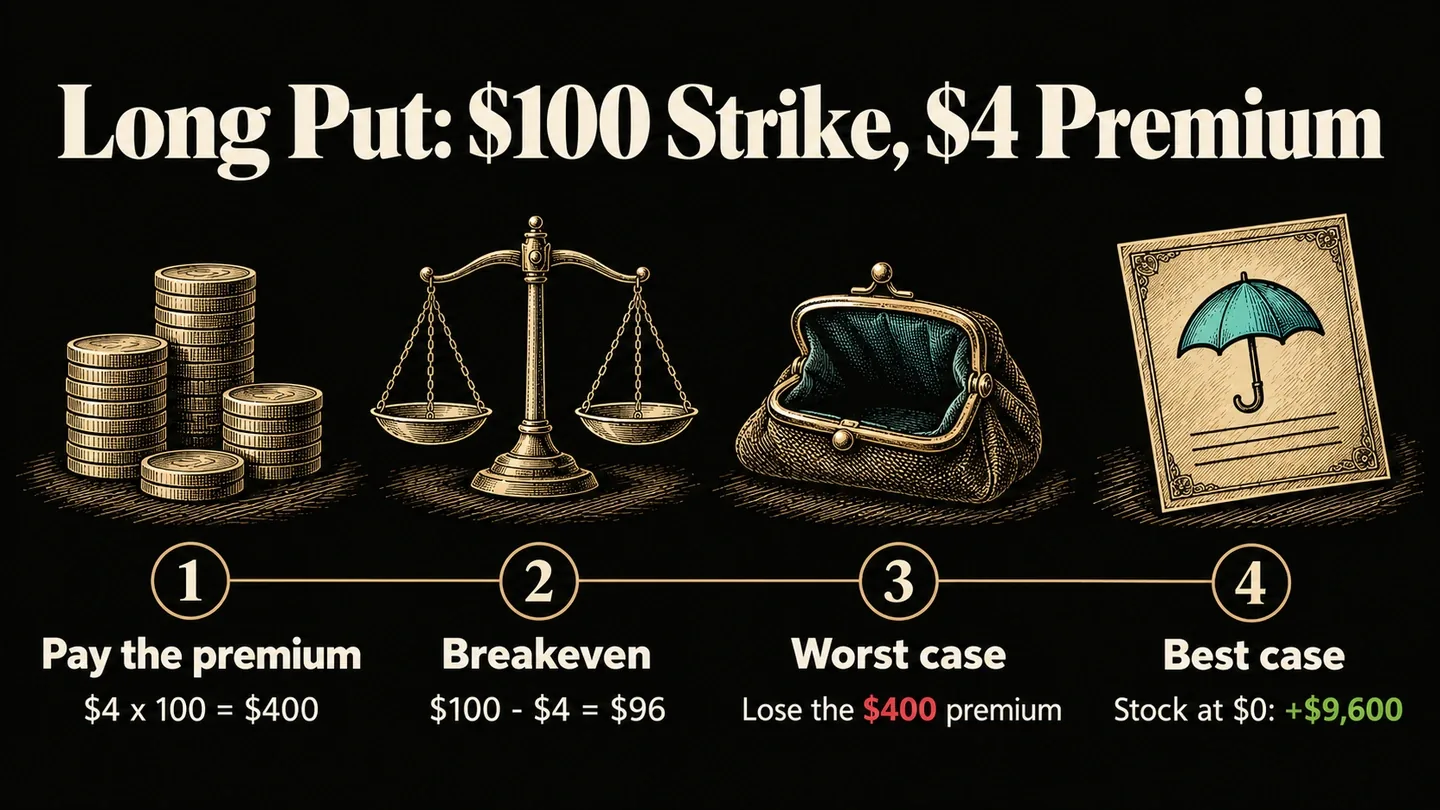
This illustration buys one $100 put for $4 per share, covering 100 shares. The stock starts at a hypothetical $100. The premium payment is $4 × 100 = $400. No costs, dividends or interest are included. The contract multiplier is an explicit assumption for this example, not a claim that every possible adjusted contract has identical terms.
- Purchased put strike: $100.
- Premium: $4 per share.
- Illustrated multiplier: 100 shares.
- Initial outlay and maximum option loss: $400.
The premium is paid at entry. The strike is not an additional payment when the put is purchased. Multiplying $100 by 100 produces $10,000, but that is the contractual stock-sale amount if exercised, not the option purchase cost. Conversely, calling the $4 quote a $4 total investment would omit the multiplier. Both errors disappear when the units are written beside each number.
Worked example: the expiration formula
Let S be the stock price at expiration. Put exercise value per share is max($100 - S, $0). Option profit or loss is [max($100 - S, $0) - $4] × 100. The max operation means that a put with no positive exercise value is assigned zero value in this expiration calculation, rather than a negative exercise value.
| Stock at expiration | Put value per share | Value for 100 shares | Option result |
|---|---|---|---|
| $0 | $100 | $10,000 | +$9,600 |
| $90 | $10 | $1,000 | +$600 |
| $96 | $4 | $400 | $0 |
| $98 | $2 | $200 | -$200 |
| $100 | $0 | $0 | -$400 |
| $110 | $0 | $0 | -$400 |
The very high left endpoint reflects the stock’s mathematical lower boundary of zero. It is not a predicted price or a likely result. The chart includes that endpoint so the word maximum has a numerical meaning. The nearby $90, $96 and $100 rows are often easier for checking how the formula behaves around breakeven and the strike.
Calculate breakeven and maximum loss twice
At $96, the put’s exercise value is $100 - $96 = $4 per share. That equals the original premium, leaving zero before costs. A second calculation uses total dollars: $400 of option value minus the $400 initial outlay equals $0. Hence the illustrated breakeven is $100 - $4 = $96. The strike itself is not the profit threshold.
At $98, the put has $2 of exercise value per share, or $200. Recovering $200 after paying $400 leaves a $200 loss. That endpoint is below the starting stock price but still above breakeven. It demonstrates, without any assumption about future prices, why a decline alone does not establish a profitable long put.
At $100 and above, exercise value is zero. Zero less the $400 outlay is a $400 loss. The per-share cross-check is $0 - $4 = -$4; multiplying by 100 gives -$400. At zero, $100 less the $4 premium leaves $96 per share, or $9,600. Each calculation uses the same initial premium once. No row receives a second premium payment.
Option value and option profit are different
A label such as in the money describes the relationship between stock price and strike, rather than whether the entire investment earned money. The glossary entries for moneyness and intrinsic value explain those terms. In the $98 row, $2 of exercise value is positive, while the net result remains negative because the premium was $4.
Consider the $90 row from two directions. First, subtract the stock endpoint from the strike: $100 - $90 = $10. Then remove the $4 premium to leave $6, and multiply by 100 to get $600. Alternatively, the expiration option value is $1,000; subtract the original $400 outlay to obtain the same $600. A worksheet that reports $1,000 as profit has counted proceeds without counting the cost.
The table is deliberately limited to expiration. A quote before that date is not given here. It would be a different input and could not be inferred by taking the $90 row and replacing its date label. A journal can record entry premium, observation date and actual or hypothetical exit premium as separate fields, keeping arithmetic and price assumptions visible.
Compare a long put, protective put and spread
A protective put adds owned shares to a purchased put. The combined result must therefore include the stock gain or loss as well as the option result. In this article’s standalone worksheet, there is no original stock holding to add. Copying the protective-put formula would change the position being studied.
A bear put spread contains a purchased put and a sold lower-strike put. Its worksheet needs the second option’s premium and exercise value. This long-put example has neither. Comparing structures requires listing all the legs, which simply means the separate holdings in the position, before comparing their totals.
For a pure arithmetic comparison, imagine adding an unexplained $200 receipt to this example. That would change its apparent loss and breakeven, but it would be incomplete unless the worksheet identified what obligation produced the receipt. The point is not to suggest another trade. It is to show why premium receipts cannot be inserted into a one-option illustration without changing the inventory and its risk.
Exercise, costs and a practice record
A purchased put provides a right, while a sold option creates an obligation. Exercising a put without shares to deliver can create a short-stock position; the OIC long put discussion expressly separates that consequence from the option holding. In practice, a holder who wants out often sells the put before expiration instead of exercising it, and OIC notes that an in-the-money put can be exercised automatically at expiration. The assignment and expiration lesson introduces these operational terms. A premium-loss limit describes the option, rather than any later stock position.
The example does not establish a broker’s permissions, margin requirement, exercise deadline or stock-borrow terms. It also excludes transaction costs and taxes. A closing transaction needs a price and available liquidity; this illustration supplies neither. For taxes, ask a tax professional. These practical questions remain distinct from calculating the illustrated expiration payoff.
A compact practice record can list the $100 strike, $4 premium, 100-share multiplier, $96 breakeven and $400 option loss limit. It can then reproduce each table row from the formula. The trade journal lesson and free journal template support recording that work. A correct record is evidence of a completed calculation, rather than proof of future returns or readiness for actual trading.
Questions people ask
Can the full premium be lost?
Yes. If this put has no exercise value at expiration, the option’s $400 outlay is lost, excluding costs.
Why does a put at $98 still lose money here?
Its $2-per-share exercise value is less than the $4 premium paid. The difference is a $2 loss per share, or $200.
Are long put gains unlimited?
No. In this stock-option illustration the stock cannot fall below zero. The maximum expiration gain is ($100 - $4) × 100 = $9,600.
Does buying a put mean owning shares?
No. The original position here contains only the purchased option. Exercise or another transaction can change that inventory.
Sources
Educational content only, not investment advice. Trading options involves risk, including the loss of your entire investment in a position.