
Strategies · November 2, 2026 · 7 min read
Protective Put Explained: Cost, Floor and Example
By Gerson Yoss
A protective put combines shares you own with a purchased put option. The put adds a right to sell the shares at a stated price for a limited time, in exchange for a premium.
The useful question is how much protection the combined position has after counting that cost. This guide separates the stock, the put and the total result with made-up prices. It is education, not advice.
The short version
- The position combines long stock and a long put on that stock.
- A floor on the stock exit price differs from a floor on total profit or loss.
- The premium raises the combined position’s breakeven.
- Protection lasts only for the option’s term; exercising changes the share position.
What the protective put adds
The OIC protective put page identifies the combination as long shares plus a long put. It distinguishes a protective put on shares already owned from a married put purchased alongside the shares. Both have the same basic position structure. The put mechanics lesson introduces the contract, and the glossary defines the strike price.
The insurance analogy describes a trade-off, rather than a promise about an account. A premium is paid to add a contractual sale right. That payment belongs in the calculation even if the put is never exercised. A worksheet that lists only the strike leaves out a real part of the illustrated cost. The example below therefore keeps the stock purchase and option payment on separate lines.
Three amounts that need separate names
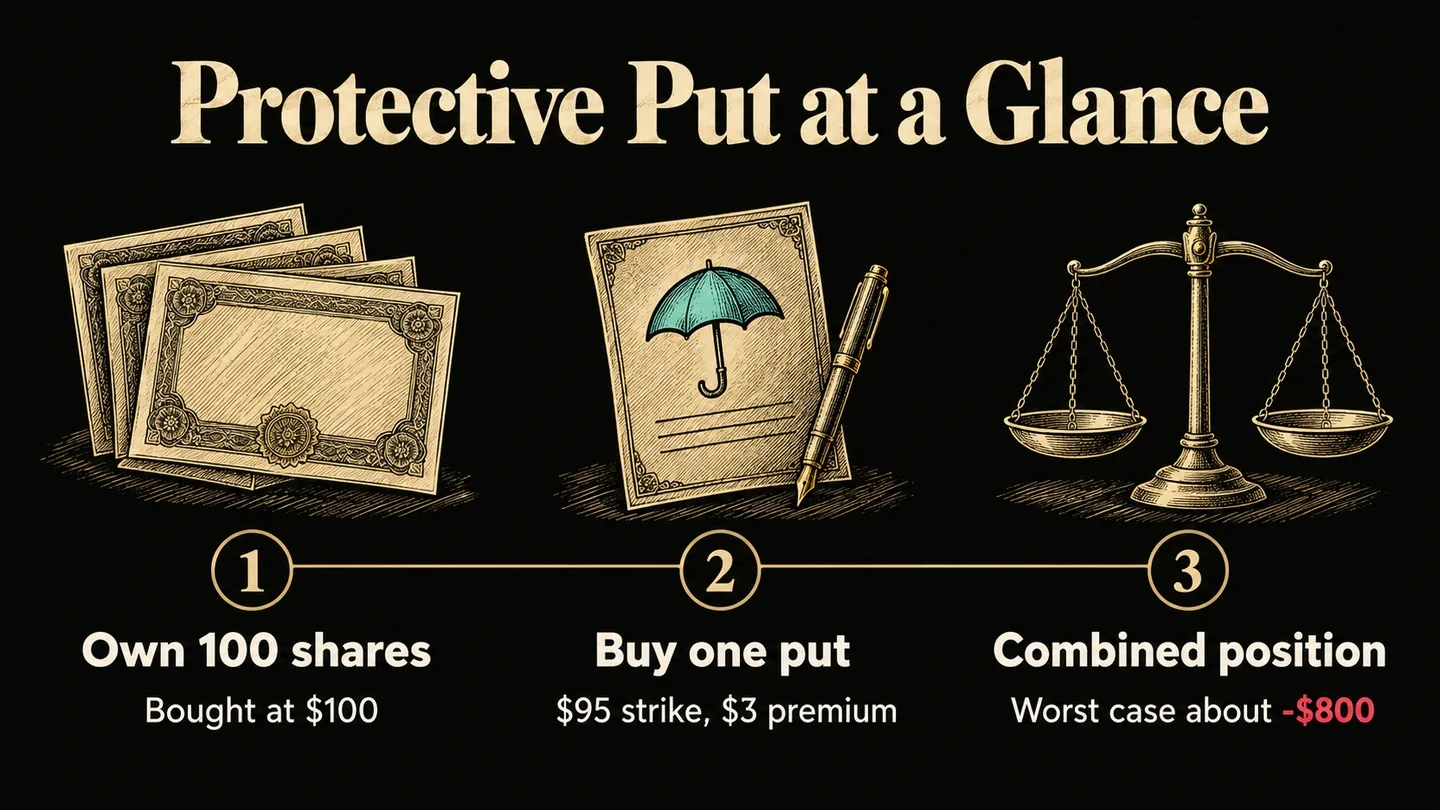
For this illustration, the share purchase price is $100, the put strike is $95 and the put premium is $3 per share. None is a market quote. The $100 describes the original stock outlay. The $95 describes the contractual sale price. The $3 describes the amount paid for the option. Replacing any of these with another would answer a different question.
| Measure | Illustrated calculation |
|---|---|
| Stock cost | $100 × 100 = $10,000 |
| Put cost | $3 × 100 = $300 |
| Combined outlay | $10,000 + $300 = $10,300 |
| Exercise sale proceeds | $95 × 100 = $9,500 |
The distance from the stock purchase to the strike is $5 per share. The premium adds another $3. The resulting $8 per share is the illustrated maximum expiration loss, excluding costs. This is why saying that the floor is $95 does not mean the investor loses only the $3 premium. The starting stock price matters as well.
Worked example: expiration results
This is an illustration with made-up prices, one put covering 100 shares, no dividends and no transaction costs. Let S mean the stock price at expiration. The combined profit or loss is 100 × (S - $100 + max($95 - S, $0) - $3). Here max means use whichever of the two amounts is greater.
- Buy 100 shares for $100 each.
- Buy one $95 put for $3 per share, or $300.
- Maximum expiration loss: ($100 - $95 + $3) × 100 = $800.
- Breakeven: $100 + $3 = $103.
| Stock at expiration | Stock result | Put value | Combined result |
|---|---|---|---|
| $0 | -$10,000 | $9,500 | -$800 |
| $80 | -$2,000 | $1,500 | -$800 |
| $95 | -$500 | $0 | -$800 |
| $100 | $0 | $0 | -$300 |
| $103 | +$300 | $0 | $0 |
| $110 | +$1,000 | $0 | +$700 |
The zero-price row is a mathematical boundary case. It is not a forecast. The $110 row is another hypothetical endpoint. Neither row assigns a probability to its outcome. The chart joins the results implied by the formula; it does not plot an observed stock path or estimate what the position could be sold for before expiration.
Read the floor in dollars
At $80, the shares have lost $20 each, or $2,000. The put has $15 per share of exercise value, or $1,500. Subtract the $300 premium: -$2,000 + $1,500 - $300 = -$800. A second way to calculate the same result is to compare the $9,500 strike-price sale proceeds with the $10,300 total outlay. That also gives -$800.
At $95, there is no positive put exercise value. The shares have lost $500 and the premium adds $300 of cost, again totaling $800. Below that strike, every additional dollar of stock loss is matched by an additional dollar of put exercise value. Above the strike, there is no such offset because the expiration put value is zero. These relationships explain both straight segments in the chart.
At $103, the $300 stock gain exactly offsets the premium. At $110, the $1,000 stock gain less the premium leaves $700. Those numbers show why stock appreciation alone is not the same as profit on the combined position. The premium can be a full loss on the option component even when the overall combination has a gain.
Compare the position with nearby structures
A standalone long put contains no shares. A bear put spread adds a sold lower-strike put to a purchased put. Those are different inventories of assets. The protective put worksheet here has shares and one purchased option; it has no sold option financing the premium. The word put appears in each name, but the total result depends on the complete inventory.
For a comparison within this illustration, consider just the 100 shares. At $80 their loss would be $2,000, versus the combination’s $800 loss. At $110 their gain would be $1,000, versus the combination’s $700 gain. The $300 difference at the higher endpoint is the insurance cost. The improved result at the lower endpoint is the purchased protection. This comparison uses identical stock purchase prices and endpoints.
The comparison does not show that one position is preferable. It records what changed when the put was added. A different premium, strike or share cost would change the numbers. It also does not establish a personal tax basis. The intrinsic value glossary explains the exercise-value term used in the worksheet.
Expiration is a boundary, not a daily valuation
The OIC pricing overview separates intrinsic value from the extra value an option may carry before expiration. Accordingly, the formula in this example uses expiration values, not an estimated sale price for the put next week. A quoted option premium before expiration is a separate input. The option chain lesson introduces the quote fields.
One way to avoid mixing dates in an educational worksheet is to give each column a date label. The $3 is the original option cost. The $15 in the $80 row is the option’s exercise value at expiration. They are not competing quotes for the same moment. Calling both simply the put price would hide the distinction. The original premium is subtracted once, not again each time a new row is calculated.
The protection has an expiration date. A worksheet for a later period would need to state whether a new option had been purchased and what it cost. Reusing this period’s $800 floor after removing the put would describe a different position.
Exercise, costs and limits
The OIC exercise guide explains exercise as using the contractual right; assignment applies to the seller on the other side. For the illustrated put owner, exercise sells the shares at the strike. The exercise and expiration lesson provides further vocabulary. The payoff table assumes the stock and put are accounted for together at expiration, rather than left as separate operational questions.
The $800 figure excludes commissions, fees, financing and any tax effects. Liquidity and the bid-ask spread also matter to an actual closing transaction; this article supplies no executable quotes. It does not specify a broker’s exercise cutoff or margin treatment. For taxes, ask a tax professional. These omissions are limits of the calculation, rather than additional protection.
A useful educational record can keep the $10,000 stock outlay, $300 premium, $95 strike and chosen endpoint together. With those four inputs visible, another reader can reproduce every row. The free journal template offers a place for practice records. A correct table still does not establish whether the position suits an individual.
Questions people ask
Does the put prevent every loss?
No. The illustration loses $800 at or below $95 at expiration, excluding costs. The stock purchase price, strike and premium all enter that result.
Why is breakeven $103 rather than $95?
The $95 is the exercise price. Recovering the $100 share cost plus the $3 premium requires $103 at expiration in this example.
Is the $800 floor permanent?
No. It describes this combined position during the put’s specified term and its expiration calculation. It does not describe unprotected shares after the option ends.
Is a protective put the same as a bear put spread?
No. This example owns shares and buys a put. A bear put spread instead combines a purchased put and a sold lower-strike put.
Sources
Educational content only, not investment advice. Trading options involves risk, including the loss of your entire investment in a position.