
A hands-on options curriculum covering real trading concepts. Read the lessons, work through examples, and test your knowledge.
OVERALL ACADEMY PROGRESS
Free Lesson
Every lesson is free to read. Subscribe to add Signal Desk, progress tracking, PDF downloads and the lesson tutor.
Lesson 7: 2.6: Central Banks & Monetary Policy
Explore how monetary authorities like the Federal Reserve influence system liquidity, interest rates, and macro reserves.
1. The Architects of Macro Liquidity
Central banks (such as the Federal Reserve, European Central Bank, or Bank of Japan) are the ultimate monetary authorities. They are responsible for managing the cost and supply of credit in the global financial system.
By setting benchmark interest rates, central banks influence borrowing costs for every business and consumer. Their policies are designed to maintain price stability (manage inflation) and support maximum sustainable employment.
★ Key Concept: Central banks are the "lenders of last resort" to commercial banks during financial crises.
2. Policy Tools: QE vs. QT
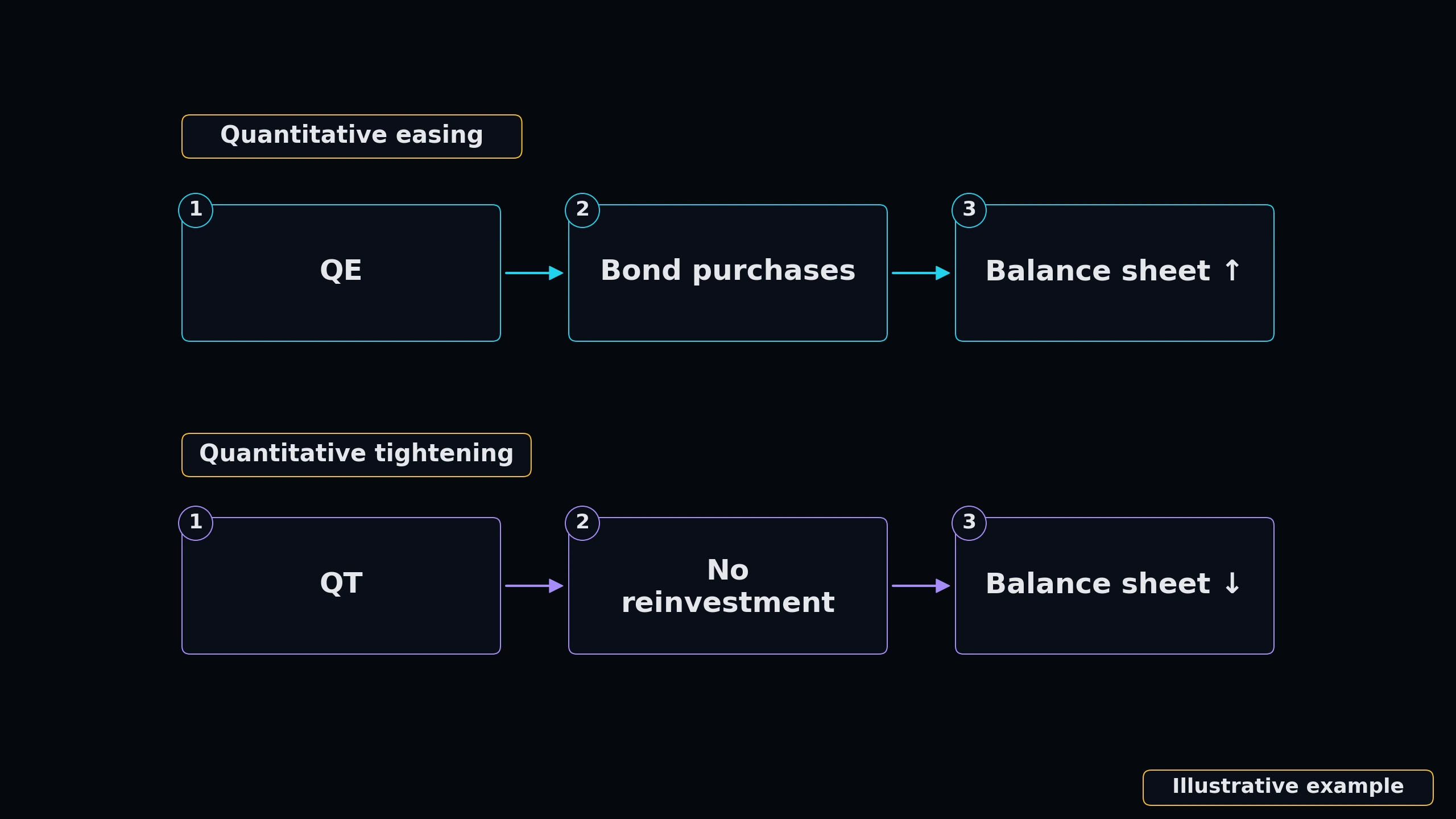
Central banks utilize modern balance sheet tools to inject or withdraw liquidity:
• Quantitative Easing (QE): Buying long-term government bonds and mortgage securities from the open market, injecting cash into the banking system to lower long-term interest rates.
• Quantitative Tightening (QT): Allowing bonds to mature without replacement, reducing money supply and withdrawing system liquidity to combat inflation.
 Click to enlarge
KNOWLEDGE RECONNAISSANCE
What is the direct consequence of a Central Bank initiating Quantitative Easing (QE)?
Which rate is controlled directly by central banks to influence borrowing costs?
More lessons in this module
- 2.0: Overview of Market Participants
- 2.1: Retail Investors & Traders
- 2.2: Institutional Investors (Mutual/Pension Funds)
- 2.3: Hedge Funds & Proprietary Trading Firms
- 2.4: Investment Banks & Underwriters
- 2.5: Market Makers & Liquidity Providers
- 2.7: Brokers & Financial Intermediaries
- 2.8: Regulators & Market Oversight (SEC, CFTC)
- 2.9: Sovereign Wealth Funds
- 2.10: High-Frequency Trading (HFT) & Algorithmic Firms
Signal Desk is where you practice this on real stocks: real option chains (about 15 minutes delayed), the Trade Check and a paper-trading account that risks no real money. Join to add it, your progress tracking and PDF downloads.